When Good Words Go Bad
October 13, 2018·Money
More than four years ago – when Epsilon Theory was still young – Ben wrote a marvelous note that discussed the importance of the meaning of words. Called The Name of the Rose (after the movie, the book and the Shakespearean reference, in that order, I think), Ben’s piece remains a must-read. It is the origin essay of our repeated encouragement to call things by their proper name.
Ben’s essay was also an early call to Clear Eyes and Full Hearts. Pursue with full hearts, he exhorts, communication with one another at the lowest possible level of abstraction. Walk with clear eyes, he cautions, knowing that those we encounter may communicate in heavily abstracted language, desiring to influence us to act against our best interests.
The complicating factor is that words also change meaning for innocent reasons. It’s something linguists call semantic shift. I don’t think it’s fair to ascribe ill intent to anyone for the fact that the last person who legitimately felt awe when he said awesome or awful was decades ago. We write about narrative, and so you, dear reader, should know that we are probably a bit wired to commit Type 1 errors on this topic. We are prone to occasionally see narrative and intent behind natural shifts in meaning. Mea culpa.
Even so, it can still be interesting to observe how words align with differences and changes in narratives among different participants in social, political and economic dialogue. For example, I’ve noticed anecdotally that the implication attached to a couple of words – acronyms, actually – seems to have changed a bit over the last year. So I took a closer look at it, and I think it’s true:
FANG and FAANG appear to be transitioning into pejorative terms.
Here’s why I think so.
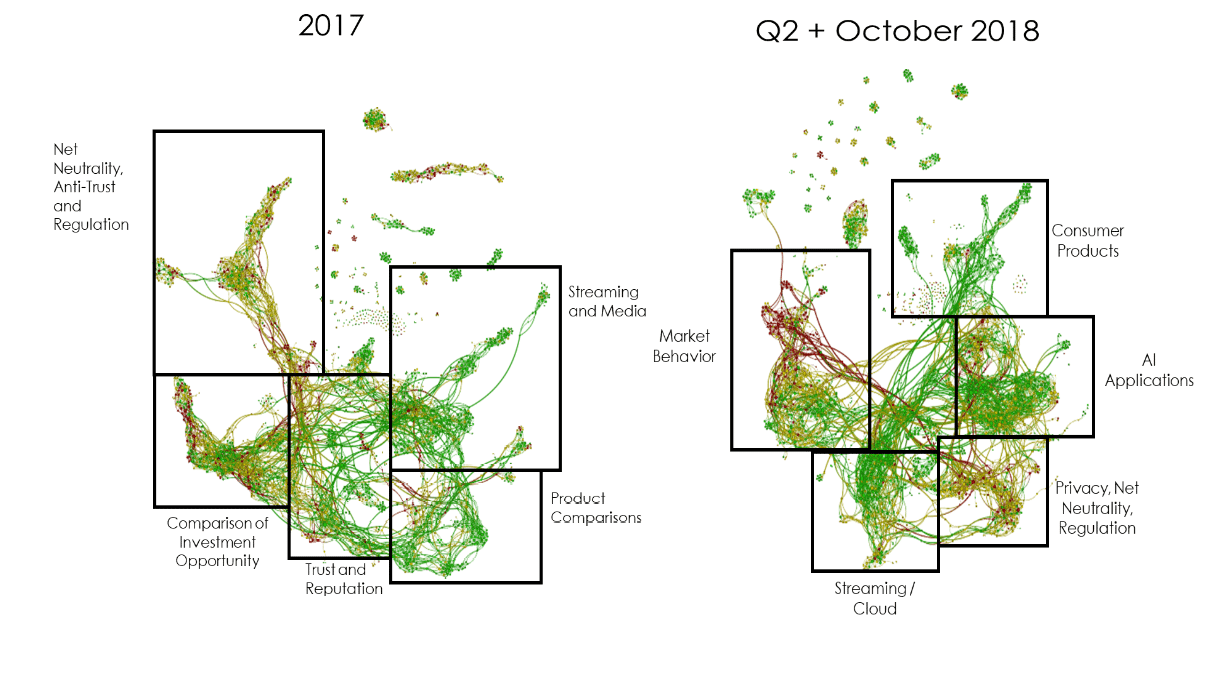
First, a couple of Quid-based narrative maps. Each of these maps shows articles which referred to each of Facebook, Amazon, Netflix and Google, but did not use the term FANG or the Apple-inclusive FAANG. The map on the left is from all of 2017, and the chart on the right is since June of this year. The topics and their connectivity have changed. For one, these articles aren’t talking nearly as much about privacy, our trust in these companies or their reputation. Their sentiment, however, has remained very positive, and has even improved slightly. For every such article in 2017, there were five scored with positive sentiment for each negative one. In Q2 2018, that number was five-and-a-half.
Not much there.
Now take a look at the articles over the same periods which did use the terms FANG or FAANG. Like with the Fang-less group, we observe some shift in the major topics. In particular, Q2’s articles were far more likely than either the fang-less articles OR 2017 to start linking the concepts of privacy, reputation, valuation and what was going on in markets. More importantly, the sentiment of these articles declined by a lot. Articles referencing FANG/FAANG were just under twice as likely to be positive as negative in 2017. In the more recent period, more articles were negative than positive.
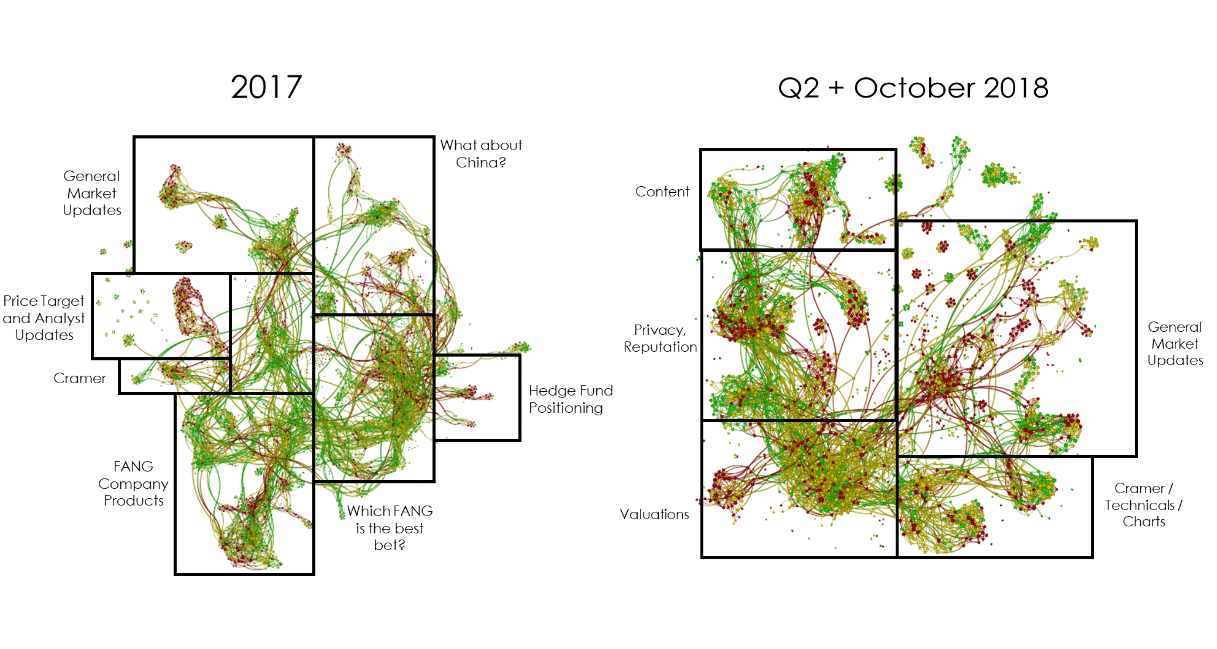
We have to acknowledge the obvious chicken-and-egg question here. Does the inclusion of the word FANG/FAANG in an article simply set it off as a piece that is likely to be from a markets-related publisher? Sure, although recall that the first set are articles that must reference ALL of the members of the group in the same article, so there is more overlap in sources than you might think. Does a bias toward markets-focused publishers mean that the negative sentiment shift is mostly representative of those articles covering weaker market performance of these stocks more than articles that are more generally about the companies and their products? In part, although it is worth noting that the ratio doesn't change if you exclude the October stub period. More importantly, we don't just observe that negative sentiment shift within stories about markets. The shift is taking place in articles about content, streaming and privacy. The shift is taking place in articles about the outlook for these companies that don’t really reference market activity.
What does all this mean?
- I don’t think there’s enough to say it means that there’s a negative general narrative forming around the big tech companies.
- I do think it is interesting to observe that as broader media seem to be developing fatigue and drifting away from any narrative about these companies that is linked to privacy, anti-trust and regulation, market-related news seems to be much more frequently integrating these concepts into the stories they are telling about price, valuation and market activity.
- I do think it’s worth observing that FANG and FAANG have shifted to terms with negative meaning, even (in my opinion) beyond their relationship to market activity.
- I don’t know if that’s part of bias or intent by any party to promote a narrative.
- I do think that I would be asking “Why am I reading this NOW?” when I saw these terms used for the time being.