When the Music Stops
April 30, 2026·Money
Grant Williams on private credit's three illusions
[PANOPTICA EDITOR'S INTRO]
Grant Williams' latest Things That Make You Go Hmmm... "A Swift Kick in the Privates" covers much of the same ground we're tracking in real-time on our Private Credit Storyboards within Perscient Pro. The overlaps felt significant enough to highlight here, outside both paywalls, as a way of showing how expert analysis and narrative-level data tend to converge when something genuinely important is unfolding. We wanted you to see that alignment.
Three years ago, private credit was a boutique asset class for institutions with patient capital and deep pockets. Today it's a $1.8 trillion market woven into the portfolios of pension funds, insurance companies, retail investors, and bank balance sheets. The speed of that growth masked a fundamental problem you've certainly heard a lot about recently: the structures built to distribute it were only stress-tested under conditions that never really included stress. Grant Williams' analysis below describes not only how we got here, but what happened when that test finally arrived. Our Perscient Pro data shows how the market is currently discussing the implications, and helps weave in what to watch for next.
THE INTERVAL FUND TRAP
GRANT WILLIAMS:
"In fairness, the first proposition was, for a period, correct, but the second has now been 'revealed' as wholly contingent—it's true in conditions of net inflows, but false the moment those inflows reverse. What the events of early 2026 have demonstrated is that the test, when it came, failed simultaneously across the largest names in the industry."
[PANOPTICA EDITOR'S NOTE] The test Grant is talking about arrived in Q1 2026, and it didn't just hit one shop. Blue Owl capped redemptions at 5%, which is only a problem because it came after investors tried to pull roughly 41% of their tech fund and 22% of their flagship credit fund in a single quarter. Carlyle's lead interval fund saw repurchase requests more than triple its limit, too. Across the entire space, only about half of requested withdrawals were actually fulfilled, leaving a backlog of "sometimes not liquid at all" capital that managers had promised as semiliquid.
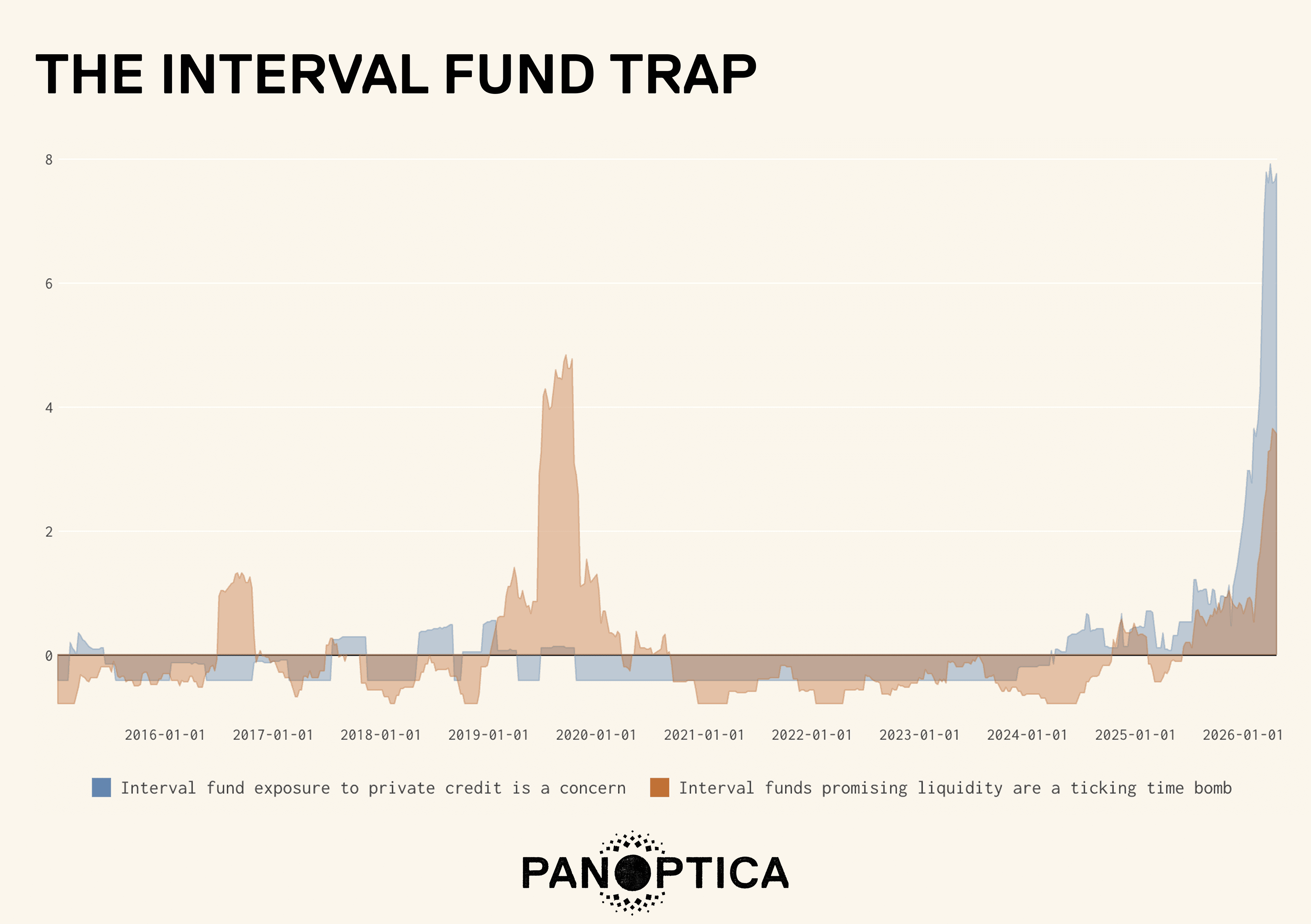
Our Perscient Pro Storyboards show this theme being discussed the loudest right now. The signature tracking "interval fund exposure to private credit is a concern" now sits near its all-time highs and has plateaued rather than fading, signaling sustained alarm rather than a passing scare. The companion signature, "interval funds promising liquidity are a ticking time bomb," has climbed in tandem. It's exactly the contingency Grant describes, where the structure works right up until it's tested, and then it fails everywhere at once.
THE RETAIL TRAP
GRANT WILLIAMS:
"Predictably, billions duly flowed in from retail and high-net-worth investors who had been told, with straight faces I'll guarantee, that they were accessing the same opportunities as the largest sovereign wealth funds and pension plans in the world. Of course, this wasn't strictly false advertising because they were—but they were doing so at a very different point in the cycle."
[PANOPTICA EDITOR'S NOTE] By the time what Grant calls the "same opportunities" pitch hit the mass-affluent and 401(k) world, the big pools were already full. Pensions, endowments, and sovereign wealth funds had largely reached their allocation ceilings; there was no more room without breaking policy. That left defined-contribution plans, roughly $12.4 trillion in US 401(k)s and similar vehicles, as the only pool of capital large enough to absorb the overflow. The alternative asset manager marketing departments have been at work on this.
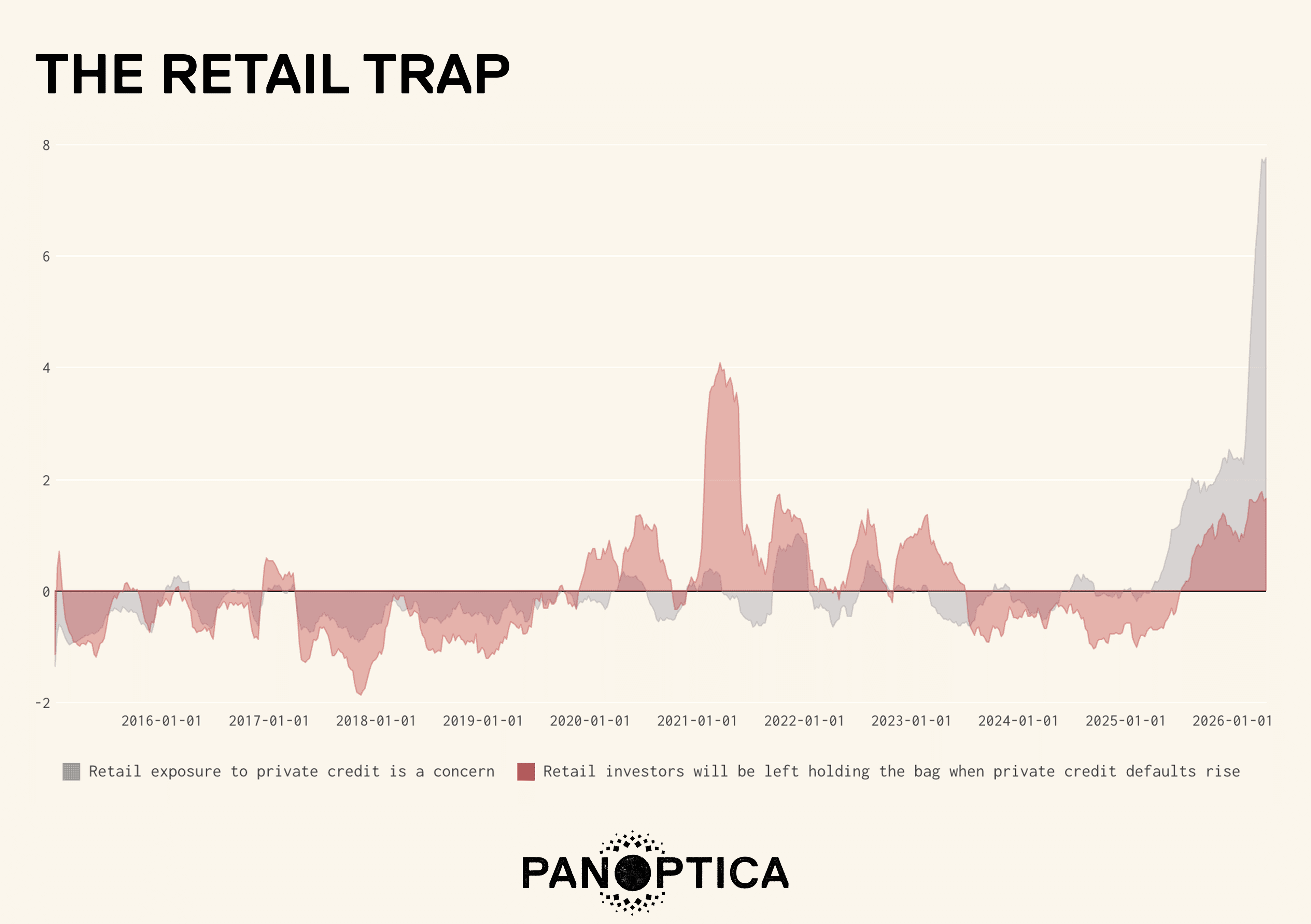
Our Signatures show how this shift feels from the outside. Concern about "retail exposure to private credit" continues to grind higher week after week. At the same time, the darker framing, "retail investors will be left holding the bag when private credit defaults rise," has been cooling rather than intensifying, even as retail exposure accelerates. In other words, the worry about retail being in the trade is rising, but the anxiety about who provides the exit when the music stops is fading. That's the trap Grant is writing about: complacency setting in just as risk is most acute.
WHEN THE MUSIC STOPS
GRANT WILLIAMS:
"Rosen's letter described a $2 trillion market on the precipice. That was in February. The precipice, as it turns out, was closer than most people thought, and the drop, as those who have been paying attention have long suspected, is rather further than the industry's glossy marketing materials ever thought to mention."
[PANOPTICA EDITOR'S NOTE] The boom only works, meaning it only sustains, so long as the music keeps playing. If credit keeps getting extended, if valuations never find a reason to get marked in public, and nobody has to find out how illiquid "semiliquid" really is, there's no crisis. If only. In another corner of the Perscient Pro data we can see the story of how everyone now understands how thin that assumption is, even if they don't agree on what happens next. That awareness is itself part of the late-cycle setup.
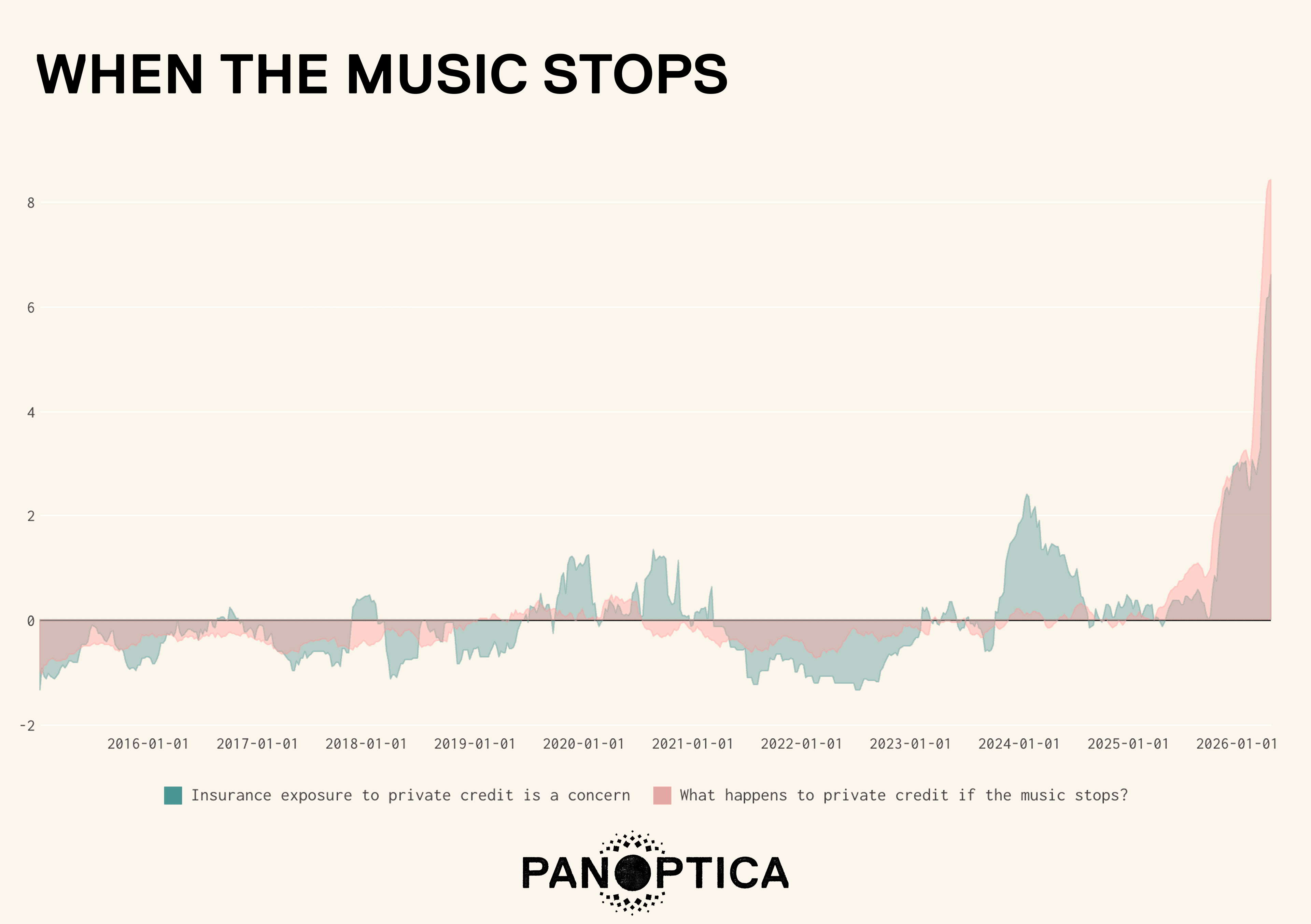
One Signature tracks media language asking "what happens to private credit if the music stops?" It has vaulted to record levels in 2026, more than six times its long-term mean, and it is still accelerating rather than cooling. Just this week, the signal jumped 16.4 points in seven days, making for the sharpest move we're tracking across the entirety of the private credit Storyboards. Running alongside it is a second narrative: "insurance exposure to private credit is a concern." Per Grant's analysis, insurers now hold on the order of 35% of their total assets in private credit and related structures, with roughly $1 trillion tied to private-equity affiliates alone. When stress finally forces marks and redemptions collide with illiquidity, insurance balance sheets could become the transmission mechanism into the banking system.
Policymakers have started trying to tamp this down. Federal Reserve and Treasury officials have insisted private credit is not a systemic risk, but our Signatures show the gap between official reassurance and media anxiety widening, not closing. That's Grant's precipice in narrative form: a system that only works while the band plays, sitting on top of institutions everyone assumes are rock-solid until they aren't. That's the inflection point we're watching.
For deeper context and regular updates across investing, politics, education, sports, and more, check out Perscient Pro.
Also be sure to visit grant-williams.com for Grant's writings, podcasts, and other features, with the depth only he can bring to the table.