Human 100%
September 15, 2026·AI
I get lots of feedback on my writing from editors, colleagues, my wife, and angry comment sections. This is a first
What happens when “human” becomes an insult? Or, worse yet, cute.
“Oh, how darling! Look sweety, a person wrote that!”
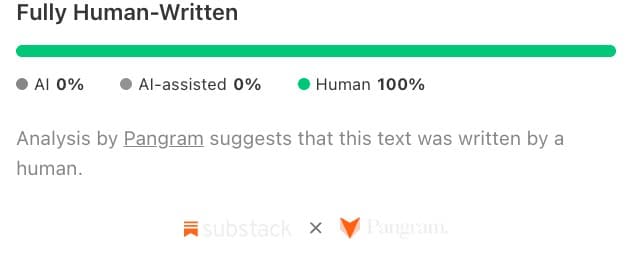
Substack added AI detector Pangram to its platform, so now everyone knows just how much LLM-ing went into what they read. So, in my latest 3-part series, “Fast Time, Slow Time,” I did what every other writer with a sensitive stomach for snarky comments would… I asked it to grade how much AI was in me.
“Human 100%.” No AI slop, here!
The answer was right. But it felt, oddly, wrong.
One software judging another’s programing, as if to say,
“Nope. Only a rural South Carolina public education could produce this.”
Therein lies my dilemma as a writer in the age of AI. Not, “how can I show this is my work,” but, “what if my work is useless crap.”
Through the AI desert on “A Horse with No Name”
Historian’s detour: crap has a complicated backstory.
The world ran on horses for a long, long time. Everything you do by subway, bus, plane, truck, or car went by equine. Even suburbanites pre-subway rides (called the omni-bus) got pulled by teams of horses… which is why trucker unions are called Teamsters.
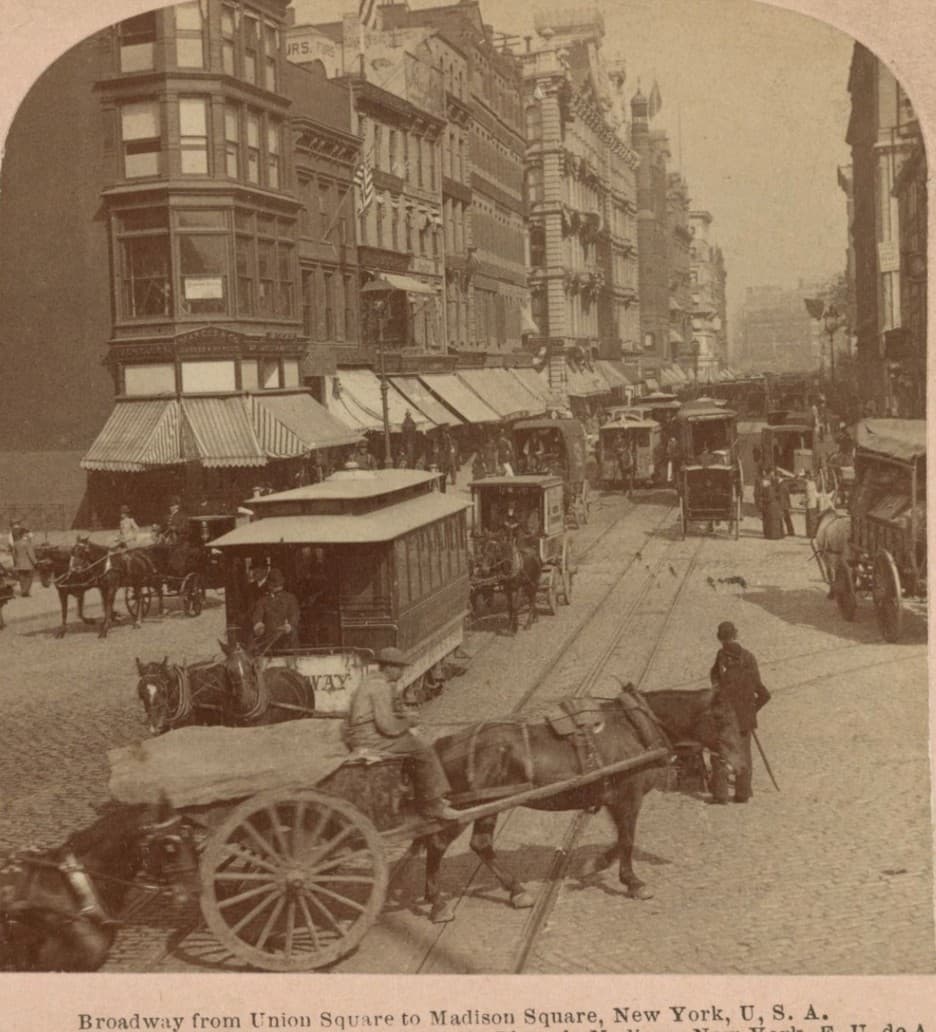
“Broadway from Union Square to Madison Square, New York, USA,” 1892
Credit: Library of Congress
The system wasn’t perfect. New York City alone dealt with 2 million pounds of daily manure, washed around by 60,000 gallons of urine. Crap in the streets required a small army roaming Manhattan shoveling shin-high dung onto carts.
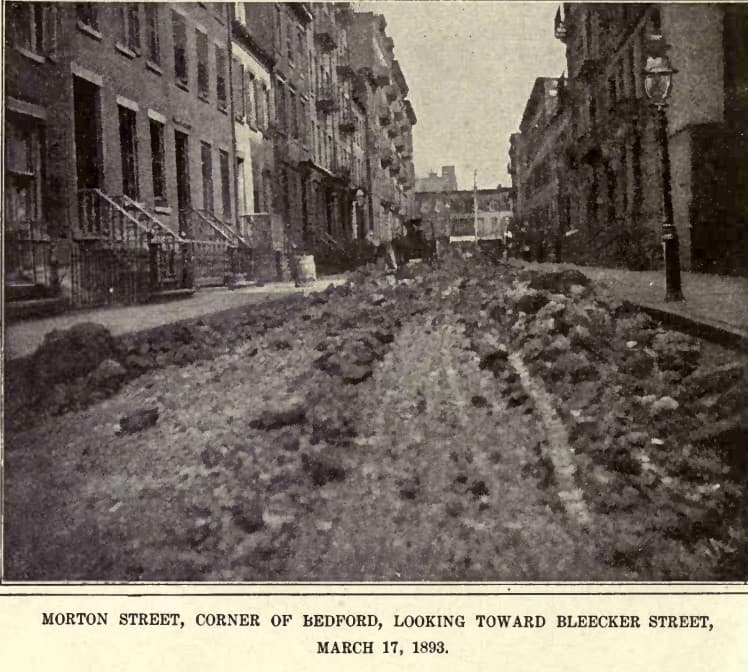
George E. Waring, Jr., Street Cleaning (1893). Public Domain
In fits and starts, electricity arrived. Cars once pulled by horses now got pushed by electricity. Waste went away. Hooray for progress! The transportation revolution was every bit the world changing technological event that AI is.
The horse industry seemed unassailable in 1890. By 1910 it was on its way out. But all the way to 1930, horse drawn delivery trucks occasionally ambled through New York City (and the rest of the world).
That’s still true today, with the inversion that the poorer the place, the more horses. If horses are part of your go to market strategy, you probably live in what is left of rural global poverty.
What about New York? Horses now lug romantic carriages through Central Park, if the lovers will withstand the morally outraged taunts of passing humanitarians screaming at them about animal cruelty. New Yorkers are not shy about sharing their moral opinions.
Horses, once tools, are now charming, offering something to do with family on holiday and pretend everyone is having a fabulous time inhaling trail dust while the 6-year-old (whose idea this was in the first place) proclaims, “this is boring.”
Cute. Horse 100%. Hauling nothing, it serves small purpose. Shitting on nothing, it causes few problems.
The De-en-shitification of writing
AI will do at least some of this to writing, and by writing to thinking, and by thinking to teaching. I can see the improvements already. Just as I have no desire to get to Fi-Di via the Brooklyn Bridge in a carriage, so, too AI is making some parts of writing “harder, better, faster, stronger,” to quote Daft Punk.
For those of us not sitting in intellectual centers of gravity, we have a world class sparring partner. I can write an essay and tell ChatGPT to pretend to be “the snarkiest reviewer at The Financial Times” and danged if it doesn’t really get into the part. Sure, this is the Chipotle of intellectual dialogue, but I would rather have that at scale than never let people far from London (or Tex-Mex) have a taste.
Or ask Claude, as I did, to explain the difference in CPI and CPE inflation in a conversation between two great writers who lived life in the rural borderlands of the Ohio watershed… the late Wendell Berry and Dave Chappelle.
You will get something like this: “Wendell, my man, CPI is my grandma’s grocery list… buys the same twelve things no matter what because that woman is stubborn as hell! Not me. Prices go up, and I’m like, “Kids! Learn to love chicken!”
Not Dave, but it beats your Econ 101 Professor’s PowerPoint by a Wendell Berry country mile.
The weakest of all the AI arguments was always “it writes like AI.” For now, sure. But we are all an algorithm, and the datacenters will process them given enough compute. Perfectly passable prose will emerge in the voice of you, me, and anyone who puts their work into the world. I, for instance, have a nasty habit, born in rural Carolina storytelling and a brief stint as a pastor, of alliterating too much. “Write this like Joseph Moore” will be an easy enough code to crack.
AI slop isn’t slop because it is AI. It is slop because it is still new, those using it are lazy, and the more likely you are to use it the less likely you wanted to do the hard work of thinking anyway. It isn’t Large Language Models ruining writing. It is the people wielding them, who were never thinking deeply to begin with. Riding a better mental rail offers at least the hope that their thinking could improve, probably make the world more intelligible, and save LinkedIn from itself. Or maybe not. But the “me-ness” of my writing seems unlikely to outweigh the benefit of grafting any thinker’s voice onto any problem at anytime from anywhere.
So, if it’s all so much horse shit, why write anything new at all?
The Waste Was the Product
The story of horses is oft told as that of a problem, solved. There is even an online urban legend: “The Great Horse Manure Crisis of 1894,” when major cities were supposedly brought to their knees by the foul stench in their streets. New tech was the only way out.
Not true…
It was never a crisis.
Horse manure never stayed in the streets, because it was extremely valuable. There was an entire ecosystem fertilizing fields for hundreds of miles around major cities. Farmers fed urbanites who went to work riding crapping horses, who sent the poo back to help sow crops. Smelly, sure, but a system.
So is writing, because real writing is just a time-honed process of thinking. It’s inefficient, rarely fast, far from precise. But it gets ideas in a row, ready for inspection.
So, too, math. This month’s big AI petition is from mathematicians, since LLMs are now solving Fields Medal level equations. Mathematics profs seem equally likely to someday be “cute.”
But they make an important point: “solving problems is only a tool and proxy for achieving the primary goal of conceptual understanding and insight. Forgetting this in the world of AI may turn the tool against the primary goal. Indeed, mass production at faster and faster pace of "true/false" statements could destroy fertile ground instead of breathing life into new ideas.”[1]
Breathing life into new ideas… You do equations to grasp problems, not problems to grasp equations. You write words to clarify the world. To decide what you believe. To propose a truth so you, and others, can audit it.
Librarian of Congress Daniel Boorstin said as much well before AI: “I write to discover what I think. After all, the bars aren’t open that early.”[2]
It seems odd to stake my argument for the utility of 100% Human writing on manure. But equally is it wrong to confuse solutions with thinking or efficiency with perfection. If we offload researching, or teaching, or strong-manning to AI, fine. But if we offload the writing, the real writing, then we have nothing left to do the thinking with, and thinking was the point. All those AI slop slingers aren’t a risk to real writing, because they were not really thinking to begin with.
As AI speeds the pace of what can be known, writing will become more useful in sifting and mixing mental manure. Humans think through stories, and as Panopotica readers know, seeing through those stories requires the ability to think about the thinking. AI does the aggregating, but writing does the work.
No. Writing won’t be cute, because it will remain useful.
Almost by definition, nothing cute is useful, and the cuter you make a useful thing the less serious work it does (babies, labradoodles, white furniture).
I keep writing not to waste the world’s time with adorable phrases, but to grind ideas through the gut of my peculiar perspective and blend them into something that helps good things grow.
It won’t be perfect, but it will be Human, 100%.
[2] Hat tip to Barry Ritholtz, who quoted this in his newsletter. “The Written Word is Not Your Work Product,” (August 21, 2026) https://ritholtz.com/2026/08/the-written-word-is-not-your-work-product/