Innocent Monsters
October 28, 2018·Politics

Another such victory over the Romans, and we are undone.
Pyrrhus, from Plutarch’s Apophthegms of Kings and Great Commanders
What strange phenomena we find in a great city, all we need do is stroll about with our eyes open. Life swarms with innocent monsters.
The Parisian Prowler, by Charles Beaudelaire (1864)
Ben and I have both been challenged by what to write about the events of the last week.
Writing about any of this in context of narratives can feel cheap, especially because of those who use the term to dismiss something as ‘a story that doesn’t fit my pre-existing views.’ There are eleven people dead in Pittsburgh at the hands of an anti-Semitic white nationalist. Two are dead near Louisville in an apparently racially motivated attack. At a nearby predominantly black church, there are many who now live knowing that the murderer was after them. There are political leaders and citizens, and hundreds of people who work for them, who now live their lives a little less freely, knowing they could have been caught up in the attempted pipe bombings. No one needs to read anything we have to write more than they need to sit in empathy for these people and their families.
It is also challenging to write about events like this for logistical reasons. We write about narratives, but narrative in our parlance is the cultivation of common knowledge, where a large group of people knows that they all know something. More often than not, that something is some several layers of abstraction away from what the thing actually is, or was. Establishing the existence of something like this takes time, and the events are fresh. But the seeds of those abstractions are there, and we are watching them grow in real-time. They aren’t pretty.
We are further challenged by the fact that the immediate aftermath of events like this exacerbates our emotional sensitivity. All of us. No matter how we write about this topic, some will think we are simply joining the fray when we should be above it. Others will think – a topic that will come up again – that by expressing a view, we make ourselves complicit in some tragedy. Fortunately, both of those views are bullshit and I don’t care. I’m going to do my best to tell you what I’m observing and how someone who believes in adopting Clear Eyes and a Full Heart ought to respond. So what am I observing?
The widening gyre is transforming all of us into innocent monsters.
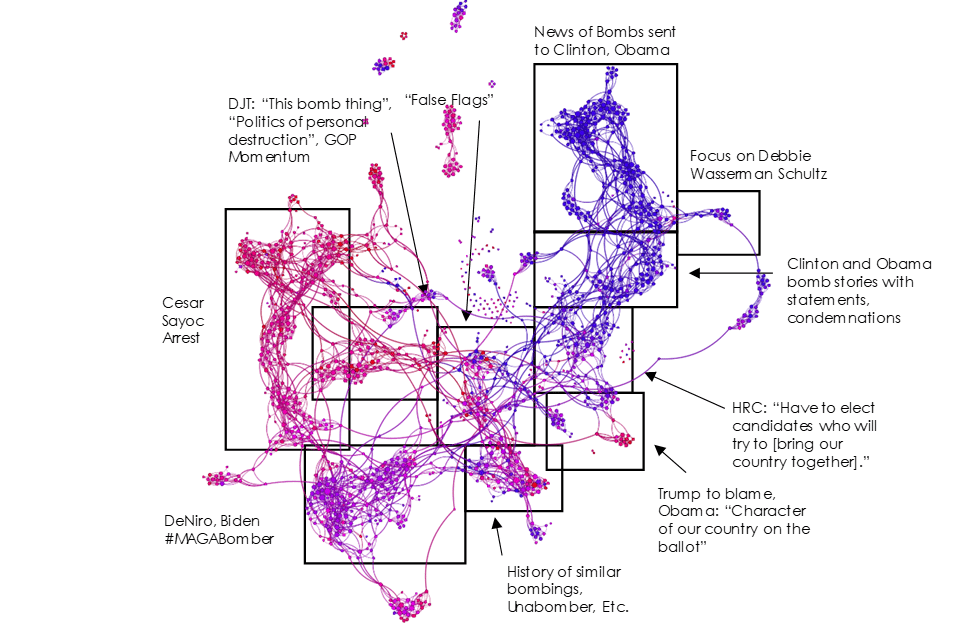
I know this is a heavy charge. For posterity’s sake, let’s take a look at a network of the articles written about the mail bomber between the 24th and the 27th. We define this as news articles referring to ‘bomb’ and any one of the words ‘pipe’, ‘mail’, ‘Clinton’, ‘Obama’, ‘DeNiro’ or ‘Biden.’ Cluster names are mine.
Source: Quid, Epsilon Theory
The first thing that stands out is that – and this is common when examining evolving news over short periods of time – the stories cluster strongly on a time dimension. The colors in the chart above reflect when they were published, starting from blue hues on the 24th to red hues on the 27th. The reason for this is intuitive: stories released at a particular time reference the events that have taken place so far, and include the statements and comments made by officials, victims and others recently. For this reason, it is almost – not completely, but almost – possible to simply read this network as beginning in the upper right on Wednesday and cascading around to the upper left by Saturday.
You don’t need the raw adjacency data here to see the center of this network, the topic that permeates and connects to nearly every other cluster. You can see it right now. False Flags, a cluster of both conspiracy theories and responses to them. Only slightly behind this cluster is the network of articles linked by statements by Hillary Clinton and Barack Obama telling Americans “to elect candidates who will try to [bring our country together]” and that the “character of our country is on the ballot”, respectively.
The gravity of this entire topic is formed around abstractions.
What do I mean by that? I mean the process by which we use things to stand in for other things even when the facts and a logical process don’t exactly allow us to make those intellectual leaps.
For many – maybe even most – on the political right, the story ceased to be about the story almost immediately. The story, you see, was really about the lengths to which shady left-wing political operatives would go to promote their cause and make Republicans look bad. It was really about the unbalanced treatment of left-wing and right-wing violence by a biased press. Even among conservatives who didn’t come out directly and embrace the false flag theory, most news outlets, pundits and commentators were on the defensive against any attempt to use the events to imply that this had anything to do with conservatives or Donald Trump.
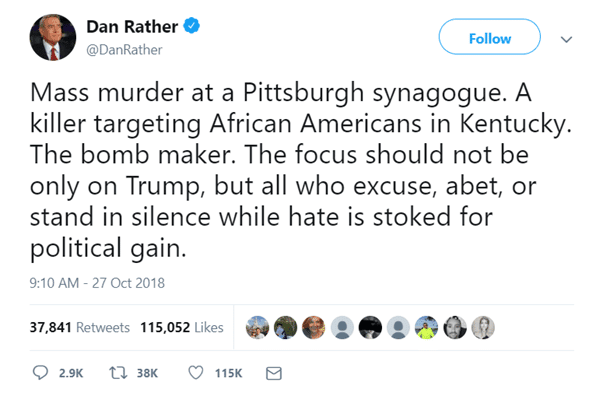
For those on the political left, a story about mail bombs was just as quickly really about Donald Trump and what he had done to inflame people toward hatred and violence. Then it was about the MAGA movement. And then, in the wake of a further tragedy in Pittsburgh, we were three layers of abstraction deep, with noteworthy personalities from the political left not only implying, but directly attributing ongoing responsibility for all violent tragedies to anyone who would dare to vote for Republicans. Sure, we can pretend that isn’t really what Dan Rather is saying here, but everyone knows that everyone knows it is what Dan Rather is saying here.
This week’s events have provided a perfect synopsis of what I believe is the primary source of our widening gyre: a narrative from the political left that the members of the political right are irredeemably committed to an ‘environment of hate’, and a narrative from the political right that the media and academy are committed to a ‘maliciously dishonest’ scheme to influence how citizens think about social and political issues. These are the narratives that will govern all future engagements.
These two narratives have incredible meta-stability and incredible polarizing power, because almost any conceivable event serves to strengthen each side’s priors. When we posit the existence of an ‘environment of hate’, every act of violence or threat, every policy that can be seen to harm one party or another, regardless of its true relationship to Trump, conservative policies or the broad conservative masses, will be attributed to them by those attached to that narrative. When we posit the existence of a ‘maliciously dishonest media’, every report with tilted language, every news report sprinkled with obvious opinions, every columnist who tries to attach every regular guy with conservative principles to psychopaths of the far right, will be seen to confirm its existence.
The two narratives will continue to reinforce each other. We will want to believe – and we will be told to believe - that speaking truth to power! or the next election, the most important in our lives! will be the solution. Sometimes they are. This time they aren’t. The more every party tries to ‘win’ this Competition Game, the deeper and wider this gyre will grow. Even when we are right, we innocent monsters will make things worse. There is no Answer to this, but there is a process:
Clear Eyes and Full Hearts. Clear Eyes to recognize and grapple with underlying truths that lie beneath the layers of our opponents’ narrative about us. Full Hearts to hold our own narratives in abeyance while we engage one another in good faith.
Good faith doesn’t mean not arguing or debating. It doesn’t mean believing both sides are always equal. It doesn’t mean not holding people, policies or parties accountable. It doesn't mean not being angry. Furious, even. It doesn't mean not campaigning, and doesn't mean avoiding acts of civil disobedience. It means a longsuffering willingness to believe what other people say about their intentions. Don’t get me wrong - good faith is a terrible electoral strategy. It is, much as we might like to pretend otherwise, also a terrible way to win in the court of public opinion. But if you think, like I do, that regaining a functioning civil society is more important than the likely tangible differences in any short-term political outcome, it’s our only way there.