
Insert XS Pun Here
November 1, 2018·Money
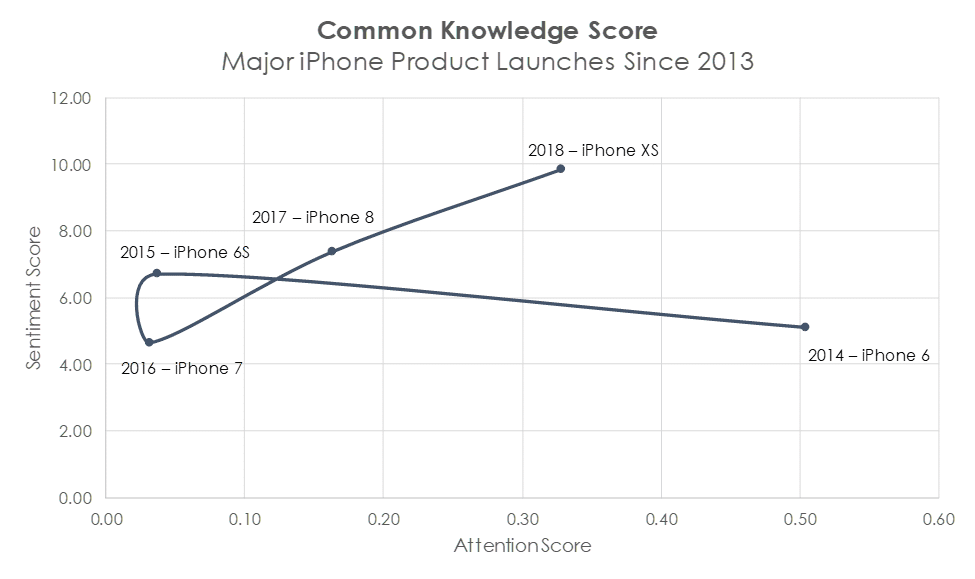
It’s Apple earnings day, so I thought we’d assemble a short brief on common knowledge around the last few September iPhone launches during the pre- and post-launch period. The long and short of it? The XS launch was the most positive and highest attention iPhone launch Apple has had in years.
For reference, sentiment is a terminology and phrasing score provided by our friends at Quid, while attention is a metric we build based on the adjacency characteristics of articles. In other words, we are trying to measure how similar and connected all of the stories being written about Apple are in the aggregate across the network.
The chart can be read chronologically from the iPhone 6 launch in 2014 to the present by following the line from the right to the left. I suspect this will largely follow your intuition.
Source: Quid, Epsilon Theory
The iPhone 6 launch was highly anticipated, highly covered, and discussed in a very consistent way. While sales of the iPhone 6 were ultimately wildly successful, the sentiment around the launch was actually mixed relative to other launches since that time. Why? It wasn’t the reports of some ‘game-breaking issue.’ Those have existed for practically every launch. In the case of the iPhone 6 the issue was ‘bend-gate’, and it faded as a story pretty quickly. Instead, what is unique about the iPhone 6 was actually its traditional pre-launch leak – it didn’t go well! When the actual launch came out of the gates, its reception and continued success were a positive surprise relative to the prevailing common knowledge.
For each of the subsequent September launches – the iPhone 6S, iPhone 7 and iPhone 8 – sentiment around the coverage of the products was fine, even a bit better than the similar coverage of the iPhone 6 launch, perhaps. But attention to any single narrative was far lower. In other words, people who talked about these launches were largely focused on different things. The attention paid to any one narrative was limited. That’s what makes the iPhone XS / Max launch so interesting: the bias toward positive sentiment is far and away the highest over this period AND the conversations seem to be hewing to a much more powerful single narrative.
Rather than define all the clusters for you, this time let me simply provide you the most interconnected articles that are most representative of the broader narrative themselves. Again, don’t read the specific articles and publishers as being the most influential – just the most representative. If you’re looking to get a picture of the broader backdrop to product-specific expectations in advance of this afternoon’s call, this should be a good resource.
(And kindly skip the obligatory “but what the media thinks about a product isn’t the same as what the marginal investor thinks about the company” emails, if you would. First, you’re right. Second, you’re not as right as you think you are. Third, if you still don’t believe me, I hope you still find it to be useful context.)
- Here's a speedy summary of all the iPhone XS and XS Max reviews – Wired
- Apple’s 6.5-inch OLED iPhone to be named ‘iPhone Xs Max’: Report - IndianExpress
- Apple’s Budget Smartphone… - Daily Mail
- Will You Buy a Gold iPhone XS? – ValueWalk
- Apple iPhone XS and XS Max Review – PhoneArena
- The powerful iPhone XS and XS Max are gorgeous big-screen phones… - HardwareZone
- New iPhone XS Unveiled by Apple… - MSN
- The Best iPhone XS Max Cases – IGN
- LG will help supply OLED panels for Apple’s iPhone XS Models – BGR
- iPhone XS and iPhone XS Max Review Roundup – iClarified
As most of our readers will know well, understanding common knowledge alone is rarely enough to make a decision, so anyone reading this thinking that high attention and positive sentiment mean a great earnings day should take their finger off the button. They don’t. What they mean is that we think we have better context for how any new data will be processed. Read the articles. Think about your own reasons for having a view on the stock. Think about what this might tell you about how other investors would respond to different outcomes. And think about how investors positioning themselves on the basis of all this being common knowledge would respond to different outcomes.
We will have more in-depth work on this and other key companies and markets available for our ET Pro subscribers when we launch the service later this month.