IT'S. ABOUT. THE. MONEY.
April 11, 2024·Money
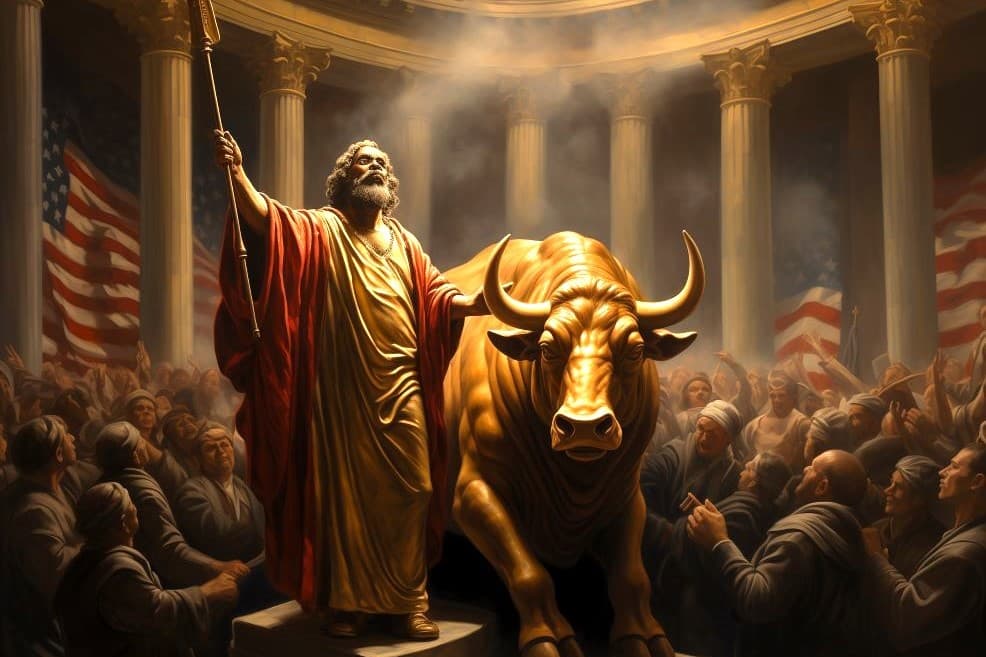
I was a late arrival to the professional investment world, getting my start at the ripe old age of 41 at a firm called Iridian Asset Management, founded by David Cohen and Harold Levy. I didn't have much interaction with Harold, but I learned a lot from David (both the easy way and the hard way!) about the business of investing. David was as big of a Godfather fan as I was, maybe bigger, and he really opened my eyes to the similarities between that world and this new world I found myself thrown into. Honestly, there's nothing that Hyman Roth and Michael Corleone say about the social dynamics of organized crime that you couldn't say about the social dynamics of Wall Street.
This is the business we have chosen.
So many of David's real-life stories - and they were real-life stories - could have been scenes in a mob movie, just without the guns and the threat of (immediate) violence. One that stuck with me was about an investor in a deal that went sideways. After going on and on about the details of the deal and why he felt so aggrieved, the guy took a long pause and finally said, "Look, David, what you need to understand is that it's not about the money. IT'S. ABOUT. THE. MONEY."
Haha! This is it, friends. This is the essential truth of the world-as-it-is, certainly the business world-as-it-is, whenever money is involved in even the most minor respect.
IT'S. ABOUT. THE. MONEY.
That's it. That's the line. It's always about The Money.
I say that it's the essential truth of the business world-as-it-is, because I think there are other essential truths in the personal world-as-it-is, essential truths like love and empathy and friendship. I think these other essential truths are more powerful than The Money, and I think they can last for a lifetime. But if these other essential truths fade in a relationship for whatever reason ... well, I think you'll find that The Money was there all along. Even if you don't see it or notice it, even if it's submerged beneath other, better essential truths, The Money is always there.
And if it's not a personal relationship imbued with love and empathy and friendship, if it is any sort of instrumental relationship like working for someone or investing with someone, then I'd like to suggest to you that The Money is at the heart of that relationship and that The Money will explain 99% of everyone's behaviors.
I'd also like to suggest that you should be wary of people who hide or obfuscate or otherwise diminish the importance of The Money in their instrumental, non-personal relationships, people who claim that their instrumental behaviors are not ABOUT THE MONEY. In my experience, these people are almost always what we call raccoons in Epsilon-speak ... highly charismatic, grifting liars who can't help themselves but to help themselves to your money or your vote or your labor.
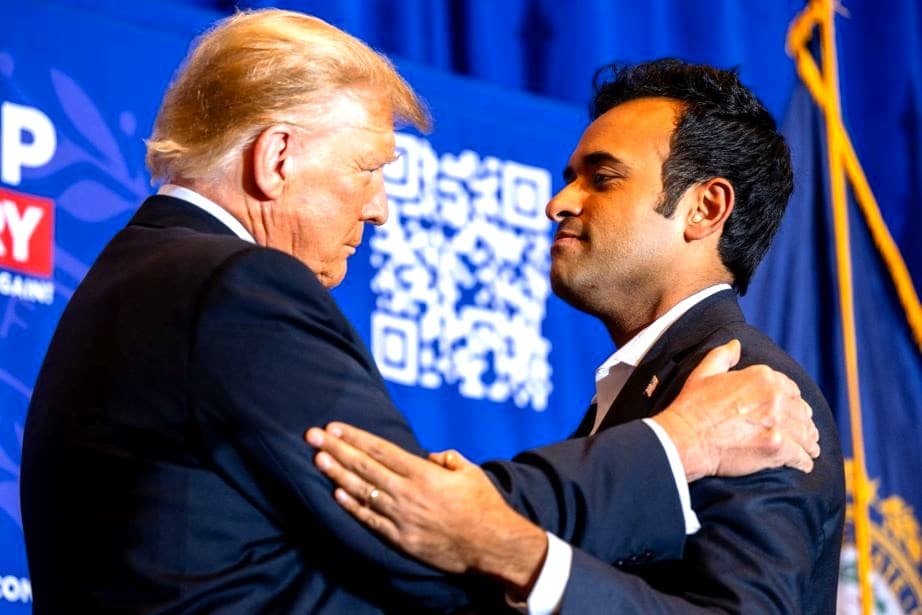
For example, when Donald Trump and Vivek Ramaswamy say that they have changed their minds about policy intervention on TikTok, I don't think it's because they have suddenly discovered "real concerns" about "the free speech implications" of TikTok legislation recently passed in the Republican-controlled House. I think it's because that legislation would potentially cost Susquehanna founder and major TikTok investor Jeff Yass billions of dollars, and Jeff Yass is the most important and active Republican donor in the country. I think it's because Trump personally stands to make billions of dollars from Jeff Yass's involvement in the Truth Social acquisition (Susquehanna is the Wall Street sponsor and largest investor in Digital World Acquisition Corp, the SPAC that took Truth Social public as Trump Media & Technology Group, which closed yesterday with a $5 billion market cap). I think it's because Jeff Yass is the richest man in Pennsylvania, and Trump can coast to the White House if he takes the state with his support. As for Vivek, who was for anti-TikTok legislation before Trump and more fiercely than Trump, I think it's because Jeff Yass gave more than $5 million to PACs and superPACs that Vivek controls, and that Vivek sees Jeff Yass as his sponsor for the next 30 years.
IT'S. ABOUT. THE. MONEY.
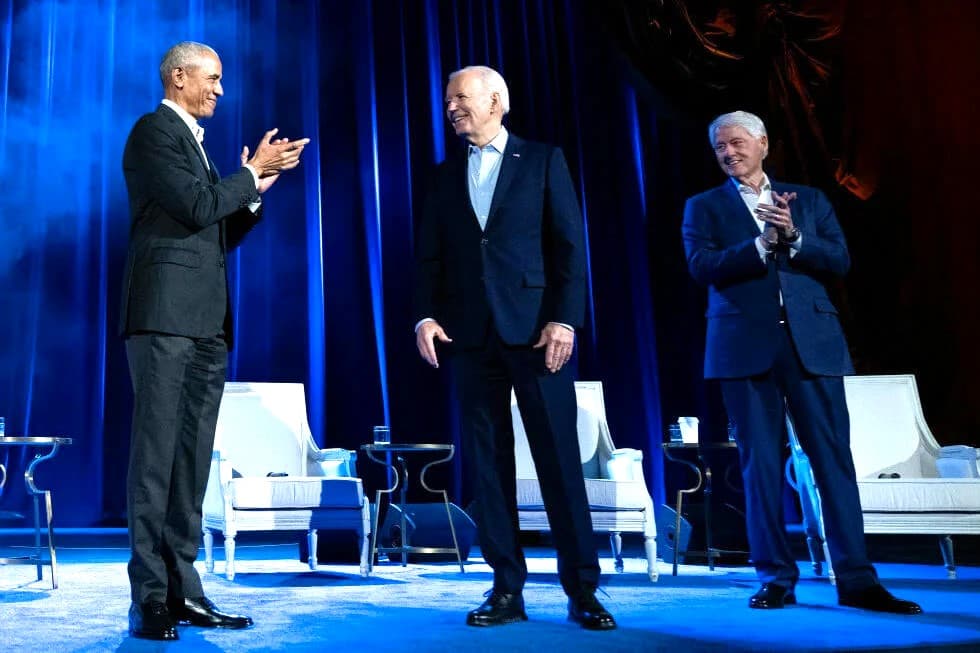
Gah. And of course this isn't just a Republican thing and it isn't just a today thing. Politics has always been ABOUT THE MONEY. But what's different today is the scale. What's different today is the brazenness. I mean, I'm old enough to remember when Hillary Clinton had to make up crazy stories about trading cattle futures to cover a $100,000 pay-off from Tyson Foods back in the Little Rock days. So quaint! Today Barack Obama gets a $65 million advance on a memoir and no one raises an eyebrow. Today Barack Obama gets a $100+ million "development deal" from Reid Hoffman and everyone cheers. Today Donald Trump gets a $3 billion dollar stake in the DJT memestock/shitcoin that Susquehanna is promoting and everyone goes yep, that happened. Three billion dollars! To the former and (maybe) next President of the United States! A few months before the election! As the kids would say, let that sink in.
They're not even pretending anymore.
Or rather, they are still pretending, like when Trump flipflops on TikTok because "concerns" or when Obama starts talking about "folks", but the pretense is so nakedly false and people like Trump and Obama are so obviously and profoundly ABOUT THE MONEY that only the believers fail to get the joke.
But most everyone is a believer these days. Everyone reading this note who is however loosely affiliated with Team Red is saying whatabout the Bidens and the Clintons and the Pelosis, huh? and everyone however loosely affiliated with Team Blue is saying I can't believe you're bothsidesing Trump and Obama! and everyone, Team Red and Team Blue alike, is saying well good for my guy he deserves every penny [insert political grievance here].
It's that last bit - [insert political grievance here] - that makes this work. What Trump and Obama (and all the others) have learned is that if they wrap their ABOUT THE MONEY-ness in their respective Red and Blue political flags, it's like no one can see The Money, like no one can see that we're just replaying Dune with House Trump and House Obama and (as minor houses) House Biden and House Clinton and House Bush. It's not that their Red and Blue political positioning doesn't matter, or that the major and minor houses just give lip service to the Red and Blue tenets of faith (although often it is just lip service), but that these these tenets are secondary to The Money. Their political tenets of faith are often in alignment with The Money, and that's nice, but they are always a shield for the The Money.
And it's not just political flags that shield the profound ABOUT THE MONEY-ness of today's clinically sociopathic society, but any sort of ideology.
Like Bitcoin.
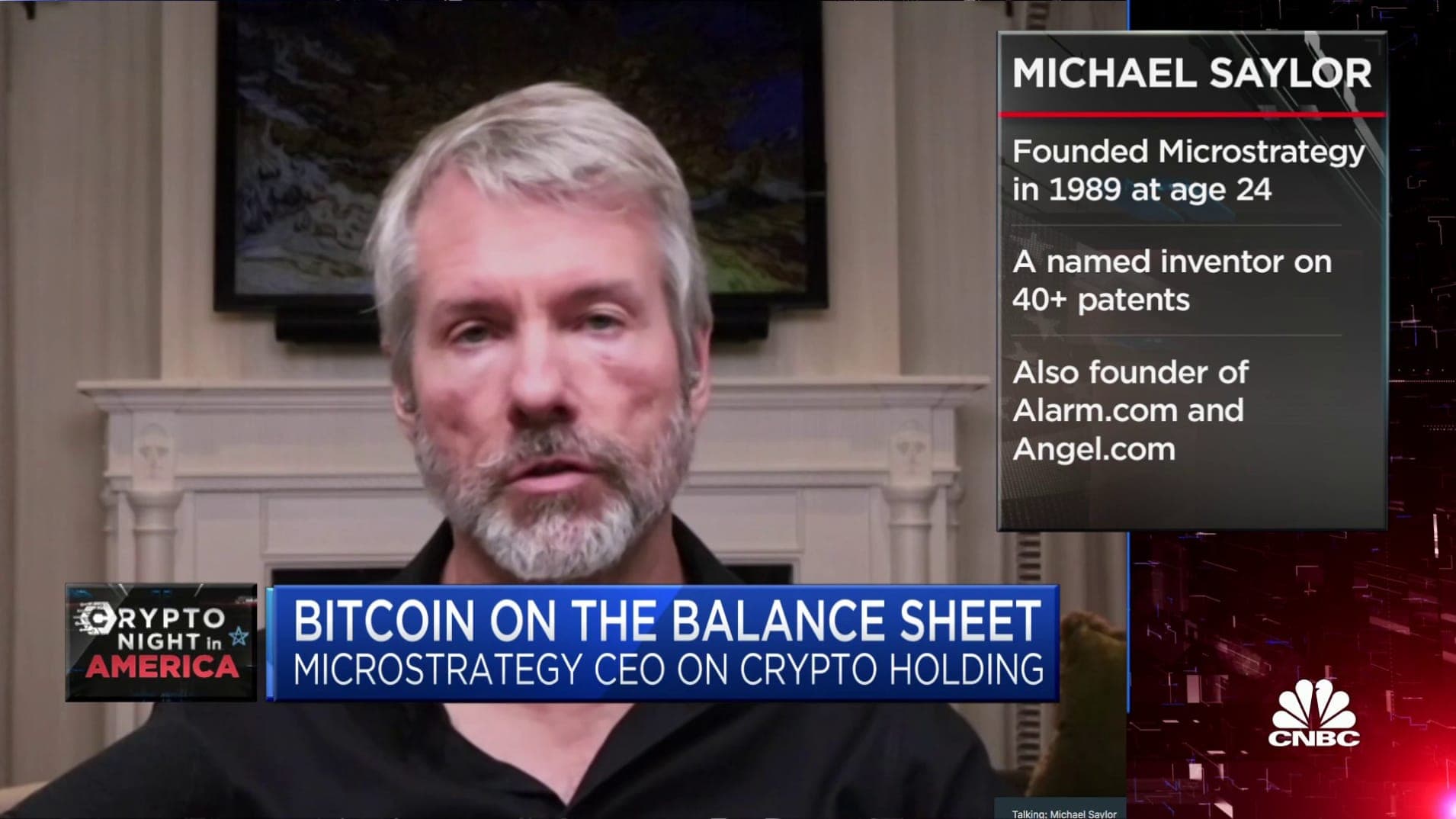
This is Michael Saylor, executive chairman of 'software company' MicroStrategy. He looks very serious, very stern in his Bitcoin maxi persona here, doesn't he? Like a desert father from the Old Testament, really, in from the wilderness to prophesy some hard truths about God and sacrifice. Hard to believe this is the same guy who famously enjoyed his yachts (plural) on the Potomac and his revelries with fellow sophisticates.

Source / Daniel Swartz / REVAMP.com
It's always fun to read the fine print in corporate proxy statements for the employment riders. Gotta say that I've never seen an executive have his reimbursement for 'personal entertainment' at company facilities capped at $130k. Not that Saylor can't spend more than that, of course, it's just that he can't bill the company for more than that. No paparazzi allowed, of course, with MicroStrategy picking up the bill for up to $1.4 million in Saylor's security costs annually. All this grossed up for taxes, natch.
So I want to be careful in what I say in the next several paragraphs, without embellishing anything for effect. Just the facts, ma'am, to use the old Dragnet line. All of these numbers come straight from SEC filings, and for everyone I mention by name I will also provide their SEC Central Index Key (CIK) so that you can also look up these documents if you are so inclined.
MicroStrategy, because of its policy to move away from the business intelligence software business and transform itself into "the world's first Bitcoin tracking stock development company", is highly levered to the price of Bitcoin. [NB - that whole tracking stock thing is actually not part of the MicroStrategy filing quote. Sorry. I know I said that I was going to be careful, but I just couldn't help myself.]
In fact, for some reason that no one can quite figure out, MicroStrategy trades at a premium to its Bitcoin holdings, meaning that "the market" assigns a higher price to its shares than the value of the Bitcoin it holds plus a generous valuation of its legacy software business. Weird.
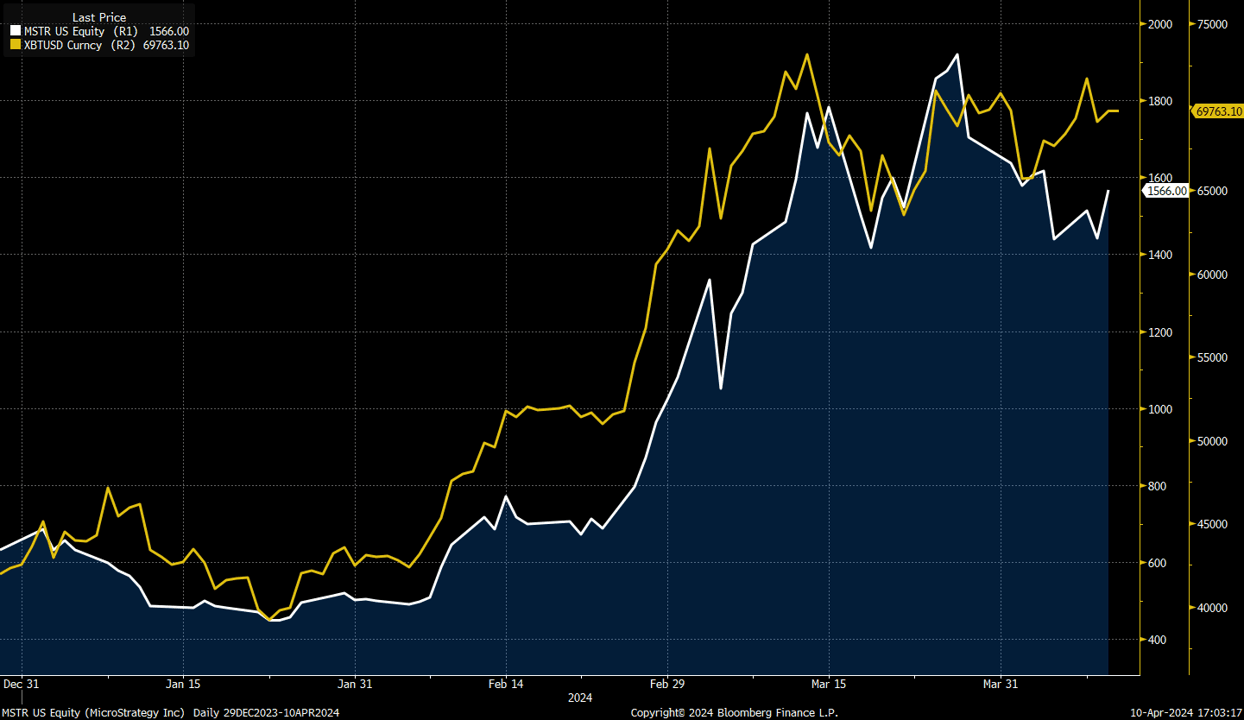
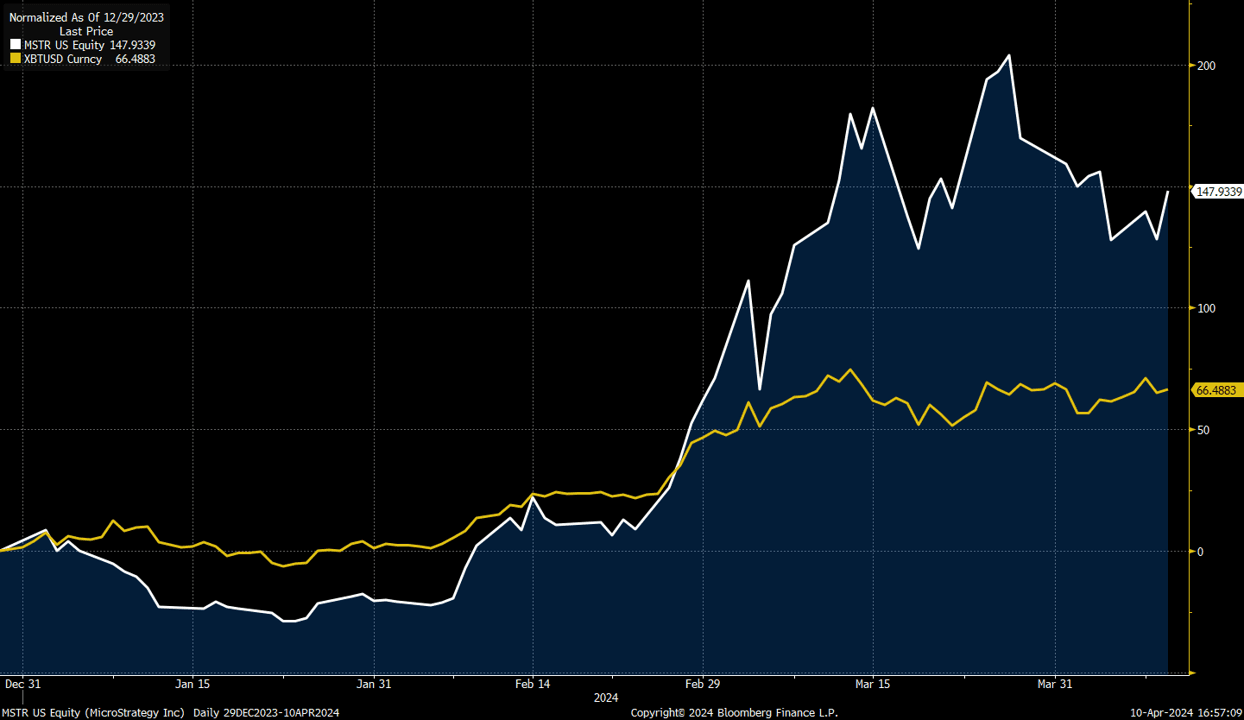
Here are two charts to show you what I mean. At the top is a price chart of MicroStrategy and Bitcoin since the first trading day of the year showing their respective dollar appreciation. MicroStrategy started the year trading at $685 per share, dipped down as low as $450/share, and then zoomed up with Bitcoin, peaking at $1,900/share and closing today, April 10th, at $1,566/share. Bitcoin started the year around $43,000 and closed today just under $70,000. Below that is a chart showing the percentage gains of MicroStrategy and Bitcoin so far this year, with Bitcoin up a whopping 66% and MicroStrategy up a whopping-er 148%. That difference in percentage increase is an inexact but pretty decent indicator of the premium that MicroStrategy shares trade for above what their holdings of Bitcoin would suggest it should trade for.
Source / Bloomberg L.P.
Source / Bloomberg L.P.
Michael Saylor (CIK 0001079782) owns an options grant which allows him to purchase 400,000 MicroStrategy shares at a price of $121.43. This options grant expires on April 30, 2024. Starting on the first trading day of the year, January 2nd, and running through April 25th, Michael Saylor is exercising 5,000 of those shares each and every trading day and then selling those shares on the open market. Through today, April 10th, Saylor has sold 345,000 shares and pocketed right at $300 million in cash profits (daily closing price less options exercise price). He has 55,000 shares left to sell, which at today's closing price would fetch him an additional $80 million. That's a $380 million payday for the first four months of 2024 ... not bad!
But here's the thing ... now Michael Saylor has to pay taxes on this $380 million. Long-term cap gains, to be sure, but even so that's a hefty tax bill. Like all mega-rich people, Michael Saylor hates paying taxes. I know this for a fact in Saylor's case because he is currently being prosecuted in the largest tax evasion case in District of Columbia history. Michael Saylor truly hates paying taxes!
So I ask you, Bitcoin maxi follower of the Prophet Saylor, don't you find it odd that he exercised these options and sold them ALL into the open market for those fiat American dollars that he rails against, subjecting himself to a massive tax bill in those same fiat American dollars?
He didn't have to do that. Saylor could have exercised the options, sold enough to cover the exercise cost and the tax consequences, and retained ... I dunno ... 300,000 MicroStrategy shares? More? All of those shares giving a greater ownership stake in the Bitcoin that he loves so dearly, in the Bitcoin that he reconfigured MicroStrategy to acquire. All of those shares being worth far more at current MicroStrategy prices than the cash he pocketed, even before the tax hit. But he didn't do that. He sold his stock hand over fist. For dollars, despite the tax bite.
So did his CEO. So far in 2024, MicroStrategy CEO Phong Le (CIK 0001651669) has exercised and sold vested options for a profit of a little more than $18 million.
So did the "independent" directors on the MicroStrategy board who have vested options. So far in 2024, directors Jarrod Patten (CIK 0001309191), Stephen Graham (CIK 0001282917) and Carl Rickertsen (CIK 0001203479) have collectively profited by about $32 million in exercised options sold on the open market. I'm putting "independent" in quotation marks because none of these three board members have any apparent experience in software or Bitcoin. They are a real estate guy (Patten, on the board since 2004), a merchant bank guy (Graham, on the board since 2014), and a private equity guy (Rickertsen, on the board since 2002), whose qualifications for board service as best I can tell are simply this: they are all DC-based Friends of Michael. Oh, and in addition to the $32 million pocketed from options so far and the millions in cash compensation paid to them over the years, they have remaining MicroStrategy shares worth about $130 million. Again, these are not company executives. They are Independent Board Members!TM. And yes, there are several excellent Epsilon Theory notes about the Independent Board Members!TM grift, including my fave The Recipe for Agent Orange, but from Saylor to the CEO to the board it boils down to this:
IT'S. ABOUT. THE. MONEY.
To be clear, I'm not saying there's anything illegal about any of this (although I'm also not saying there's not anything illegal about all this, particularly the whole Independent Board Members!TM thing). But Michael Saylor hasn't broken any laws by exercising his options and selling them for cash, and he isn't the first guy to pack a board of directors with his buds. Michael Saylor was about The Money when MicroStrategy revealed in March 2000 that Saylor and other senior officers had faked their revenue numbers for years, costing shareholders billions and sparking the dot-com crash when the news was announced. Michael Saylor was about The Money when he settled with the SEC on fraud charges later that year, paying $350,000 in direct fines and millions of dollars in disgorgement of profits. Michael Saylor was about The Money then, and it shouldn't be a surprise to anyone that Michael Saylor is about The Money today. Michael Saylor has always been about The Money.
But it is a surprise to many. I can't tell you how many people I've talked with -- hundreds, easily -- who only know Michael Saylor through his impassioned arguments for Bitcoin and think he is about Bitcoin. Just like all the people I know who think Barack Obama is about public service. Just like all the people I know who think Donald Trump is about patriotism.
And that's why I dislike guys like Saylor and Trump and Obama so much on a human level. They wrap their ABOUT THE MONEY-ness in an ideology that yes, I'm sure they believe in because why not, but then they use that ideology to make not just more money but MOAR! money, and then they use that ideology to make their believers not just accept their new wealth but YAY! their new wealth.
To be clear, I don't think there's an answer to this. Not from a top-down, national politics perspective anyway. I mean, the last national politician who I think was authentically about public service and not The Money was Jimmy Carter, and as much as people "pay their respects" to the man today, let's not forget that Jimmy Carter was reviled by his own political party for decades and a laughingstock to the other political party. Our system is not built for the Jimmy Carters of the world. They don't naturally do well in the system and if by chance they are thrust into a position of leadership, like Carter was, they flounder and fail, like Carter did.
Our system is built for high-functioning sociopaths who are about The Money but can put on a mask of being about something with ideological appeal.
So that's what we're going to get until the system breaks, either from without or within. And that's when the masks come off.
On that note ...
If you were a smart guy like Michael Saylor and you thought a stagflationary tsunami of enormous proportion was going to wash over the US economy regardless of who wins in November, what would you be doing right now?
I think you might be doing whatever you can to get liquid in the global reserve currency without spooking the marks.
Just sayin'.
PS - I think there are a lot of Michael Saylors out there.



Comments
Great post. As far as Saylor’s followers go, its about the money for them too. I don’t think they are disciples as much as they all think they are giving him a wink and a nod to go find other disciples. None of them are the actual sucker at the table, in their eyes (which means, of course, they all are).
I seem to remember a very similar BBY story that you, or someone here, wrote not so long ago. There are more Saylors than not and more Obamas, Trumps, Trudeaus, and the list is just too long. In the good old days at least there would have been a reconciling through an old fashioned bloodletting that would retool the playing field and the players. Maybe your tsunami will be ours. One can hope.
Great read, thanks.
What is money? Really? It’s a religion. Maybe a beneficial and even necessary one, but a religion nevertheless. (And BTW the supernatural is not required for a religion, as Confucianism, liberalism, conservatism, patriotism, etc. demonstrate.)
It always requires faith to function. Not just faith in money in general, but faith in a particular kind of money, from gold to fiat dollars to anything in between.
You can see how controlling this religion (or even being an early convert) will translate into a lot of wealth/power. So the chances that a high priest (whether affiliated with a state or not) is only motivated by societal good, well, are not high.
Hi Karl,
Yes, I think you are mostly correct. I can see a difference though. The supply of religion and the monetary supply each have intrinsic characteristics.
Religious faith is difficult to use for trade, because it is inseparable from the person.
It would be comforting to think that money belief cannot be forced upon a person, in the way that religions aren’t so much anymore, but societies make demands that faith in God doesn’t.
I don’t understand why this logically follows from a “stagflationary tsunami”. I naively would think that loading up on “real” assets (real estate? utilities? commodities?) would be the smart thing to do.
Can someone ELIFI (explain like I’m financially illiterate)?
Liquid in the global reserve currency provides the most options, not necessarily the highest return. Investors are trained on the back test. But, the returns ahead probably aren’t part of the correlations in the model.
Indeed. When the IRS passes their collection plate they’ll expect you to believe in nothing but the accepted faith.
What a fantastic note, @bhunt
I couldn’t help but relate this note to one of the historically observable truisms that Dalio points out in his latest book - Why Nations Succeed and Fail - about the symbiotic relationship between Money and Power. Not that Dalio was the first to observe this phenomenon — Power Corrupts & Absolute Power Corrupts Absolutely and all that… But it does seem Dalio correctly points out that we’ve reached an absurd level of such in the current cycle here in the United States to the point where its effects are shifting from a normal and manageable part of life to exerting a detrimental effect on our economy, markets, society and political environment. I’m about what lies ahead for us.
No human being has ever wielded absolute power.
Much that those imaginings may please, it is vanity.
Though industrial and financial technology is vast power amongst mortals, we are not gods. Time is thane of all. It has even corroded Lord Acton’s quote. “Power tends to corrupt…”. His public writings were probably biased by his membership of La Casta.
William the Conqueror was stripped naked by his “followers” as they stole his clothes, and left for dead on the forest floor, when the old man fell from his horse.
Lack of power and the greed for, corrupts the hearts.
Fiat money has a power to distort a nation’s subjective time preferences, their choices between consumption or saving and the ability to be self-made (a non-posthumous honour). It does not have power over objective time itself.
Yes, I think money is somewhat different from traditional religion, in that the faith has a smaller footprint, and the analysis has a larger one, for money.
Also, there’s the monotheism vs. polytheism issue. We the West have been monotheistic for so long that we tend to forget polytheism is pretty prevalent around the world. For money, we went strongly monotheistic when Britain instituted the international gold standard (mid-19th century,) but both before and after that polytheism did and probably will have a lot of power to assert itself.
Continue the discussion at the Epsilon Theory Forum...