The Almanac and the Ambulance
June 9, 2026·AI
Epsilon Theory Unplugged is an ongoing series featuring a rotating cast of authors. Each Tuesday, a new note is published. We cover a variety of topics, all focusing on our relationship with technology and ourselves. Sign up to keep up to date on the latest Unplugged notes.
At this point I think just about everyone knows that AI is going to change just about everything. The closer you work with AI models, the more likely you are to know that they already have changed everything. But you wouldn’t know it from the way most companies, campaigns, non-profits, universities, and governments are thinking about AI, much less by how they are deploying it.
It’s an old problem. For the first several years after a big thing comes along, humans don’t really use transformational technology in transformational ways; instead, we use its efficiency and power to slap a new coat of paint on the old ways we did things. Paul David at Stanford famously wrote about this in context of electric motors in the 1890s. The transformational deployment of the technology was to put dedicated electric motors in every machine in the factory so that layouts could be optimized instead of being oriented around some big floor-spanning shaft and a forest of pulleys and belts. For the first forty years or so, though, we just…well…didn’t. We swapped out the big, dumb steam engine for an electric motor and had it drive the same shaft, pulley, and belt system. Same thing with the printing press, which for 60 years after Gutenberg mostly tried to simulate hand-generated script and often left blank spots for rubricators to add hand-drawn illuminations. Early television was dominated by cameras pointing at people reading like they would on the radio, and the early internet was essentially a bunch of publishers and businesses reproducing their print collateral as static sites.
In short, when it comes to transformational technologies, it’s not a failure of adoption ─ it’s a failure of imagination. And yeah, if your first thought there was to notice the em dash and the “it’s not X, it’s Y” construction above, you might just be in failure-of-imaginationland yourself.
What David was trying to answer in his paper was the why behind the “productivity paradox” made famous by Robert Solow. If you aren’t familiar with his Nobel Prize-winning work, Solow first identified the inordinate role of productivity in economic growth and then revealed how two decades of IT investing didn’t seem to pay off. David’s explanation, simplified to a fault, is basically that the benefits of transformational tech are marginal until humanity discovers, arrives at, or builds the transformational deployment of that tech.
But there’s a special kind of transformational technology for which our old deployments are even stickier, even slower to update, and where the forgone transformational deployment is often a difference in kind rather than magnitude: instruments of measurement.
Which is a problem for AI. Or at least from society putting it to its most productive uses.
That’s because – just in case you missed our thesis on this topic - large language models are properly thought of as extraordinarily fast and extraordinarily precise instruments of semantic measurement.
If you’re looking for a clean case study for missed AI-driven productivity, the best example to extrapolate over the next few years will be the ‘media monitoring’ and ‘social listening’ industries.
There was a farmer who lived on the end of my road in rural Illinois when I was a kid. He was an older gentleman and looked after a pretty niece of his that was a couple years ahead of me in school. They were both the kind of genuinely nice and hard-working people you’d expect to be doing that kind of work in a little town on the plot of six-foot-deep Drummer series prairie soil just off the ridge of the Minooka moraine his parents had owned and worked for decades before him. I got caught chasing fireflies in his field a few times but never got into very much trouble for it.
Mr. S, as we called him, probably because his family was Polish or German and he didn’t trust us not to butcher it, used to carry around and read a book you’ve probably seen and heard of: the Old Farmer’s Almanac. Now, Mr. S was not an unintelligent man, nor did he seem especially superstitious or against farming with the aid of modern technology. He sprayed and rotated his crops, and I think if he’d lived long enough to buy one of those quarter-of-a-million-dollar harvesters that are basically operated by GPS and an iPad, he’d have been delighted.
But he still carried the almanac.
Now, every good almanac — and the Old Farmer’s Almanac may be the most famous of them all — depends on two things.
An almanac must at the very least pretend to have a method, a philosophy about the way the world works sold as secretly discovered or passed-down-through-the-generations knowledge. The moment the Mr. S’s of the world think you’re just making it up as you go is the moment they figure they’d have a better time and be no worse off going for the Weekly World News two slots over at the checkout line at the grocery store.
An almanac must also have an origin story. It must be common knowledge that the folk wisdom contained within it has made miraculous predictions in the past that could not have been made if its method were not accessing some True Knowledge about the world.
The Farmer’s Almanac, as it was originally called when Robert Bailey Thomas founded it in 1792, has both a method and a founding story. For more than a century going back as far as 1846, the Almanac and others trumpeted a claim that its 1816 Almanac had called for “rain, hail, and snow” on July 13 of that year. Quite a prediction for the continental United States to have snow in June and July, but it’s true. That was the year after Mt. Tambora blew its top (along with 38 cubic miles of rock, ash, dust, and other ejecta into the atmosphere) and which led to the Year without a Summer. All of that is true. That is, except for the story that the Almanac had predicted it in their 1816 edition, which found copies have repeatedly confirmed they absolutely did not. But origin stories do not, strictly speaking, need to be true, especially for stories about events that were so romantic in nature that they inspired poems by Lord Byron.
Without knowledge of the massive explosion on sparsely populated Sumbawa, many people around the world concluded that the temperature and darkness could only be explained by massive sunspots that were visible from the naked eye at the time. As it happens, sunspot analysis was also the method, the secret knowledge that was the foundation of Thomas’s formulas hidden away in a tin box in Dublin, New Hampshire as if they were a secret recipe for drug store cola. Researchers at the Almanac interpret recent and current solar activity (especially sunspots), compare it to similar periods, and consider global phenomena like oscillations in the jet stream to produce their forecast.
The reality of their method is a lot simpler. They “predict weather trends and events by comparing solar patterns and historical weather conditions with current solar activity.” In other words, the Old Farmer’s Almanac uses a narrow version of what’s called analog forecasting. They measure solar activity, temperatures, wind, precipitation, and the jet stream on individual days and weeks and months, then build a matching model to find “what happened next” based on the best historical analog – the days and weeks and months that had the most similar values for those metrics.
The problem with this isn’t that analog forecasting, or almanacking, as you might call it, can’t be useful. “If you could stop every atom in its position and direction, and if your mind could comprehend all the actions thus suspended,” as Tom Stoppard’s Thomasina put it, “then if you were really, really good at algebra you could write the formula for all the future.” But the Old Farmer’s Almanac doesn’t comprehend all the actions thus suspended. It comprehends one strong proximate predictive mechanism for weather that is so variable as to be practically useless for long-term predictions (jet stream), one extremely weak causal mechanism (sunspot activity), and a whole lot of downstream effects. Analog forecasting on the basis of a bag of observed effects and two almost irrelevant factors for the time horizon the Almanac publishes predictions is no better than a coin flip. And that’s the realized experience for readers. The Old Farmer’s Almanac’s predictions have the right direction or “sign” right around half the time, which is why they have since relented and resorted to bolting on actual climate science and meteorology to their work.
Almanacking for any complex and chaotic system is a coin flip dressed up as science.
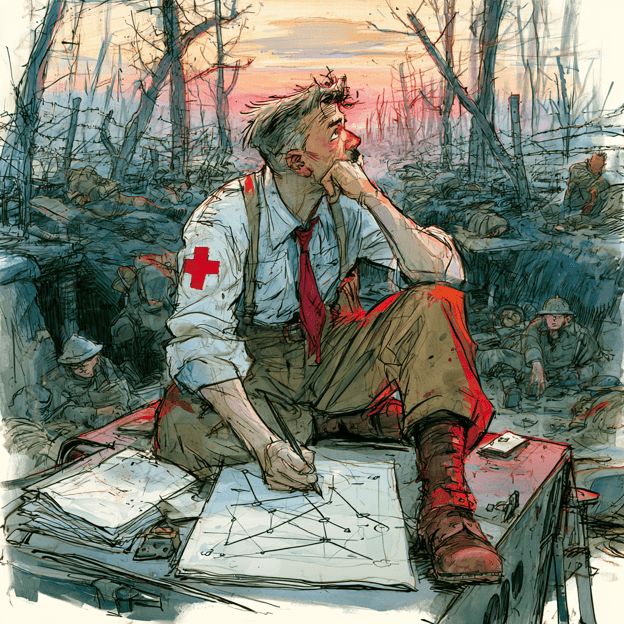
A little over a hundred years after Thomas started the Almanac and long before I first spied a copy of it in Mr. S’s shirt pocket, a war was raging in central and western Europe. An English Quaker and mathematician by the name of Lewis Fry Richardson joined the Friends’ Ambulance Unit, a unit consisting of conscientious objectors from the British Society of Friends. Attached to the 16th French Infantry Division, Richardson spent much of 1916-1919 doing something that would turn out to be very unlike almanacking.
A few years before, Norwegian physicist Vilhelm Bjerknes had tabulated and published data collected from a series of simultaneous balloon launches across Europe. The data from one such date (May 20, 1910) was especially good. And so, between his forays into no man’s land to retrieve those cut down by machine gun fire and into trenches to treat infections and disease, a 35-year-old Richardson sat on “heaps of hay in a cold rest billet” arranging the data to facilitate its use in meteorological calculations.
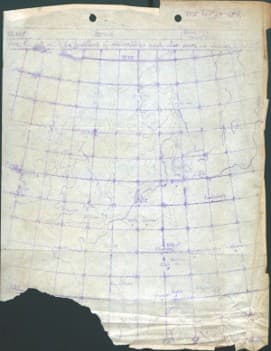
He first organized a 3-dimensional grid of Europe’s geography, a checkerboard version Europe. Each 200km square in the grid roughly corresponded to (or could be interpolated to respond to) Bjerknes’s balloon data, which was further divided on a vertical dimension into layers with boundaries at 2, 4, 7, and 12 kilometers that corresponded to equivalent masses of air. In each of the 125 resulting compartments, he recorded barometric pressure, moisture, and temperature in one “cell”, and then calculated the mass of air movement on the two non-vertical axes of his checkerboard: east-west and north-south.
He used this work to build a 6-hour forecast which, unlike an almanacking exercise, was built on a model (that resolved to a literal map) based on mechanisms with causal links rather than mere correlative relationship. Pressure drives wind. A rotating Earth twists winds (Coriolis effect). Wind redistributes mass, which changes pressure. Compression heats air. Air can’t go through the earth, so net horizontal inflow to a checker column has to go up.
For all that, the forecast failed. The proximate cause was a hand-calculated forecasted pressure rise of 145.1mb over Bavaria. That calculation meant a forecasted pressure of 1,108mb, higher than the highest barometric pressure ever recorded on the planet (New Year’s Eve in the heart of Siberia in 1968). At this time of year? At this time of day? In this part of the country? Localized entirely in Munich? Yes, or at least that’s what Richardson’s book on the topic would conclude. And Richardson’s chain of causal mechanisms was right. The calculations were right. The measurements were individually reasonable. But there was a missing assumption in his model in which the initial conditions needed to be balanced. In short, if you have multiple big gross “inflow” numbers to a checker that are being offset to produce a vanishingly small “net”, small observation and measurement changes or errors in which gross and net values interact can produce a massive forecast error. If you’ve ever built a model, this risk should be familiar to you.
In short, Richardson’s forecast failed because the transformational deployment was immature AND because the transformational technologies that would empower it to be deployed at scale – radar, computing, satellites – were not yet developed. But his method, to model the way the world works rather than seeking historical analogs to observed effects, is very much like what we use in meteorology today. And very unlike what the Old Farmer’s Almanac did for centuries.
Complex and chaotic systems with known and measurable causal dynamics do not need a faster coin flip; they need transformational measurement technologies and transformational deployments tuned to that technology.
___
All of which is why I think the media monitoring and social listening industries are the cleanest examples of a huge swath of functions across practically every industry and organization which depend on socially-mediated meaning – and why they’re going to continue to disappoint on productivity if they don’t embrace the transformational nature of this technology.
The media monitoring and social listening industries have experienced explosive growth since the onset of social media and always-on news. For the unfamiliar, media monitoring providers engage with companies, media campaigns, brands, famous individuals, and other institutions to, well, monitor media. You can think of it rather like systematic and continuous public relations consulting. They track what people are saying about you, your brands, your marketing, your reputation, your competitors, and your markets more broadly.
Social listening is properly thought of as a sub-set of media monitoring which actively listens to these conversations on social media, review sites, and forums in particular. These efforts tend to emphasize constructing segments of users, customers, and commenters to help companies understand the different parties who care about them and to whom they may need to tailor some forms of communication.
They’ve also been some of the most voracious and early users of AI. Most media monitoring tools now incorporate predictions (viral scores!) of marketing copy and pretty visuals and on-demand executive summaries of brand and reputation that would have been out of reach for all but the most well-resourced consultant shops just 10 years ago. But look under the hood, and you’ll see the same shafts, pulleys, and belts that existed for fifty years hitched to a fancy new engine to drive them faster and more efficiently. Cluster graphs based on words that show up most frequently around the name of your company or its product. Sentiment analysis that grade words based on how nice or hurty they are and associate them with audience clusters. Trend association, in which we see which brands, competitors, and products have names that are co-located with topics that have a lot of published volume. And now: virality predictions based on pattern matching old viral content!
Media monitoring today is a very expensive almanac with repurposed word clouds.
Social listening today is a very expensive almanac with beautiful audience clustering charts.
And yet, the transformative technology whose purpose and nature is more perfectly attuned to this industry than any other is being used as a mere novelty. As a source of marginal improvement in operating efficiency and product quality. Narratives, brands, and reputations have causal mechanisms every bit as much as weather patterns, measurable features that can be modeled rather than matched. The effort expended by institutions to pre-shape interpretations of future events gives birth to predictive narratives and interpretative framings. Isolated burstiness of certain narrative frames reveals narrative shaping effort and virality. Accumulated deviation of semantic signatures from historical anchors can identify precisely the point where a common knowledge regime – what everybody knows everybody knows about your brand, reputation, or product – has changed. LLMs are the transformational technology that makes all of this possible.
The industries that are affected by this go far beyond just media monitoring and social listening, of course – they’re just the pure plays on interpretation of social meaning that give us a glimpse into how this technology is being used to poor effect. Every organization with a marketing function, a product function, a brand, a reputation, a pricing model, competitors, customers, advertising, voters, constituents, or investors – which is to say, basically every organization on the planet – is going to be affected by this, too.
And for now, the pure plays seem committed to almanacking. And maybe if they can figure out an origin story or a way to describe some secret passed-down-through-generations knowledge, they may still find a market with the Mr. S’s of the world. For the rest, I fear, the clock is ticking.