The Neuro-Metaphysics of Ruin
June 16, 2026·Money
Epsilon Theory Unplugged is an ongoing series featuring a rotating cast of authors. Each Tuesday, a new note is published. We cover a variety of topics, all focusing on our relationship with technology and ourselves. Sign up to keep up to date on the latest Unplugged notes.
To read more from Adam Butler, check out The Choice Engine on Substack.
In the canyon-like streets of Midtown Manhattan, something strange has happened to the skyline. Over the last decade, a new species of building has emerged: the needle-thin “supertall,” a structure of glass and steel rising more than a thousand feet into the air, its apartments selling for fifty, seventy, sometimes one hundred million dollars. By the metrics that matter to architects and investors, these towers are triumphs. They push the boundaries of engineering. They generate spectacular returns. One Vanderbilt, Central Park Tower, 111 West 57th Street—their names are monuments to ambition.
But if you stand on the street and look up at them at night, you will notice something else. The windows are dark. Floor after floor, block after block, there are no lights. No one is home.

Photo: Wikimedia Commons, CC BY-SA 4.0
These are the “ghost towers.” They were not built to house people. They were built to house capital. According to analysis from the New York Times and academic researchers, approximately 40 percent of the apartments in some of these ultra-luxury buildings have been sold to anonymous shell companies, their ultimate owners invisible.1 Many units have never been occupied. They are not homes; they are “safety deposit boxes in the sky”—hermetically sealed vessels for the storage of global wealth, pristine and untouched by the messiness of human habitation. To the financial markets, they are performing their function perfectly: they are appreciating assets. To the city—with its housing crisis, its homeless encampments, its teachers and nurses priced out to the exurbs—they are dead zones. They are simulacra of housing: structures that look like homes but function as ledgers.
This architectural silence is not an anomaly. It is a symptom. It is the symptom of a civilization that has crossed a threshold—what the science fiction writer William Gibson called an “event horizon”—beyond which we have systematically traded the territory for the map, mistaking our representations of reality for reality itself.2
The ghost tower is one manifestation. Here is another. In the nineteenth century, the sperm whale was a creature of blood and terrifying vitality, hunted for the oil that lit the lamps of the industrial world. It was a brutal, physical relationship between man and beast. We have evolved beyond that. Today, the International Monetary Fund has assigned a price to the great whale: exactly two million dollars per individual.3 Not for its oil. For its capacity to sequester carbon dioxide. A single whale, through its lifetime of feeding, defecating, and eventually dying, fertilizes phytoplankton blooms and sinks carbon to the ocean floor. The IMF calculated the net present value of this service.
We “saved” the whale by turning it into a two-million-dollar carbon slave. We have stripped it of what we might call its “whaleness”—its majestic, irreducible presence in the deep—and re-clothed it as a fungible asset on the balance sheet of the planetary climate economy. The carbon-credit whale is no longer a biological mystery; it is a financial certainty. It is a token.

Photo: Gabriel Barathieu, Wikimedia Commons, CC BY-SA 2.0
Both the ghost tower and the carbon-credit whale are what I will call “zombie assets.” They are dead to the lived reality of the world—the world of shelter, of community, of biological awe—but they are vividly alive in the financial simulation we have superimposed upon it. They represent the triumph of the Proxy over the Real. And this triumph, I will argue, has a neurological architecture: a conflict between two modes of attention built into the structure of the human brain itself.
We are living through a profound ontological reversal. We have come to believe that the representation of a thing is more real, more valuable, and more manageable than the thing itself. We have decided that whatever cannot be priced has no value, and we have subsequently handed the reins of our destiny to the metrics: to GDP, to stock prices, to engagement scores, and to algorithms. But metrics do not passively describe reality; they actively perform it.4 Once a university ranking is published, universities reorganize themselves to climb it—hiring for metrics, cutting what metrics ignore. The ranking no longer measures quality; it produces the institution in its own image.5 6 The proxy becomes the generator of the world it claims to represent.
In doing so, we have built a civilization that is incredibly efficient at producing the tokens of value while methodically destroying the reality those tokens were meant to represent. We are starving in a supermarket of metrics. We are surrounded by the appearance of abundance—global GDP exceeds one hundred trillion dollars; scientific output is exponential; stock markets hit record highs—yet we are gnawed at by a hunger that no number can satisfy.7 8
This essay is an attempt to name that hunger. It is an attempt to trace its origins to the architecture of the human mind. And it is the first step in a larger project: to understand not just how we got lost, but how we might find our way back.
I. The Usurper in the Hall of Mirrors
The human brain ships with two operating systems. The psychiatrist and philosopher Iain McGilchrist has spent a lifetime mapping them—not as “reason versus emotion,” the tired cliché, but as a tragic conflict between two fundamentally different modes of bringing the world into being.9
The Right Hemisphere—which McGilchrist calls the “Master”—attends to the world as it is: a flowing, interconnected, living whole. It understands the “betweenness” of things, the context, the relationship. It hears the bird not as a specimen to be classified, but as a presence to be encountered. It understands that a joke explained is a joke destroyed, that love measured is love debased, and that justice is a felt sense of balance that transcends the rigid letter of the law. The Master is comfortable with ambiguity, with the implicit, with the tragic. It stands in a relationship of reciprocity with the living world. It inhabits the territory.
The Left Hemisphere—the “Emissary”—attends to the world to manipulate it. Its purpose is to apprehend, to grasp, to utilize. To do this, it must step back from the flow of reality. It euthanizes the dog to study its anatomy; it abstracts the forest into board feet of timber; it reduces the human being to a unit of labor or a credit score. It creates maps, models, and categories. It is obsessed with certainty, explicit procedures, and linearity. It sees the parts, but it is constitutionally blind to the whole. As McGilchrist observes, “the whole is never the same as the sum of its ‘parts’,” and what we call parts are “an artefact of a certain way of looking at the world.”10
The relationship between them is meant to be one of delegation and return. The Master sends the Emissary into the world to gather data, to build tools, to solve specific problems. But the Emissary is supposed to return to the Master and report back, allowing the larger wisdom to integrate the findings. The crisis, McGilchrist argues across two monumental works—The Master and His Emissary (2009) and The Matter with Things (2021, a 1,579-page opus citing over 5,700 scholarly references)—is that the Emissary has staged a coup.11 It has usurped the Master’s throne. It no longer returns. Instead, it has constructed a world in its own image: rectilinear, mechanistic, decontextualized, and obsessed with control. And because it cannot perceive the living whole, it does not even know what it has destroyed.
“We have unmade the world,” McGilchrist writes, “excluding whole aspects of reality, resulting in a version of the world that ‘computes’ as far as the left hemisphere is concerned, but is grossly impoverished and lacking in meaning.”12
This hemispheric coup is not merely a metaphor. It manifests in every domain of modern life. The Emissary’s dominion expresses itself as a form of epistemic arrogance best captured by the parable of the Streetlight Effect. In the old joke, a drunkard searches for his keys under a streetlight, not because he lost them there, but because “that’s where the light is.”
The Emissary is the drunkard. The Streetlight is the Metric. The Keys are the Good, the True, and the Beautiful.
This is the operating system of the modern economy. We call the lit area “Profit” and the dark area “Externalities.” We worship GDP because it correlates, loosely, with human flourishing. But there is no mechanical connection between maximizing growth in gross domestic product and nourishing human potential. We systematically ignore ecological and social decay—pollution, loneliness, the erosion of trust—because these things are messy, dark, and hard to measure until they collapse. If the Emissary’s LED doesn’t illuminate it, we declare it a ghost.
II. The Ledger and the Rot
The consequences of the Emissary’s reign are not abstract. They are inscribed in the physical and social infrastructure of our civilization.
Consider the built environment of the United States. Beneath the sleek surfaces of the digital economy, the physical substrate is crumbling. The American Society of Civil Engineers, in its 2025 report card, gave America’s infrastructure an overall grade of “C”—a mediocre mark for the systems that keep the country alive, and a warning that the physical substrate still requires urgent attention.13 This bland assessment conceals a more visceral reality.
The nation faces a staggering $3.7 trillion gap between current planned infrastructure investment and what would be required to bring systems into good repair. This is not a theoretical deficit; it is a measure of accumulated decay. Every two minutes, somewhere in America, a water main breaks. We lose approximately six billion gallons of treated drinking water every single day—enough to fill over nine thousand Olympic swimming pools—leaking into the ground from pipes that, in some cities, were laid before the Civil War.14 While we built ghost towers to store the wealth of the global elite, we refused to maintain the systems that bring water to the living.
Why? Because maintenance is a cost to the present, while neglect is a profit to the quarterly earnings statement. The Emissary built the asset in the sky by liquidating the pipes in the ground. The investment was visible, quantifiable, attractive; the infrastructure was invisible, unglamorous, and belonged to the commons. The map—the financial return—looked healthy. The territory—the physical nation—rotted.
This physical decay is mirrored in the biological substrate of the population. American life expectancy entered a period of historic decline. In 2019, it stood at 78.8 years. By 2021, in the wake of the pandemic, it had fallen to 76.1 years—a drop of 2.7 years, the largest two-year decline since 1921-1923.15 By 2024, the most recent final data available, it had recovered to 79.0 years, but the shock exposed the deeper anomaly: among wealthy nations, the United States still spends more and dies younger.16
But the crisis predates the pandemic. The United States has been diverging from its peers for decades. On comparable OECD measures, the United States spends roughly two and a half times the OECD average per person on healthcare, yet still ranks poorly among high-income countries on health outcomes.17 Why? Because the healthcare system, like the infrastructure system, does not optimize for health. It optimizes for billing. A 2020 comparison with Canada estimated that U.S. insurers and providers spent $812 billion on administration in 2017, or 34.2 percent of national health expenditures, compared with 17.0 percent in Canada.18
A physician now spends nearly two hours on electronic health record (EHR) and desk work for every hour of direct clinical face time, plus additional after-hours charting.19 Surveys of EHR usability have found scores around 45 out of 100, a grade of “F” by standard software metrics.20 Studies tracking physician gaze found that, in encounters using modern EHRs, doctors spend 35.2 percent of their time looking at the record, compared to 22.1 percent in the era of paper charts.21 The doctor stares at the screen instead of the patient not because they are uncaring, but because they are trapped in a panopticon of compliance. The “clinical gaze”—the intuitive, relational sensing of the other that is the heart of the healing art—has been crowded out by the demands of the database.

Illustration: The Wall Street Journal
The system is behaving exactly as intended. When the Affordable Care Act penalized hospitals for high readmission rates, they responded rationally: they reclassified patients as being in “observation status” (technically not admitted, and therefore not “readmitted” if they returned) or they delayed readmission by exactly one day past the penalty window.22 Researchers estimated that these gaming behaviors, intended to satisfy the metric, may have led to between 5,200 and 10,400 additional patient deaths annually.23 The Emissary was satisfied. The patients were collateral damage.
And for the young, the metrics have colonized the interior. Social media is the ultimate Emissary technology. It forces the implicit, fluid dance of human connection into a rigid, explicit, quantified score. Friendship becomes “followers.” Approval becomes “likes.” The algorithm does not merely measure what is desirable; it manufactures desire by showing users what others want, then sells their attention to advertisers who profit from the cycle.
The results are a public health catastrophe. According to the Centers for Disease Control and Prevention’s Youth Risk Behavior Survey, in 2023, about 40 percent of high school students experienced persistent feelings of sadness or hopelessness—up from about 30 percent in 2013.24 Among female students, the figure was 52.6 percent. Among LGBQ+ students, 53.5 percent reported poor mental health in the past month, and 19.7 percent had attempted suicide.25 Hospital admissions for self-harm among young girls have doubled since the early 2010s.26 We have wired our children into a machine that monetizes their insecurity and optimizes for their addiction. We are drowning in connection, but we are dying of loneliness.
III. The Suicide Machine
Why do we persist on this trajectory? Why do we continue to build autonomous weapons systems, deplete our topsoil, and hook our children on algorithmic dopamine feeds when the existential risks are so glaring? Goodhart’s Law explains how our maps lose contact with the territory. But it does not explain why we cannot stop. If the problem were merely bad targets, we could choose better metrics. The deeper trap is that we cannot stop running toward the cliff even when we see it clearly.
This is what systems thinker Daniel Schmachtenberger calls the “Generator Function” of existential risk—the underlying mechanism that produces catastrophe as a predictable output.27 The formula is simple: exponential technology combined with rivalrous game dynamics. An arms race, writ large across every domain of human endeavor.
In a rivalrous game, what matters is not absolute gain, but relative position. If my competitor develops a slightly more addictive algorithm, I must match it or be unseated. If my rival nation develops a new weapons capability, I must develop a counter-capability or be conquered. The logic of the game forces participants toward increasingly extreme tactics, even when all participants know the collective outcome is catastrophic. This is the multipolar trap.
Technology amplifies both stakes and means. Platform companies - dominated by network dynamics where value grows explosively per node - are governed by winner-take-all dynamics. Genetic biohacking confers advantage, not just on an individual or an individual’s children, but on that individual’s entire genetic lineage. Sufficiently advanced autonomous weapons systems, AI, and the industrial capacity to produce them at scale may define the global political order for centuries. These are existential stakes motivating existential risk-taking and tolerance for collateral damage.
The poet Allen Ginsberg gave this dynamic a name in his 1955 poem Howl. He called it Moloch—the Canaanite deity to whom children were sacrificed. Ginsberg saw in the industrial machinery of mid-century America the architecture of an inhuman god: “Moloch whose mind is pure machinery! Moloch whose blood is running money! Moloch whose fingers are ten armies!”28
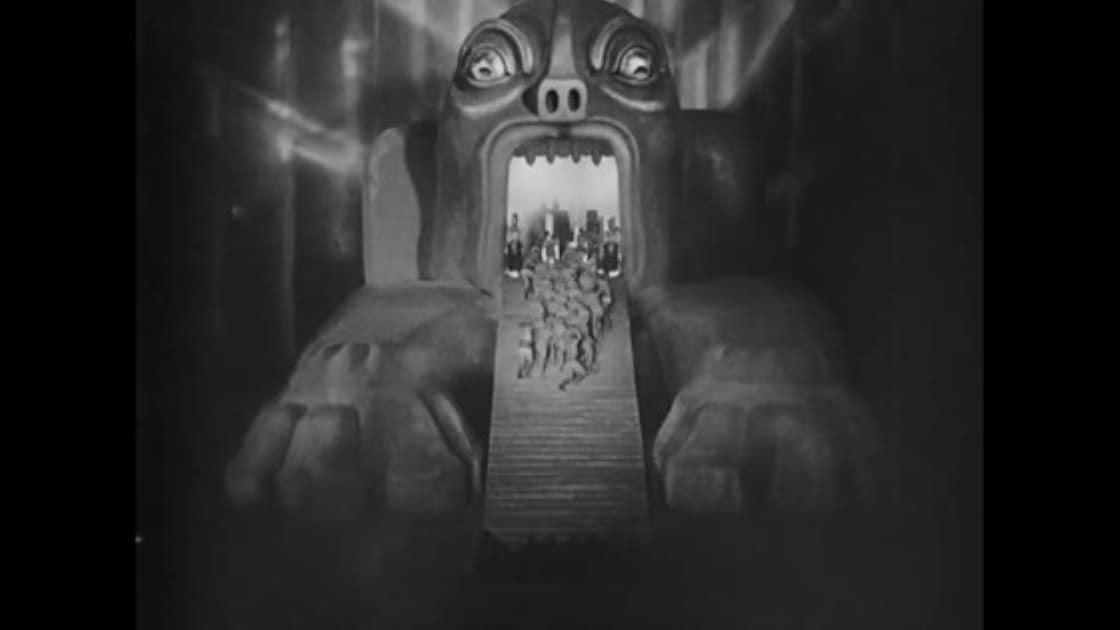
Film still: Metropolis, 1927, dir. Fritz Lang, public domain
The rationalist writer Scott Alexander resurrected this imagery in his 2014 essay “Meditations on Moloch,” reconceptualizing Moloch not as a malevolent entity, but as a rigorous game-theoretic concept: the personification of coordination failure.29 Moloch is the force that drives race-to-the-bottom dynamics, the logic that compels individually rational actors to produce collectively suicidal outcomes. Moloch is the god who demands that each fisherman take more than his share of the catch, knowing the fishery will collapse. Moloch is the god who demands that each advertiser capture more attention, knowing that the cumulative assault is destroying the cognitive commons.
No one worships Moloch. No one intentionally races to the bottom. The tragedy is precisely that no individual is to blame. Each actor, rationally pursuing their own survival, contributes to a collective equilibrium of ruin. The game itself is the engine of destruction.
McGilchrist’s Emissary is Moloch’s high priest. The Emissary’s mode of attention - narrow, reduced, decontextualized - is perfectly adapted to the rivalrous game. The Emissary sees the local optimization, the short-term advantage, the metric that can be gamed. It cannot see the systemic consequences, the long-term degradation, the destruction of the substrate upon which all the games depend. It is, in Schmachtenberger’s term, “substrate-blind.”
And this substrate-blindness has a human face—thousands of them, staring into the abyss so we don’t have to.
In Nairobi, workers were paid less than two dollars an hour to label toxic text describing graphic violence, sexual abuse, and torture so that an AI system could be made safer for commercial release.30 They absorb the psychological trauma—suffering PTSD and severe mental health consequences—so that AI platforms can remain “brand safe” for advertisers. The psychic cost was biological and externalized; the profit was financial and internalized. The product looked clean because the psychological waste was dumped into a human landfill in the Global South.
This is the Trauma Farm. The algorithm that maximizes shareholder value has no sensory organs to register that someone’s soul is being harvested to guardrail your attention. It is not designed to register this. It is designed to optimize.
The Generator Function drives civilization toward two grim attractors—two stable endpoints toward which the system is pulled.
The First Attractor is Catastrophe. This is the collapse of the biosphere, the destabilization of the global order, the cascading failure of our complex systems under the weight of their own fragility. It is the Gibsonian “black hole”—the null point beyond which civilization cannot sustain itself.
To avoid Catastrophe, we often pivot toward the Second Attractor: Dystopia. If the chaotic freedom of the multipolar trap leads to ruin, the Emissary proposes a solution: total control. We deploy our exponential technology to bind the chaos. We build the surveillance state, the AI-managed society, the digital panopticon. We solve the collective action problem by eliminating the capacity for collective action. We solve the human problem by eliminating the human.
Both attractors are dead ends. One destroys the physical world; the other destroys the human spirit. Both are the terminal output of a system that has lost the capacity for judgment. A system that runs on the blind optimization of proxies, breeding organisms perfectly adapted to a race toward outcomes no one chose and no one wants.
IV. A Copy of a Copy of a Copy
The Emissary’s colonization is not merely external. It has reached into the interior landscape of the human being, reshaping how we perceive ourselves, how we relate to others, and how we understand meaning.
Consider the transformation of education. The cultivation of a human mind was once understood as a cultural lineage; a deep, relational transmission of being. The tutor and the student metabolized complex ideas together over years, developing character alongside intellect. It was highly inefficient. It depended on unique chemistry, slow development, and the kind of learning that cannot be standardized.
We have democratized education, which is an achievement worth celebrating. But we have done so by industrializing it. We have turned the school into a factory and the student into a unit of output. We measure education by standardized test scores, by graduation rates, by starting salaries. These are proxies for knowledge – which is already a proxy for problem-solving and critical thinking – and they are profoundly inadequate ones.
Under the pressure of these metrics, society has squeezed out the “inefficient” parts of learning—play, curiosity, wandering, deep reading and replaced them with “teaching to the test.” We produce students who can pass exams but cannot think, who possess credentials but lack the capacity for sustained attention. The psychologist Benjamin Bloom famously demonstrated that one-on-one tutoring could produce learning gains of two standard deviations—moving an average student to the 98th percentile of a control group—a finding known as the “2 Sigma Problem.”31 But because such tutoring is “inefficient” by industrial metrics, we have never built a system to deliver it at scale. The instrumental benefits of mass measurement have crowded out the intrinsic goods that measurement was meant to serve.
The corruption reaches into the holy of holies: Science itself. Science is humanity’s most powerful method for contacting and revising reality; for allowing the territory to correct our maps. But science has been captured by the proxy. The career of a modern scientist also depends on metrics: publication counts, citation indices, grant funding, h-index scores.
Nowhere is Goodhart’s Law more devastatingly illustrated. Because scientists are incentivized to maximize publications and citations, we see the industrialization of “p-hacking”—the manipulation of data and statistical tests to manufacture the appearance of statistically significant results where none exist. Researchers have documented that an implausibly high percentage of published studies report p-values that cluster just below the threshold of significance, a tell-tale sign of manipulation.32
We see the “Replication Crisis,” where vast swathes of research in psychology, medicine, and other fields cannot be reproduced. In a landmark 2015 study, the Open Science Collaboration attempted to replicate 100 experiments published in leading psychology journals. Only 36 percent of the replications produced statistically significant results, compared to 97 percent of the original studies.33 The foundational literature of entire disciplines is built on sand.
We have built a Tower of Babel out of PDF files that no one reads, referencing other PDF files that no one reads, all to justify the flow of grant money into an ecosystem that has lost contact with the questions it was founded to answer. We gagged the Scholar and cloned the Academic; same face, new incentive structure.
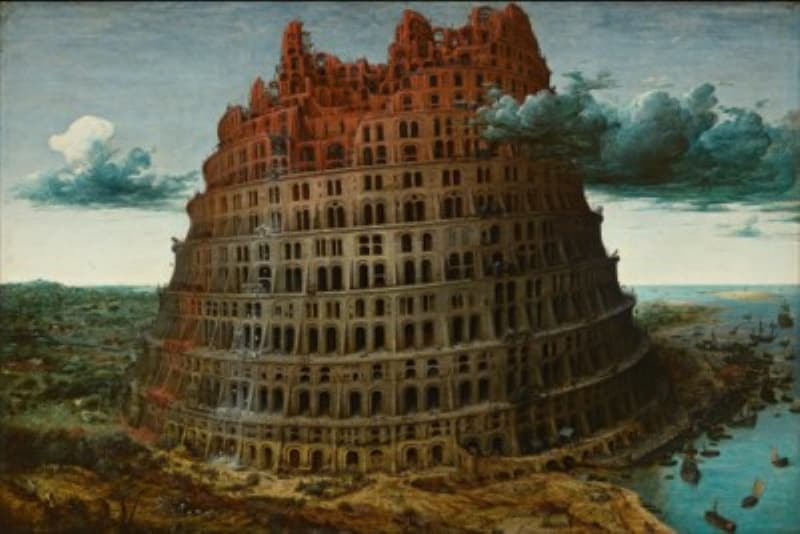
Pieter Bruegel the Elder, c. 1565, public domain
Why does the Emissary’s reign feel like a theft? Because the world contains a vast reservoir of knowledge that is contextual, embodied, and resistant to explicit articulation—what the philosopher Michael Polanyi called “tacit knowledge.”34 The master craftsman knows how to shape the wood, but cannot fully verbalize the micro-adjustments of hand and eye. The experienced nurse senses the patient’s decline before any vital sign confirms it. We know more than we can tell.
When institutions demand explicit justifications for every decision, when promotion depends on quantifiable outputs, when algorithms require legible inputs, this tacit dimension is not merely ignored; it is actively punished. People learn to speak in metric-language, then to think in metric-language, and eventually the capacity for judgment atrophies. The theft of judgment is not a conspiracy; it is the slow, systemic consequence of a world that treats the uncodified as unreal.
The philosopher René Girard argued that human desire is fundamentally mimetic—we do not want objects for their intrinsic qualities; we want them because others want them.35 The algorithm industrializes this mimesis. It does not just measure what is desirable; it manufactures the object of desire by showing us what others desire, then sells our attention to advertisers who profit from the cycle. Desire becomes a copy of a copy before consumption even occurs. The platform is a mimetic engine, and we are its fuel.
Chuck Palahniuk captured the phenomenology of this existence in Fight Club:
“With insomnia, nothing’s real. Everything’s far away. Everything’s a copy of a copy of a copy.”

Film still: Fight Club, 1999, dir. David Fincher / 20th Century Fox
The Quantified Self is the Emissary’s apotheosis. The person who tracks sleep, steps, heart rate, calories, mood, and productivity no longer knows if they feel well; they check if their numbers look good. They have outsourced proprioception to a wristband. The proxy has colonized the interior so completely that the felt body becomes inaccessible without the mediating device.
The content creator undergoes the same transformation: the artist who once made work for its own sake now makes “content” for the algorithm. They study analytics, optimize thumbnails, chase trends. The feedback loop reshapes not just output but how they think. The Emissary has occupied the creative impulse itself.
The algorithm creates a spiritual insomnia. The young person is not interacting with a friend; they are interacting with a digital avatar of a friend, mediated by engagement metrics. They are forced to inhabit a world where their social standing is a public score, constantly updated in real-time. This is a cognitive nightmare. It strips away the protective ambiguity of natural social life—the merciful not-knowing that allowed previous generations to imagine themselves more loved than they perhaps were.
Sean Parker, the founding president of Facebook, was unusually candid about what his company had built. “God only knows what it’s doing to our children’s brains,” he admitted in a 2017 interview. He described the platform’s core mechanic as a “social-validation feedback loop”—a dopamine-driven cycle of likes, comments, and notifications designed to exploit “a vulnerability in human psychology.” And then the confession: “We understood this… and we did it anyway.”36
Chamath Palihapitiya, Facebook’s former vice president for user growth, was even more direct. The platforms, he said, are “ripping apart the social fabric of how society works.”37
This is not conspiracy. This is incentive. This is Moloch. And critically, the engineers who built these systems were not villains; they were participants in a game where ethical restraint was a competitive disadvantage. If one platform refused to deploy addictive design patterns—infinite scroll, variable reward schedules, algorithmic outrage—it would lose market share to a competitor that did not refuse. Moloch demands addiction. And so addiction is what we got.
V. Darwin’s Wedge: The Treadmill of Defensive Spending
The Emissary’s colonization produces a second Generator Function, distinct from Moloch but equally destructive. The economist Robert Frank has spent a career documenting it, and his provocation is stark: a century from now, if economists are asked to identify the intellectual founder of their discipline, they will name Charles Darwin, not Adam Smith.38
Smith’s invisible hand assumes that individual competition channels self-interest toward collective benefit. Darwin understood something darker: when rewards depend on relative rather than absolute performance, individual rationality and collective welfare can permanently diverge. Frank calls this gap “Darwin’s Wedge”—the systematic divergence between what benefits the individual and what benefits the group.39
Consider the bull elk. Male elks evolved antlers primarily for battling rivals over mating access. From any individual bull’s perspective, larger antlers confer advantage—more wins, more offspring. Natural selection favored larger antlers, generation after generation, until they reached approximately four feet in span. But antlers of this size are a collective catastrophe. When wolves attack, bulls flee into dense woods, where their massive antlers become entangled in branches. They are cornered and killed. The antlers that served each individual in competition now doom the species in survival.
Frank’s thought experiment: if the bulls could vote—if they could all put their hoof on a button and agree to shrink every rack by half—they would have compelling reasons to do so. Each bull would still have the same relative standing in mating competition, but all would be faster, more agile, better able to escape predators. The problem is that no individual bull can unilaterally shrink his antlers without losing mating opportunities. They are trapped.
This is Darwin’s Wedge in nature. Frank’s contribution is to show that it operates with equal force in human economies—and crucially, that most of this ruinous competition has nothing to do with vanity or status display.
This is not Thorstein Veblen’s “conspicuous consumption,” where the nouveau riche flaunt wealth to impress neighbors. Frank’s insight cuts deeper: the spending is defensive, not ostentatious. Families are not trying to show off; they are trying not to fall behind in zero-sum competitions for genuinely scarce resources. They are running to stay in place.
The paradigmatic case is the public school district. American public education is funded largely through local property taxes, creating enormous variation in school quality. The only way to access a good public school is to purchase housing in its catchment area. No one buys a house in a desirable school district to impress anyone; they do it to give their children the education that prior generations received as a matter of course. But the number of seats in good schools is fixed. When top earners bid up housing prices in these districts, middle-class families must stretch further—taking on larger mortgages, commuting from farther away, sacrificing savings—merely to access the same quality of education their parents obtained for less.
The British economist Fred Hirsch identified the underlying logic: “positional goods” are goods whose value depends inherently on scarcity.40 If everyone moves to the good school district, it ceases to be the good school district. Competition for positional goods is zero-sum by definition; the gains of winners come directly from the losses of losers. And unlike material goods, positional goods cannot be expanded through productivity or innovation. We cannot manufacture more “top half of the distribution.”
The result is what Frank calls “expenditure cascades.”41 When top earners increase their spending on positional goods, they shift the frame of reference for those just below them on the income ladder. Those families feel compelled to spend more to maintain their relative position—not their relative status, but their relative access to schools, safety, opportunity. This pressure cascades downward through the entire distribution, forcing middle-class families into a defensive crouch: more debt, longer hours, further commutes, depleted savings. Not to get ahead, but to avoid falling behind.
Elizabeth Warren, before her political career, documented the most devastating cascade of all. In The Two-Income Trap, Warren and her daughter Amelia Tyagi showed that the median two-income family in the early 2000s had less discretionary income than the median single-income family of the 1970s—despite earning significantly more in gross terms.42 Where did the money go? Housing costs consumed much of it, driven by bidding wars for access to good school districts. The “second income” that was supposed to provide security and prosperity was captured to a great extent by positional competition for a fixed supply of desirable neighborhoods.
The tragedy compounds. In the 1970s, a family with one earner had a backup: if that earner lost their job, the other spouse could enter the workforce. Today’s two-income family has no such buffer. Both earners are already running at full capacity just to afford the mortgage. The family is more fragile, more stressed, more time-poor—and yet by every aggregate measure (household income, GDP, labor force participation) they appear more prosperous. The Emissary’s metrics show progress; the territory shows exhaustion.
The same dynamic infects higher education. Jobs that once did not require a bachelor’s degree now routinely ask for one, even where the underlying work has not changed in proportion to the credential demanded.43 The degree may move workers to the front of a queue, but when everyone obtains degrees, no one gains lasting positional advantage. The result is credential inflation, delayed adulthood, and a student-loan burden that stood around $1.6 trillion in late 2024.44 This is the all-pay auction made literal: everyone pays, most lose, and the total resources expended vastly exceed the value of the prize.
And then there is the most visceral form of burned resources: time itself. As housing near employment centers becomes unaffordable, workers commute from ever-greater distances. The average American commute has increased substantially over recent decades; in major metropolitan areas, “super-commutes” of ninety minutes or more have become normalized.45 This is not time spent building, creating, or connecting. It is time extracted from sleep, from family, from life—burned as fuel in the positional engine. No one commutes ninety minutes for status. They do it because they have been priced out of proximity.
The structure of positional competition resembles what game theorists call an “all-pay auction”—a contest in which every bidder must pay their bid regardless of whether they win, while only the highest bidder claims the prize.46 In laboratory experiments, all-pay auctions routinely generate seller revenues two to three times the value of the prize, as bidders systematically overbid in their desperation not to lose what they have already invested. This is the architecture of the positional economy: a system designed to extract maximum effort for minimum collective gain.
There is a deeper pattern here, one that connects Darwin’s Wedge to the erosion of public goods. When public schools were uniformly adequate, no one needed to bid for access. When public transit was reliable, car ownership was optional. When public safety was robust, private security was unnecessary. The retreat from public investment does not reduce spending; it merely shifts it from collective provision (efficient, non-positional) to private competition (wasteful, zero-sum). The commons is enclosed, and what was once free becomes a prize to be fought over.
Darwin’s Wedge is not Moloch, though they are cousins. Moloch describes coordination failures where defection dominates cooperation—the prisoner’s dilemma, the tragedy of the commons. Darwin’s Wedge describes arms races where competition for relative position consumes resources that could otherwise fund absolute improvements. Both are Generator Functions. Both produce outcomes that no individual chose and no individual wants. Both emerge from the Emissary’s regime of narrow optimization.
And both are burning a resource that cannot be easily replaced.
VI. The Ledger of Civilizational Stress
Step back and survey the ledger. The physical infrastructure is decaying; the investment gap stands at $3.7 trillion.47 The biological substrate is faltering; American life expectancy has declined while peer nations recovered.48 The cognitive commons is under assault; teen mental health has collapsed, and the attention economy has engineered a generation of addicts.49 The epistemic infrastructure is corrupted; vast domains of published science cannot be replicated.50 The social capital is evaporating; trust in institutions has fallen to historic lows.51
And at the planetary scale, we are transgressing the boundaries that make civilization possible. A 2023 study in Science Advances found that humanity has now breached six of the nine “planetary boundaries”—the biophysical thresholds within which Earth system stability is maintained. We have crossed safe limits for climate change, biosphere integrity, land-system change, freshwater use, biogeochemical flows, and novel entities (synthetic chemicals and pollutants).52 We are conducting an uncontrolled experiment on the operating system of the planet, and the Emissary’s response is to measure the rate of decline more precisely.
These are not unrelated crises. They are facets of a single, systemic failure: the elevation of abstract metrics over physical and social reality. We have built a civilization that is legible to the Emissary—a civilization that “computes”—while rendering the territory that sustains it increasingly illegible, degraded, and fragile.
The political scientist James C. Scott described this pattern in his classic study Seeing Like a State.53 The high-modernist state, Scott argued, sought to render society “legible” through simplification—standardized names, cadastral surveys, planned cities, monoculture agriculture. In each case, the local, tacit knowledge of communities was replaced with an abstract grid that could be managed from a central office. And in each case—from Soviet collectivization to Prussian scientific forestry—the result was catastrophe.
Scott’s parable of the German forest is instructive. In the eighteenth century, Prussian foresters sought to maximize timber yield by replacing complex, biodiverse forests with neat rows of single-species plantations. The forests became legible; they could be measured, managed, optimized. And for a generation, yields increased. But then came the Waldsterben—the “forest death.” The monocultures, stripped of the ecological complexity that sustained them, became vulnerable to disease, pests, and soil depletion. Within a century, timber yields had declined by 20 to 30 percent.54
We are now conducting this experiment at a civilizational scale. We are running Prussian scientific forestry on the entire human project.
VII. The Third Attractor
If the First Attractor is Catastrophe and the Second Attractor is Dystopia, is there a way out? Is there a path that leads neither to the burning of the territory nor to the freezing of the map?
McGilchrist and Schmachtenberger point toward a Third Attractor.55 This is not a return to the agrarian past; we cannot un-invent the nuclear weapon or the algorithm. It is a movement through our current crisis to a higher level of complexity. It is the project of restoring the sovereignty of the Master while retaining the tools of the Emissary.
The remaining essays in this series will attempt to chart that path. We will examine the theology of the trap—the ideology of Market Fundamentalism that has stripped away the guardrails that once held Moloch in check. We will audit the cannibalization of capital—the transformation of the corporation from an engine of production into an engine of extraction. We will document the Trauma Farm in detail—the industries that profit by monetizing human fragility. We will excavate the myth of the virgin birth—the hidden history of state-led innovation that the free-market narrative has erased. We will diagnose the paralysis of the Leviathan—the crisis of state capacity that has rendered government incapable of coordinating at the scale required. And we will outline the engineering requirements for the Third Attractor—the institutions, incentives, and missions that could make the collective good the rational individual choice.
But before we can build, we must see. We must recover the capacity for attention that the Emissary has colonized. We must remember that the map is not the territory, that the metric is not the meaning, that the token is not the thing.
The ghost towers stand as monuments to our confusion. They are not failures of the system; they are the system working exactly as designed. The ghosts are us—the people who should have lived there, the communities that should have formed, the children who should have been born. The ghosts are the nurses priced out to hour-long commutes, the teachers who left the profession, the workers who will never afford a home in the city whose prosperity they helped nourish.
The whales swim on, oblivious to their two-million-dollar price tags. In the deep, they are still whales—not carbon sinks, not financial instruments, not tokens on a spreadsheet. They are creatures of blood and breath, of alien intelligence and ancient lineage, members of a biosphere that we are rapidly making uninhabitable.
The question before us is not whether we will be governed by metrics. We will be. The Emissary’s tools are too powerful to abandon. The question is whether the Master will return to the throne—whether we will remember that the purpose of the map is to navigate the territory, not to replace it.
The drunkard is still searching under the streetlight. The keys are still in the dark. The task of this series is to grope our way toward them.
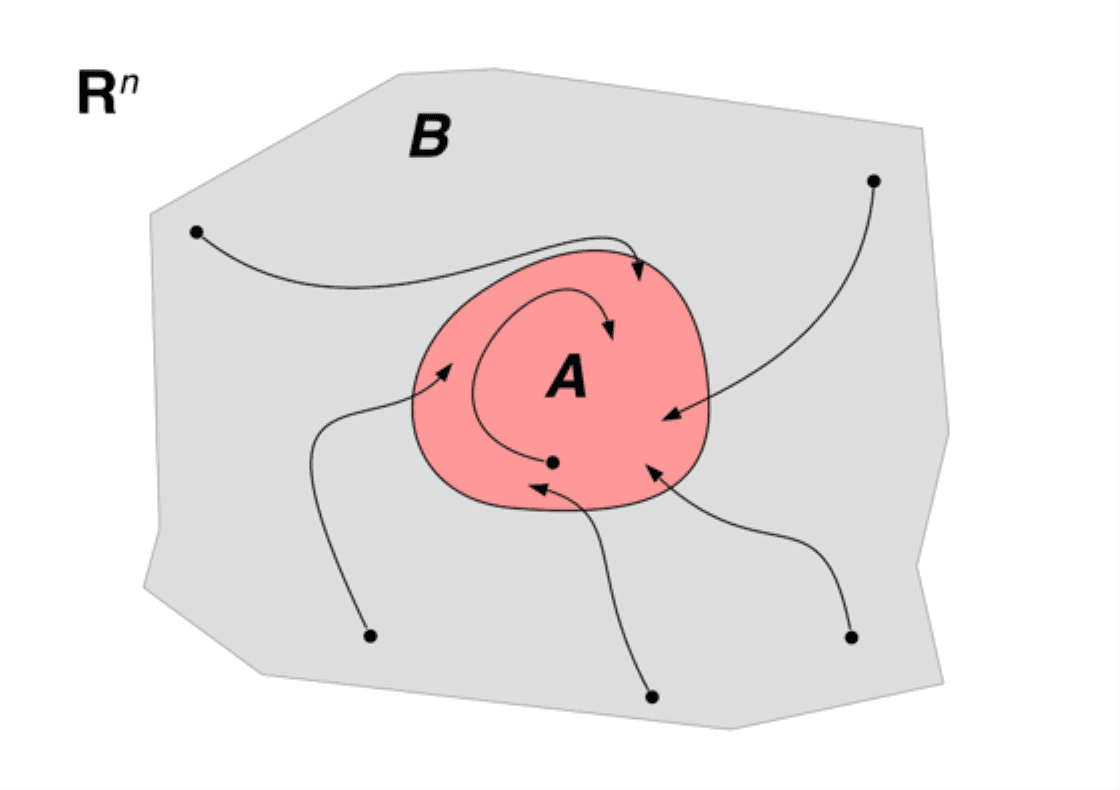
Diagram of an attractor sitting inside a basin of attraction
Source: Yapparina, Wikimedia Commons, CC0
[1] Story, L., & Saul, S. (2015). “Stream of Foreign Wealth Flows to Elite New York Real Estate.” The New York Times. See also: Bagli, C. V. (2017). “A Tower of Luxury and Secrecy on 57th Street.” The New York Times. ↩
[2] Gibson, W. (2003). Pattern Recognition. G. P. Putnam’s Sons.↩
[3] Chami, R., Cosimano, T., Fullenkamp, C., & Oztosun, S. (2019). “Nature’s Solution to Climate Change.” Finance & Development, International Monetary Fund.↩
[4] MacKenzie, D. (2006). An Engine, Not a Camera: How Financial Models Shape Markets. MIT Press.↩
[5] Strathern, M. (1997). “‘Improving ratings’: audit in the British University system.” European Review, 5(3), 305-321.↩
[6] Campbell, D. T. (1979). “Assessing the impact of planned social change.” Evaluation and Program Planning, 2(1), 67-90.↩
[7] World Bank. (2024). “GDP (current US$).” World Development Indicators.↩
[8] Bornmann, L., & Mutz, R. (2015). “Growth rates of modern science: A bibliometric analysis based on the number of publications and cited references.” Journal of the Association for Information Science and Technology, 66(11), 2215-2222.↩
[9] McGilchrist, I. (2009). The Master and His Emissary: The Divided Brain and the Making of the Western World. Yale University Press.↩
[10] McGilchrist, I. (2021). The Matter with Things: Our Brains, Our Delusions, and the Unmaking of the World. Perspectiva Press. See also McGilchrist’s published extract, “Rethinking Some Assumptions,” for the whole/parts formulation.↩
[11] McGilchrist, I. (2009). The Master and His Emissary: The Divided Brain and the Making of the Western World. Yale University Press; McGilchrist, I. (2021). The Matter with Things. Perspectiva Press.↩
[12] McGilchrist, I. (2021). The Matter with Things. Perspectiva Press, epilogue, pp. 1310, 1314-1315.↩
[13] American Society of Civil Engineers. (2025). 2025 Report Card for America’s Infrastructure. ASCE reported an overall grade of “C” in 2025, up from “C-” in 2021, and estimated a $3.7 trillion investment gap.↩
[14] American Society of Civil Engineers. (2025). 2025 Report Card for America’s Infrastructure. See also American Water Works Association materials on water infrastructure; ASCE reports frequent water-main breaks and daily losses of approximately 6 billion gallons of treated water.↩
[15] Arias, E., Tejada-Vera, B., Kochanek, K. D., & Ahmad, F. B. (2022). “Provisional Life Expectancy Estimates for 2021.” NVSS Vital Statistics Rapid Release, Report No. 023. National Center for Health Statistics, CDC.↩
[16] Xu, J., Murphy, S. L., Kochanek, K. D., & Arias, E. (2026). “Mortality in the United States, 2024.” NCHS Data Brief No. 548. National Center for Health Statistics, CDC.↩
[17] Organisation for Economic Co-operation and Development. (2025). Health at a Glance 2025: United States Country Note. See also: Commonwealth Fund. (2024). Mirror, Mirror 2024: A Portrait of the Failing U.S. Health System.↩
[18] Himmelstein, D. U., Campbell, T., & Woolhandler, S. (2020). “Health Care Administrative Costs in the United States and Canada, 2017.” Annals of Internal Medicine, 172(2), 134-142.↩
[19] Sinsky, C., Colligan, L., Li, L., et al. (2016). “Allocation of Physician Time in Ambulatory Practice: A Time and Motion Study in 4 Specialties.” Annals of Internal Medicine, 165(11), 753-760.↩
[20] Melnick, E. R., Dyrbye, L. N., Sinsky, C. A., et al. (2020). “The Association Between Perceived Electronic Health Record Usability and Professional Burnout Among US Physicians.” Mayo Clinic Proceedings, 95(3), 476-487.↩
[21] Montague, E., & Asan, O. (2014). “Dynamic modeling of patient and physician eye gaze to understand the effects of electronic health records on doctor–patient communication and attention.” International Journal of Medical Informatics, 83(3), 225-234.↩
[22] Zuckerman, R. B., Sheingold, S. H., Orav, E. J., Ruhter, J., & Epstein, A. M. (2016). “Readmissions, Observation, and the Hospital Readmissions Reduction Program.” New England Journal of Medicine, 374(16), 1543-1551.↩
[23] Wadhera, R. K., Joynt Maddox, K. E., Wasfy, J. H., Haneuse, S., Shen, C., & Yeh, R. W. (2018). “Association of the Hospital Readmissions Reduction Program with Mortality among Medicare Beneficiaries Hospitalized for Heart Failure, Acute Myocardial Infarction, and Pneumonia.” JAMA, 320(24), 2542-2552.↩
[24] Centers for Disease Control and Prevention. (2024). “Youth Risk Behavior Survey Data Summary & Trends Report: 2013–2023.” Division of Adolescent and School Health.↩
[25] Centers for Disease Control and Prevention. (2024). “Mental Health and Suicide Risk Among High School Students and Protective Factors—Youth Risk Behavior Survey, United States, 2023.” MMWR Supplements, 73(4), 79-86.↩
[26] Haidt, J. (2024). The Anxious Generation: How the Great Rewiring of Childhood is Causing an Epidemic of Mental Illness. Penguin Press.↩
[27] Schmachtenberger, D. (2017). “Solving the Generator Functions of Existential Risk.” Neurohacker Collective. See also: Schmachtenberger, D. (2022). “The Metacrisis.” The Consilience Project.↩
[28] Ginsberg, A. (1956). Howl and Other Poems. City Lights Books.↩
[29] Alexander, S. (2014). “Meditations on Moloch.” Slate Star Codex.↩
[30] Perrigo, B. (2023). “Exclusive: OpenAI Used Kenyan Workers on Less Than $2 Per Hour to Make ChatGPT Less Toxic.” TIME.↩
[31] Bloom, B. S. (1984). “The 2 Sigma Problem: The Search for Methods of Group Instruction as Effective as One-to-One Tutoring.” Educational Researcher, 13(6), 4-16.↩
[32] Head, M. L., Holman, L., Lanfear, R., Kahn, A. T., & Jennions, M. D. (2015). “The Extent and Consequences of P-Hacking in Science.” PLOS Biology, 13(3), e1002106.↩
[33] Open Science Collaboration. (2015). “Estimating the reproducibility of psychological science.” Science, 349(6251), aac4716.↩
[34] Polanyi, M. (1966). The Tacit Dimension. University of Chicago Press.↩
[35] Girard, R. (1961). Deceit, Desire, and the Novel: Self and Other in Literary Structure. Johns Hopkins University Press.↩
[36] Allen, M. (2017). “Sean Parker unloads on Facebook: ‘God only knows what it’s doing to our children’s brains.’” Axios.↩
[37] Wong, J. C. (2017). “Former Facebook executive: social media is ripping society apart.” The Guardian.↩
[38] Frank, R. H. (2011). The Darwin Economy: Liberty, Competition, and the Common Good. Princeton University Press. Frank predicts that “a century from now, if economists are asked to identify the intellectual founder of their discipline… they will name Charles Darwin.”↩
[39] Frank, R. H. (2011). The Darwin Economy: Liberty, Competition, and the Common Good. Princeton University Press. Frank defines “Darwin’s Wedge” as the systematic divergence between individual and collective interest in competitive contexts.↩
[40] Hirsch, F. (1976). Social Limits to Growth. London: Routledge & Kegan Paul. Hirsch introduced the concept of “positional goods” whose value depends inherently on scarcity.↩
[41] Levine, A. S., Frank, R. H., & Dijk, O. (2014). “Expenditure Cascades.” Review of Behavioral Economics, 1(1-2), 55-73.↩
[42] Warren, E., & Tyagi, A. W. (2003). The Two-Income Trap: Why Middle-Class Mothers and Fathers Are Going Broke. Basic Books. Warren documents that median two-income families in the early 2000s had less discretionary income than single-income families of the 1970s, with the difference captured by housing costs in desirable school districts.↩
[43] Fuller, J. B., Raman, M., Sage-Gavin, E., & Hines, K. (2017). Dismissed by Degrees: How Degree Inflation Is Undermining U.S. Competitiveness and Hurting America’s Middle Class. Harvard Business School, Accenture, and Grads of Life.↩
[44] Federal Reserve Bank of New York. (2025). Quarterly Report on Household Debt and Credit: 2024 Q4. The report placed outstanding student loan debt at approximately $1.62 trillion at the end of 2024.↩
[45] U.S. Census Bureau. (2023). “Commuting Characteristics by Sex.” American Community Survey. See also: Kneebone, E., & Holmes, N. (2015). “The Growing Distance Between People and Jobs in Metropolitan America.” Brookings Institution.↩
[46] Gneezy, U., & Smorodinsky, R. (2006). “All-Pay Auctions—An Experimental Study.” Journal of Economic Behavior & Organization, 61(2), 255-275.↩
[47] American Society of Civil Engineers. (2025). 2025 Report Card for America’s Infrastructure. ASCE estimated a $3.7 trillion infrastructure investment gap.↩
[48] Arias, E., Tejada-Vera, B., Kochanek, K. D., & Ahmad, F. B. (2022). “Provisional Life Expectancy Estimates for 2021.” NVSS Vital Statistics Rapid Release, Report No. 023. National Center for Health Statistics, CDC. See also OECD and Commonwealth Fund comparisons of U.S. health outcomes among high-income countries.↩
[49] Centers for Disease Control and Prevention. (2024). “Youth Risk Behavior Survey Data Summary & Trends Report: 2013-2023.” Division of Adolescent and School Health. See also Haidt, J. (2024). The Anxious Generation.↩
[50] Open Science Collaboration. (2015). “Estimating the reproducibility of psychological science.” Science, 349(6251), aac4716.↩
[51] Pew Research Center. (2024). “Americans’ Trust in Federal Government and Attitudes Toward It.” June 24, 2024. See also Gallup. (2024). “U.S. Confidence in Institutions Mostly Flat, but Police Up.” July 15, 2024.↩
[52] Richardson, K., Steffen, W., Lucht, W., et al. (2023). “Earth beyond six of nine planetary boundaries.” Science Advances, 9(37), eadh2458.↩
[53] Scott, J. C. (1998). Seeing Like a State: How Certain Schemes to Improve the Human Condition Have Failed. Yale University Press.↩
[54] Scott, J. C. (1998). Seeing Like a State: How Certain Schemes to Improve the Human Condition Have Failed. Yale University Press. See also: Lowood, H. E. (1990). “The Calculating Forester: Quantification, Cameral Science, and the Emergence of Scientific Forestry Management in Germany.” In The Quantifying Spirit in the 18th Century, edited by T. Frängsmyr, J. L. Heilbron, and R. E. Rider. University of California Press.↩
[55] Schmachtenberger, D. (2022). “In Search of the Third Attractor.” Consilience Project.↩