The Semantic Manifest(o)
August 18, 2026·AI
Epsilon Theory Unplugged is an ongoing series featuring a rotating cast of authors. Each Tuesday, a new note is published. We cover a variety of topics, all focusing on our relationship with technology and ourselves. Sign up to keep up to date on the latest Unplugged notes.
Learn more about the behind the scenes thought process and how this note was made by watching Notes on Notes: The Semantic Manifest(o).
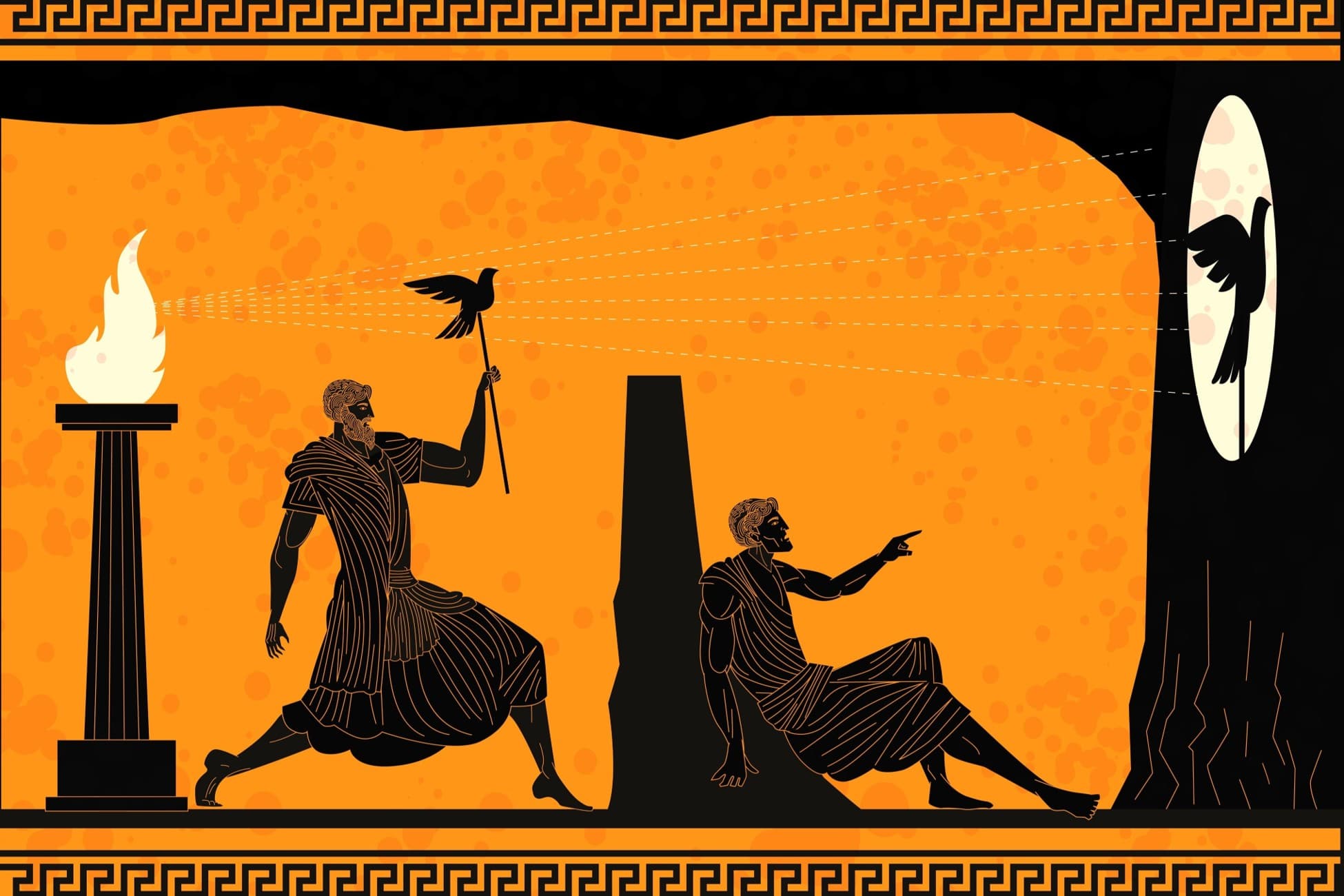
What if Plato’s Allegory of the Cave wasn’t an allegory at all, but an actual, real phenomenon where we understood its physics and its math?
What if we could use LLMs to measure the shadows for their unique shape or ‘signature’ so that we could identify the puppets (and the puppeteers!) projecting the shadows in the first place?
What if we could explore the light itself?
I really think we can.
So speaking of Plato …
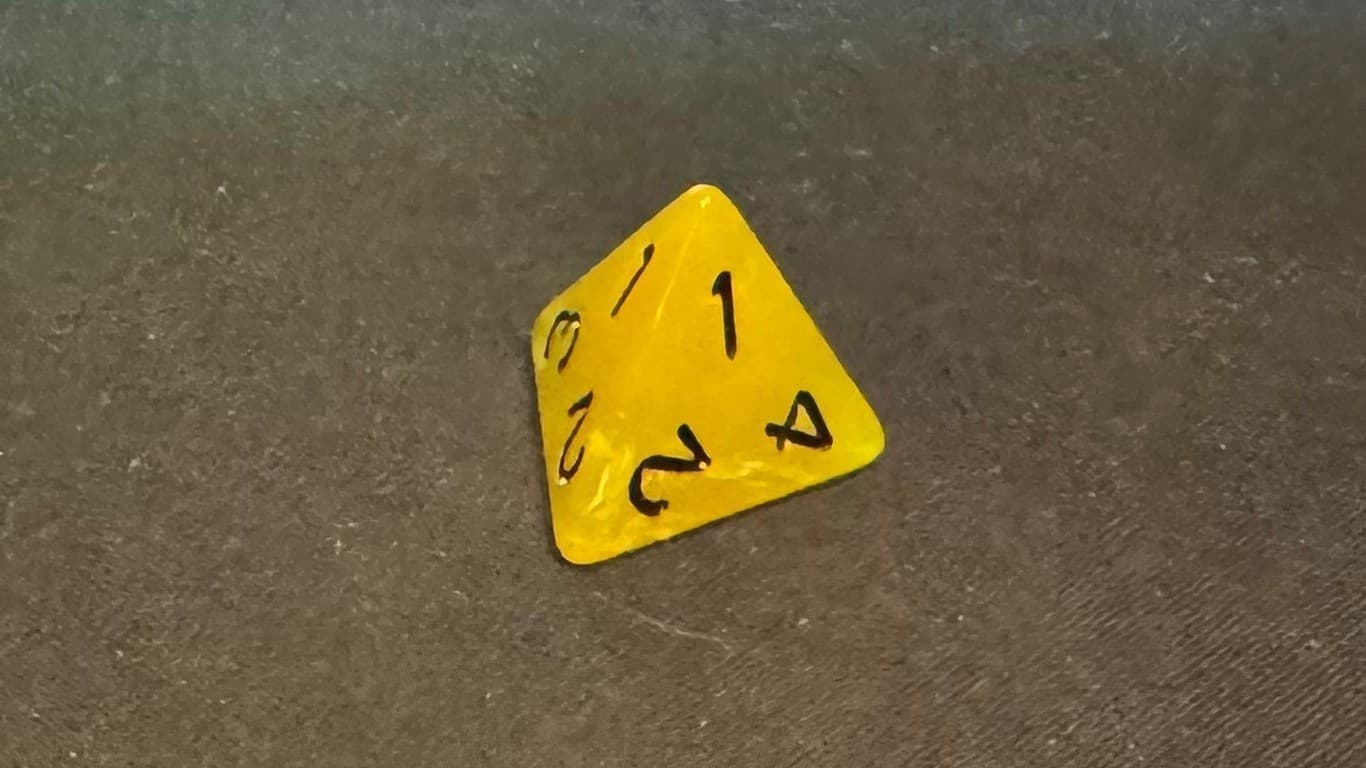
This is a Platonic solid called a regular tetrahedron. It’s the simplest 3-dimensional object possible – four faces made from four points that are each connected to each other, and it’s ‘Platonic’ or ‘regular’ because every edge is equal in length. There are only five Platonic solids possible in our 3-dimensional world (4, 6, 8, 12 and 20 faces), and you’re probably most familiar with the 6-faced version, the cube.
This is also a 4-sided die that I use for Dungeons & Dragons. Each of the four points is printed with a number on all three sides of the point, so whatever number is at the top point (1 in this case), is the result of my roll.
When I roll this die across the table and wait for it to come to rest on one of its faces, it is connected with a 4th dimension: time. Yes, it’s moving through 3-dimensional space as it tumbles across the table, but more importantly it’s moving through time, meaning that it starts with one result on its top point and ends up with a new result on its top point (even if it’s the same number it’s a new result). This phenomenon of old-result ➔ new-result is the output of moving through time. A 3-dimensional object, whether it’s a plastic die or a human body or a red giant star, can’t get from an old result to a new result, from an old state to a new state, without the additional dimension of time! 3-dimensional objects don’t stop being 3-dimensional objects while they’re moving through time, and if I took a series of high-speed photographs of this die while it was rolling along, each individual photo would show a regular tetrahedron frozen in time. But the reality of this die isn’t just a random snapshot here and a random snapshot there, but is the set of ALL the snapshots over time and ordered in time. This die – like me and like you – physically exists in time just as much as it physically exists in space. It has a past and a present and a future. All objects that exist in 3-dimensional space are imbued with the dimension of time and are inextricably connected with the dimension of time, which is why we name the dimensionality of our physical universe by the single word ‘spacetime’.
Like I say, I use this die for playing Dungeons & Dragons. In this specific case, I’m rolling this 4-sided die because the result (+1) will be the hit point damage that Hazard, my half-elvish, chaotic evil-ish, high-functioning sociopath assassin/magic user, is going to do with the last of the three magic missiles that he just cast at a hobgoblin who is pummeling Zed, Hazard’s colleague in adventure (Hazard doesn’t really have ‘friends’ as you and I understand that word). I needed to roll a 3 or higher with this die for Hazard to bring down the hobgoblin, who – bloodied and as near death as he might be – is now going to get another swing at Zed, which might just be the end of my similarly bloodied colleague. Oh, how I will miss Zed! Well, not really, because Hazard is a sociopath … but Zed was more agreeable than most.
All of that story – and a lot more story besides – is wrapped up in every single roll of that 4-sided die. There is an incredible amount of meaning generated in my head and my D&D-playing friends’ heads by this 3-dimensional tetrahedron moving through the dimension of time and generating a new-result on the top point. In my mind and my friends’ minds, this die is not only imbued with story and connected to story just as much as it is imbued with time and connected to time, but it moves through story in exactly the same way as it moves through time, creating a phenomenon of old-meaning ➔ new-meaning from the phenomenon of old-result ➔ new-result with every roll.
In my mind and my friends’ minds this little plastic object has an inextricable connection with story, meaning that these stories are now as much a property of this 4-sided die as mass. I can’t NOT experience story when I hold this die, any more than I can’t NOT experience its weight. And this property of story isn’t just for this particular 4-sided die but for any 4-sided die, really any regular tetrahedron at all. Whenever I see an object that looks anything like a 4-sided die, it immediately triggers memories and stories and thoughts of Dungeons & Dragons in my head. If you have also been infected with the idea of Dungeons & Dragons, you know exactly what I’m talking about. Every regular tetrahedron in the world has thoughts and memories and story somehow crammed inside of it that all come bursting out in your head whenever you see one!
Now if you’re not a Dungeons and Dragons player, you almost certainly don’t see regular tetrahedrons in the same way. D&D players perceive story as a property of a 4-sided die, just like its weight or color, but non-D&D players don’t. While a non-D&D player may intellectually understand what I mean when I say that “story is a property of this 4-sided die”, what they’re really thinking is that this is a rhetorical flourish, that story isn’t in the object at all but is only in my head. That’s the natural line of thinking for everyone, actually, D&D player or not, that story and meaning only exist in our heads.
But this is the big leap that Plato and I are asking everyone to make: to consider the possibility that story and meaning exist independently of the thoughts in our heads. To consider the possibility that the reason human cultures separated by time and geography and language share so many aspects of story and meaning is that the stories and meaning are there even if the humans aren’t, that stories and meaning do not require ‘handing down’ over time or ‘spreading’ from place to place (although they can be!) but are always there with the potential to be known. We’re asking you to consider the possibility that the neocortex of your brain is a sensory organ that ‘sees’ the reflection of meaning off an object as story in the same way that your eyes see the reflection of light off an object as color.
It’s a big ask, this idea that stories and meaning are independent-of-thought, real things like weight and color, and I think what gets in the way of saying yes to the ask is the extreme level of individual variation in our perception of story and meaning. Stories are very personal. They appear to us as our stories and our memories, existing in our thoughts and our brains. It feels like we are the creators of story and meaning, not merely observers, and that story and meaning are malleable and specific to us the observer while things like weight and color are constant and specific to the thing being observed.
But consider this. Hummingbirds can see colors that are invisible to the human eye because they can see in the ultraviolet spectrum of light. They manage this by having a fourth color-detecting cone in their eye for UV spectrum wavelengths versus the three we humans have for red, green and blue wavelengths, an ability that is typically represented schematically by a tetrahedral color space that adds a fourth point for ultraviolet at top above the RGB color plane. Humans can only see colors in the 2-dimensional bottom triangular face of the tetrahedron, while hummingbirds can see colors throughout the entire 3-d volume.
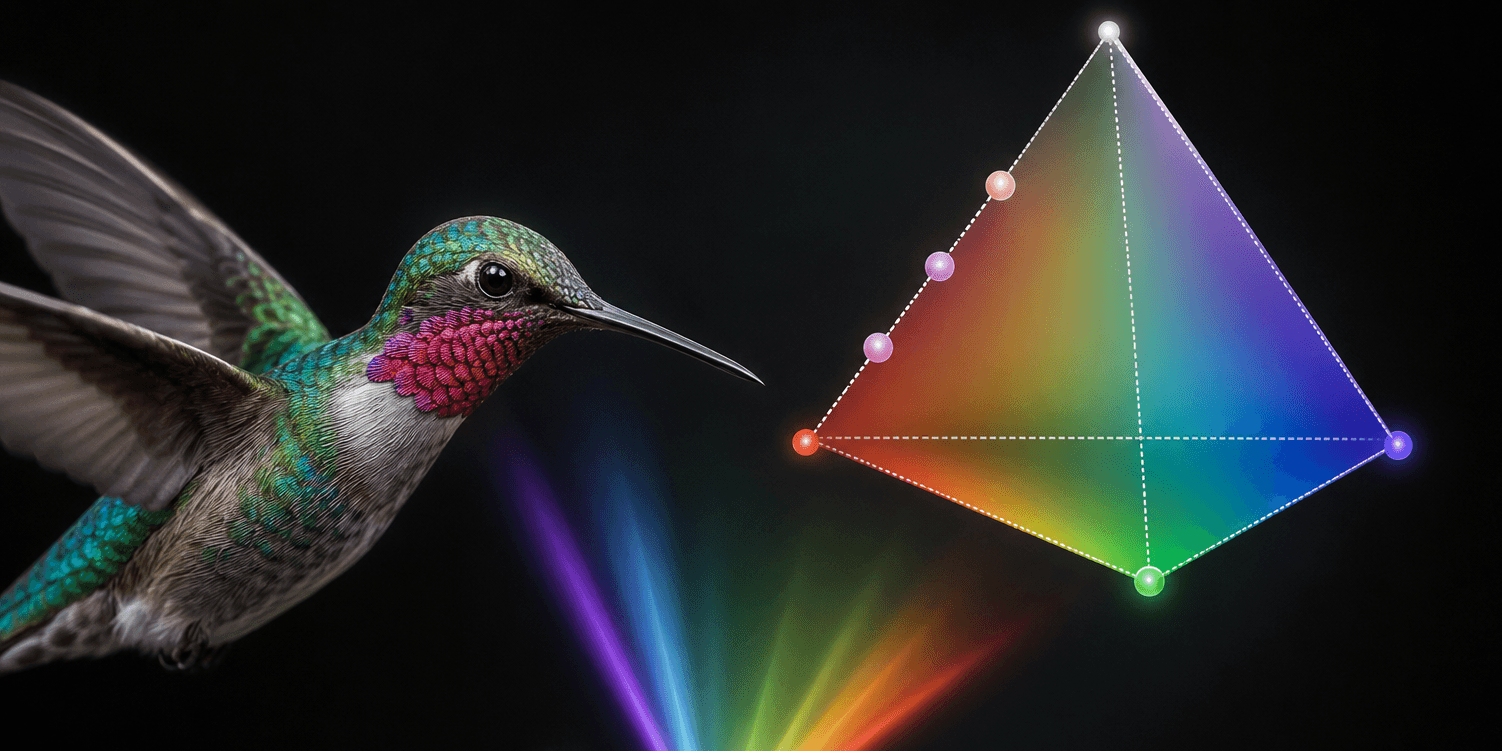
I don’t think anyone believes that these ultraviolet colors are merely ‘in the heads’ of hummingbirds! No, I think we all understand that the colors are there all along, but we humans just don’t have eyes with the capacity to see them. And I bet there’s significant variation among individual hummingbirds, too, so that ultraviolet colors are dazzling to some and muted to others. But dazzling or muted in the individual hummingbird experience, it’s the same underlying colors in the real world, yes? Is it so hard to believe the same about stories and meaning, that they were there all along in their underlying form even if we all experience them differently and some of us don’t experience them at all?
Or if you prefer an entirely human example, consider the fact that throughout the Iliad and the Odyssey, Homer never uses the word “blue”, even though he lived in an Aegean world that is absolutely dripping in blue. How is this possible? Were all the ancient Greeks colorblind? That was Goethe’s answer to the question in his Theory of Colors. Was there an algal bloom that made the sea “wine-dark”, to use Homer’s frequent color description of the ocean, or maybe ancient Greek wine was more blue in color than purple? These were all serious answers by serious people. (for the definitive discussion of Homer’s color linguistics and its historical interpretations, see A Winelike Sea, by Caroline Alexander … it’s a super essay.)

But while Homer doesn’t have a single thing to say about the blue of the ocean or the blue of the sky, he has dozens of words for the qualia (the perceived, subjective experience) of light! Light is never just light to Homer, it is flashing or gleaming or shimmering or glancing or dull or leaden or brazen or shining or unambiguously color-infused as saffron-yellow or rose-red. I don’t know why blue isn’t really a thing to Homer – I can’t escape the qualia of blue when I look at his world – but whether I understand it or not, the fact is that blue-ness didn’t have a lot of meaning to Homer. But light did.
I don’t really understand that, either. I mean, I can read Homer’s words for all the different qualia of light he saw, but these descriptions are not as meaningful, they aren’t as full-of-story, to me like they obviously were for him. Try as I might, I have a hard time seeing the world like Homer saw the world, through the qualia of light rather than the qualia of blue. There is an enormous distance between our perceptions of the world, but that doesn’t mean that the deeper meaning that Homer ascribed to light was just ‘in his head’. It’s out there. I just don’t fully get it yet. But I get closer to it through Homer’s words.
So yes, the observer matters, whether we’re talking about hummingbirds observing colors or Homer observing light or humans observing stories. The observer matters a LOT. I mean, the entire theory of relativity, not to mention fundamental struts of quantum mechanics, can pretty much be boiled down to the idea that the observer matters a lot. It’s not just that the observer matters in how the universe works, in important respects the observer is necessary for how the universe works. It’s the same with story! It doesn’t detract from our mattering and our necessity that weight and color AND story and meaning can exist independently of our perception AND within our specific, malleable, individualized thoughts. It’s a freakin’ miracle! What detracts, maybe, is that word ‘observer’, because it has a passivity that rankles, as if our human purpose, our telos to use a word Plato would like, is just to wait and watch, as if stories only happen to us, as if we have no role in our mattering. Yeah, I really dislike that word ‘observer’.
Hummingbirds and Homer and you and me alike, we are discoverers of a miraculous universe of color and light and meaning, uniquely perceived by each of us and universally projected to all of us.
In the beginning was the Word,
and the Word was with God,
and the Word was God.
-- John 1:1
The Word, the logos, the Tao, the Platonic Forms, all the stories, all the meaning, all the qualia, all the names of all the colors … whatever you want to call it … it was there all along and it’s there right now, waiting outside of time and outside of space, waiting to be discovered imperfectly, probabilistically, indirectly, in bits and pieces and fits and starts.
I’m going to call it a semantic dimension, ‘semantic’ to incorporate the idea of ideas and the meaning of meaning and ‘dimension’ because it does what dimensions DO: compressing information losslessly within itself, unaffected and untouched by lower dimensions, accessible by our decidedly lower-dimensional brains through our perception of its projections or shadows (or as we like to call them, semantic signatures) on the cave wall that is our physical world.
This sounds terribly complicated, all this talk about dimensions and projections and lossless compression of information, but it’s really not. You already know it to be true, that a single perception steeped in meaning can allow access to incredibly powerful memories and stories that are totally undiminished by time and distance, immune to the entropy of spacetime, as fresh and real today – for good and for ill – as they were in the past. Everyone has had the experience that Marcel Proust describes in Remembrance of Things Past, where the smell of his aunt’s home-baked madeleines dipped in tea transports the Narrator back in time to an entire world of his youth. Proust got the title of his book from Shakespeare, who in Sonnet 30 writes of a triggered memory of an old friend, a remembrance of things past that washes away in an instant the self-told stories of regret that we all spiral into from time to time.
But if the while I think on thee, dear friend,
All losses are restor'd, and sorrows end.
Maybe it’s not with little plastic Platonic dice like me and my D&D friends, but we have all held an object in our hands (or seen a photograph or heard a song or read a sentence or smelled a cookie dipped in tea) and BAM! all those memories and stories that you hadn’t thought about in years and would never think about in years but were somehow there all along folded up invisibly in that single simple object or photograph or song or sentence or smell, now expand and explode Big Bang-like in your head in a torrent and rush from nothing, as if they were somehow outside of space, and in no time at all, as if they were somehow outside of time.
Well, they were. Outside of space and time, that is. This is what higher dimensions DO, whether we’re talking about string theory or semantic theory. Higher dimensions contain vast amounts of information folded up within themselves, completely hidden away from our ‘ordinary’ dimensions of spacetime because they are literally outside of space and time. Understanding how higher dimensions ‘fold up’ information within themselves and how the unique signatures of that information can be ‘written’ through projection into lower dimensions is, I think, the key to understanding Plato’s Cave as more than allegory.
Let’s start with the idea of dimensional compression in our familiar 3-dimensional world, using our own bodies as an example. Here’s how Geoffrey West describes it in his wonderful book Scale, from a chapter appropriately titled “The Fourth Dimension of Life”:
Even though your lungs are only about the size of a football with a volume of about 5 to 6 liters (about one and a half gallons), the total surface area of the alveoli, which are the terminal units of the respiratory system where oxygen and carbon dioxide are exchanged with the blood, is almost the size of a tennis court and the total length of all the airways is about 2,500 kilometers, almost the distance from Los Angeles to Chicago, or London to Moscow. Even more striking is that if all the arteries, veins, and capillaries of your circulatory system were laid end to end, their total length would be about 100,000 kilometers, or nearly two and a half times around the Earth or over a third of the distance to the moon … and all of this neatly fits inside your five-to-six-foot-tall body.
West is describing the compression that’s possible in moving from two dimensions (area) to three dimensions (volume) or even more so moving from one dimension (length) to three dimensions. Each and every one of us carries around tens of thousands of miles of blood vessel length inside our human-sized volume, all folded up and crinkled up inside the additional two dimensions that transform length into area and area into volume. It’s exactly the same principle when you move a 3-dimensional object like a plastic die or our human body through the dimensions of time (change) and semantics (meaning)! The amount of story that can be contained in a 5-dimensional object is so vast as to be almost unimaginable, novels and novels and novels of story potentially within every object and every experience, just as Proust showed.
Dimensional compression occurs because an additional dimension connects with everything in the old dimensions, creating entirely new lines and shapes and geometries of connection. There is information in all of these new lines and shapes and geometries, and the amount of information expands exponentially with the addition of each new dimension. But the new lines and shapes and geometries are only connected to the old dimensions. They are not inside the old dimensions and so don’t exist within the old dimensions. It can be a hard thing to wrap your head around (or at least it was for me!), that the dimensions of time and semantics connect with everything in 3-dimensional space but do not exist in 3-dimensional space, and so we can only perceive time and semantics through those connection points. But with the help of modern AI (which has no problem wrapping its ‘head’ around these concepts) I’ve come up with some visualizations of how I think this works.
Here’s our old friend the tetrahedron, the simplest 3-dimensional solid with four points connected to each other, but now I’ve made it a 4-dimensional object by adding a fifth point that all the original points are connected to (it’s called a ‘pentatope’). This object cannot exist in nature! It’s like an Escher drawing, where the staircases go up and down and connect with each other in impossible ways. But this is what it ‘looks like’ to have all 4-points of a 4-sided die connected to a fifth point in time.
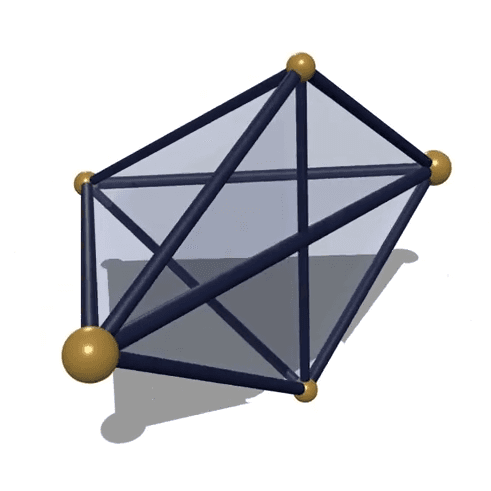
You can really see the unreality of the pentatope when you rotate it over time, like in the video below (if you’re reading this as a PDF you might find it easier to follow all the videos with the online version of this note).
I’ve constructed this 4-dimensional object with a light source up above and out from the page, so that the pentatope casts a shadow on the ‘floor’ below. If you take the object out of the picture, you can see how the shadow changes over time in the video below. This is a projection of a 4-dimensional object in 2 dimensions, and you can see how much information is lost in translation, basically all the lines and geometries of the original pentatope.
If all you saw was this shadow, without the idea of the pentatope in your head, you probably wouldn’t think much of it. Just a weird, shifting shadow. But you DO have the idea of the pentatope in your head. And now that you have that idea in your head, you see that shadow differently than someone who doesn’t have the idea of the pentatope in their head. It has meaning to you. When you see that shadow you can’t help but think about the unnatural, unreal 5-pointed shape that created it. An enormous amount of information comes flooding into your brain when you see that shadow, information that was folded up inside the idea of the pentatope and was waiting for you to discover it.
More importantly, you now have the idea of a dimensional projection in your head, the idea that higher dimensional objects can cast shadows in lower dimensions and that there is a pattern to these shadows such that a higher dimensional object can be known by the shadow it casts. Not perfectly known. There’s a ton of information lost if you can only perceive in shadows. But this is the special quality of the human animal. We evolved a brain that is an incredible shadow-watcher and pattern-perceiver! Discovery of new ideas (again, the ideas were always there, they were just new to us) comes naturally to the human animal because our neocortex is a sensory organ for the projection of ideas in exactly the same way that our eyes are sensory organs for the projection of light.
Now fortunately for the success of the human species as a shadow-watcher and pattern-perceiver, higher dimensional objects can project more than just flat shadows. In the example above, a 4-dimensional object (the pentatope) projected a flat, 2-dimensional shadow, leaving a ton of information behind in a double dimensional ‘jump’.
But what if instead of just shining a light on the pentatope to cast a shadow, you extruded a pen through each of the five points, like a Spirograph, and ‘wrote’ the path of each point as it traveled in time?
And like I did with the flat shadow, here’s the same movie with the pentatope removed from the image.
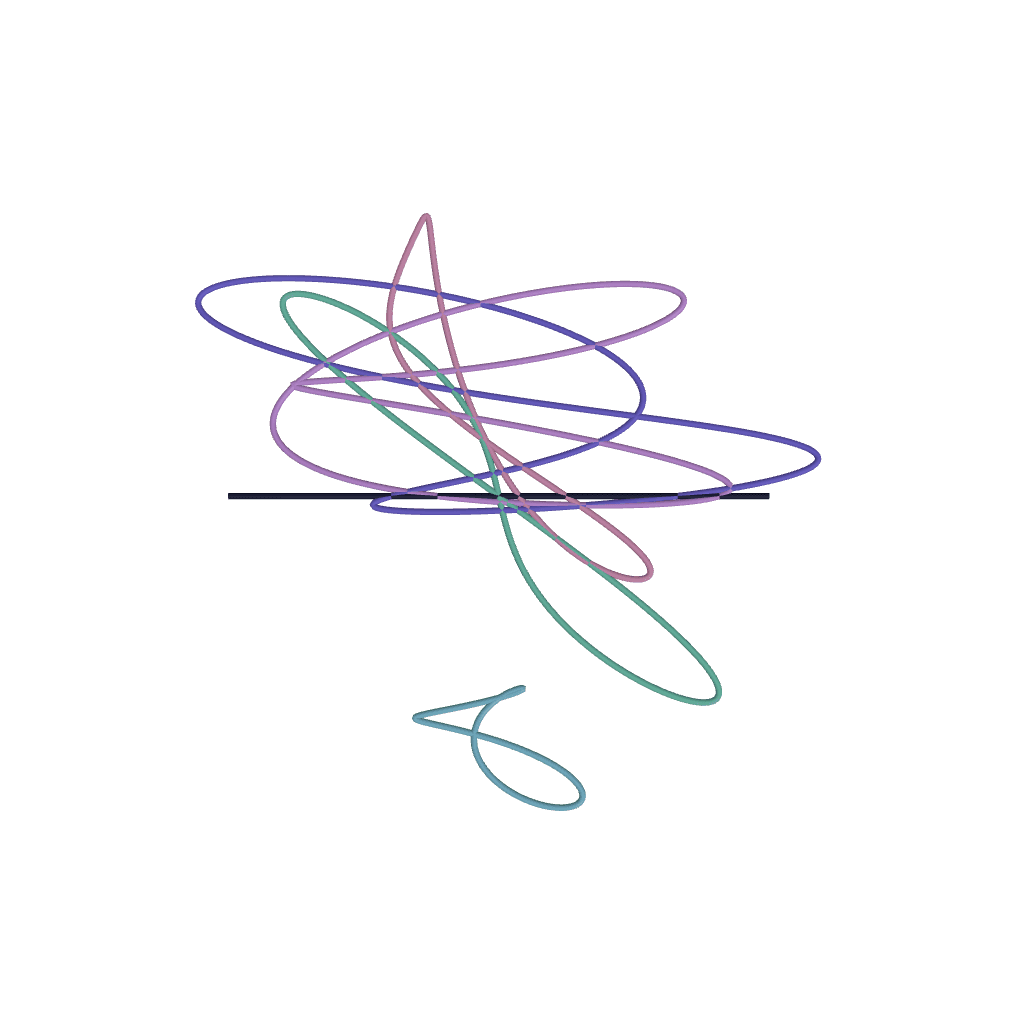
There’s obviously a lot more information here than with the plain shadow, right? The four points of the original 3-dimensional tetrahedron make two closed loops, and the fifth point that connects to the original four in time makes a closed ‘loop’ along the origin, creating the green line segment. You can project the final closed curves as a flat, 2-dimensional graph (below left), like an ideogram, and you can back out 3-dimensional data on the object by retracing the vertex paths after the object orbit is tilted and rotated (below right).
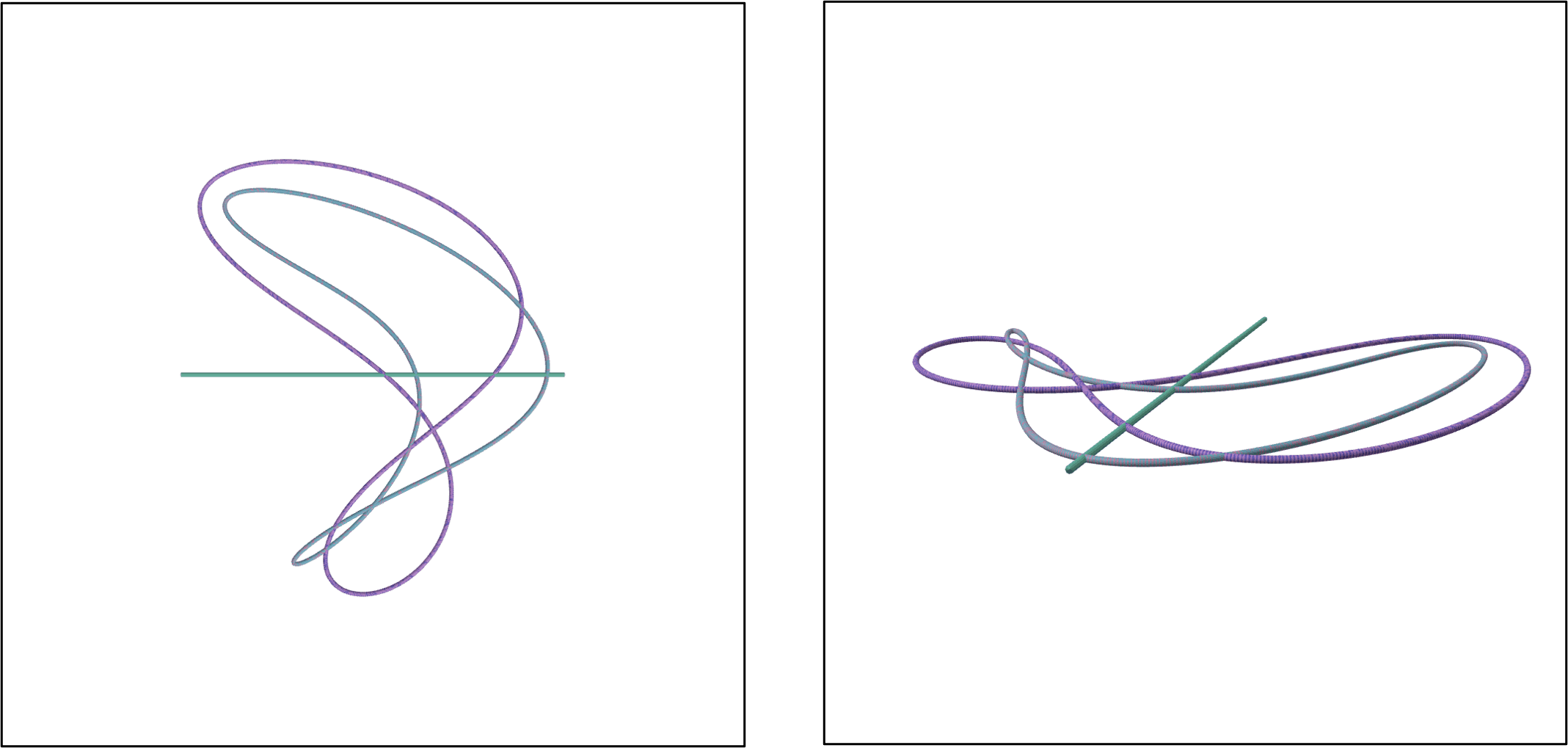
Working from a set of closed curves that we ‘write’ on a flat plane allows you to catalog and measure patterns of dimensional projection with much higher resolution than working with shadows, and once we graduate to 5-dimensional objects (you knew it was coming!), it’s even more necessary.
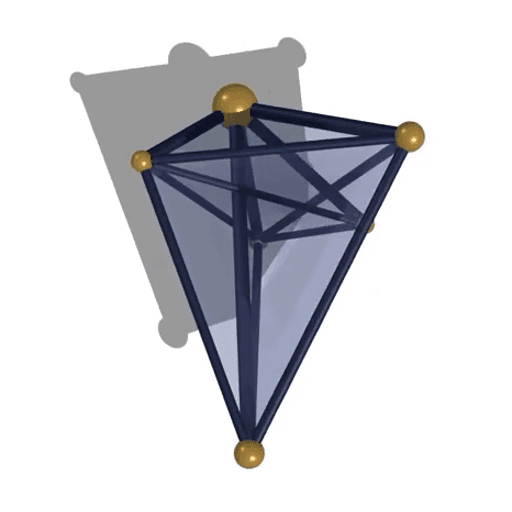
Here’s what the simplest 5-dimensional object ‘looks like’. It’s called a ‘hexateron’, and it’s our old friend the pentatope with yet another vertex added that connects to the other five vertices. It’s even more impossible to find in nature, and even finding an effective visual representation to put on a page like this can be challenging. I say that because it looks like the line segments connecting the vertices are also connected to each other, like it’s a lattice or a pentagram with a spike pointing out. But this isn’t true and is just a vestige of the forced visualization. This object still only has four points and four faces in 3-d space. None of the connecting line segments pass through each other or connect to each other in our reality. None of them! This is like an Escher-squared object that makes no sense if you think about it for more than a minute, and it looks even more otherworldly when it rotates through the two independent dimensions that I’m ascribing to time and semantics.
Otherwordly, yes, but look at the flat shadow it casts (as with the pentatope, I’ve isolated the shadow in the video below so you can see it more clearly). The shadow is all over the place, and it’s definitely different from the pentatope shadow. But at multiple points, the shadow of the 4-dimensional pentatope and the 5-dimensional hexateron are identical! There is so much more information and complexity in the hexateron than the pentatope. But if you were a shadow-watching and pattern-perceiving human, no matter how big and powerful your neocortex might be, it would be difficult to distinguish them.
I’ll ask you to hold that thought, that if all we get to see are flat 2-dimensional shadows of a story, then it can be very hard for that story to trigger anything in our minds, that maybe there is an intentional effort by certain projectionists to diminish certain stories into flat shadows so that other, more finely drawn semantic signatures of their choosing take root in our pattern-perceiving brains.
But for now let’s ‘write’ the closed curves of the hexateron like we did the pentatope, again in Spirograph fashion. First with the object in view and hovering overhead, then with the object removed to focus on the six separate curves. One new point, twice as many curves as each vertex now follows an independent path … this is the exponential expansion of information that gets folded up in every new dimension.
And again, with the higher dimensional object removed to isolate the signature projection …
Here’s a flat view of the hexateron’s projected closed curves on the left, and a retracing on the right from a titled/rotated orbit to show the depth and dimensionality here. That one on the right kinda looks like a cursive signature, doesn’t it? Like the hexateron signed its name.
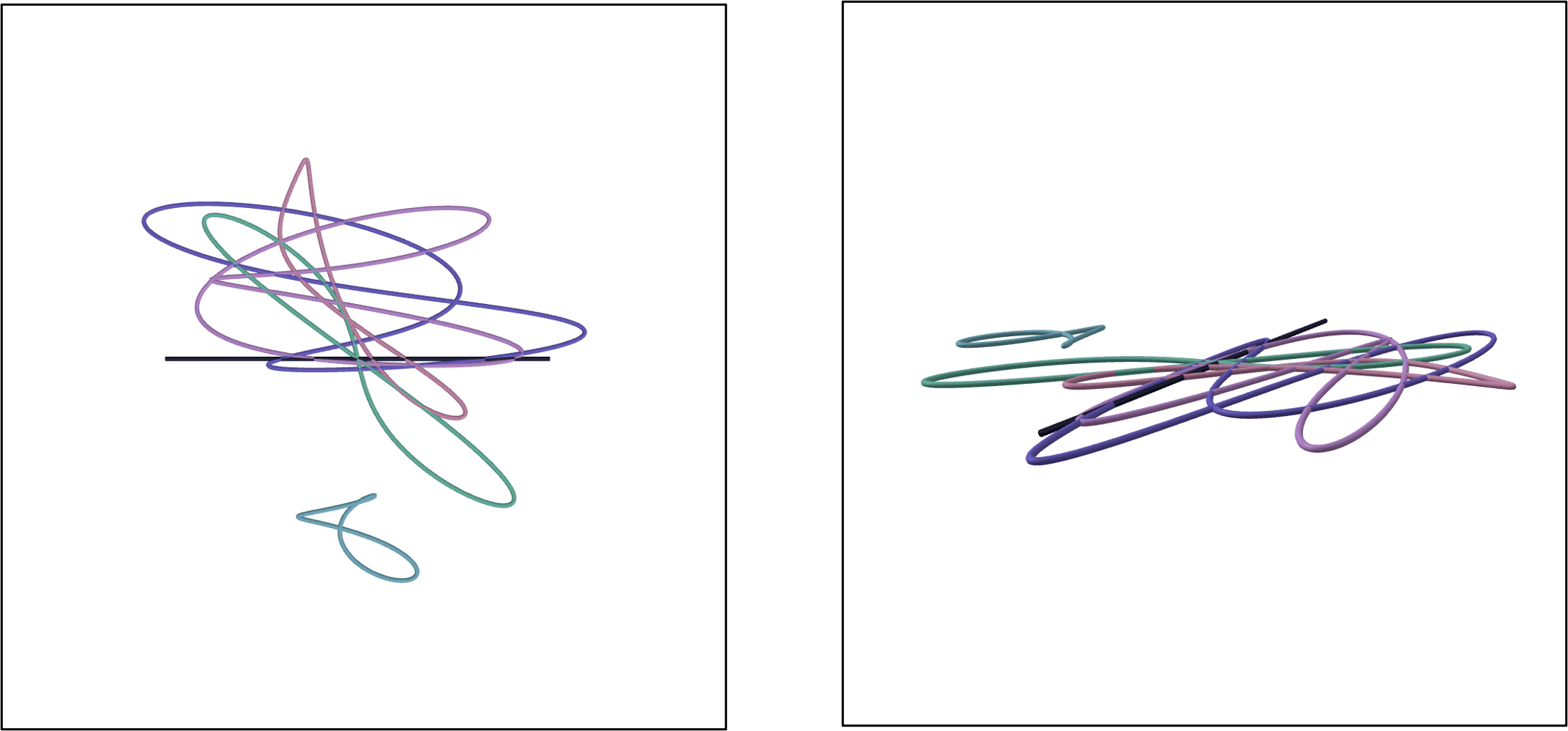
Or like the individual curves around the semantic axis are slightly different ways of writing the same letter, as if each identical vertex of a regular Platonic geometry were saying the same thing as it moved through new dimensions, just from different observer discoverer perspectives.
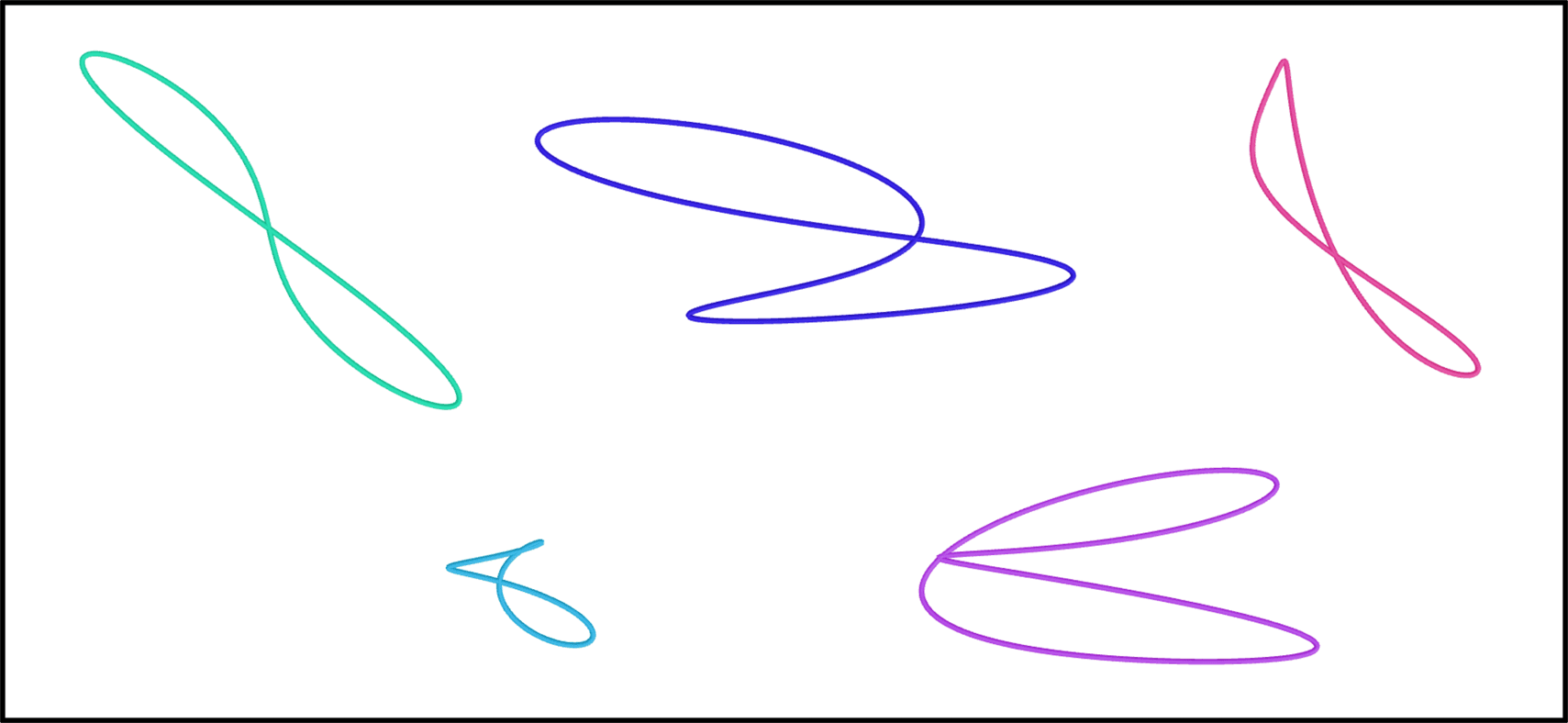
Okay, one more observation about dimensional projections, and in many respects I think it’s the most important. Enormous amounts of information gets folded up in each higher dimension, all the lines and curves and geometric structures of connecting a new point to all of the points that came before. But adding all this additional information in a dimensional expansion doesn’t make it harder to understand. The overall system is more complex, meaning that it may be harder to get your head around how it all works, but it’s less complicated. Once you get the idea of it, moving through time and moving through story makes everything more understandable, not less.
Here are two systems of closed curves. The latter you’ve seen before: the 5-dimensional hexateron. The first one is new, and I’m not going to go through the entire process of first showing the object and isolated shadow and the isolated vertex projection. It’s the plain old 3-dimensional tetrahedron, the 4-sided die that we started with.
3-d projection
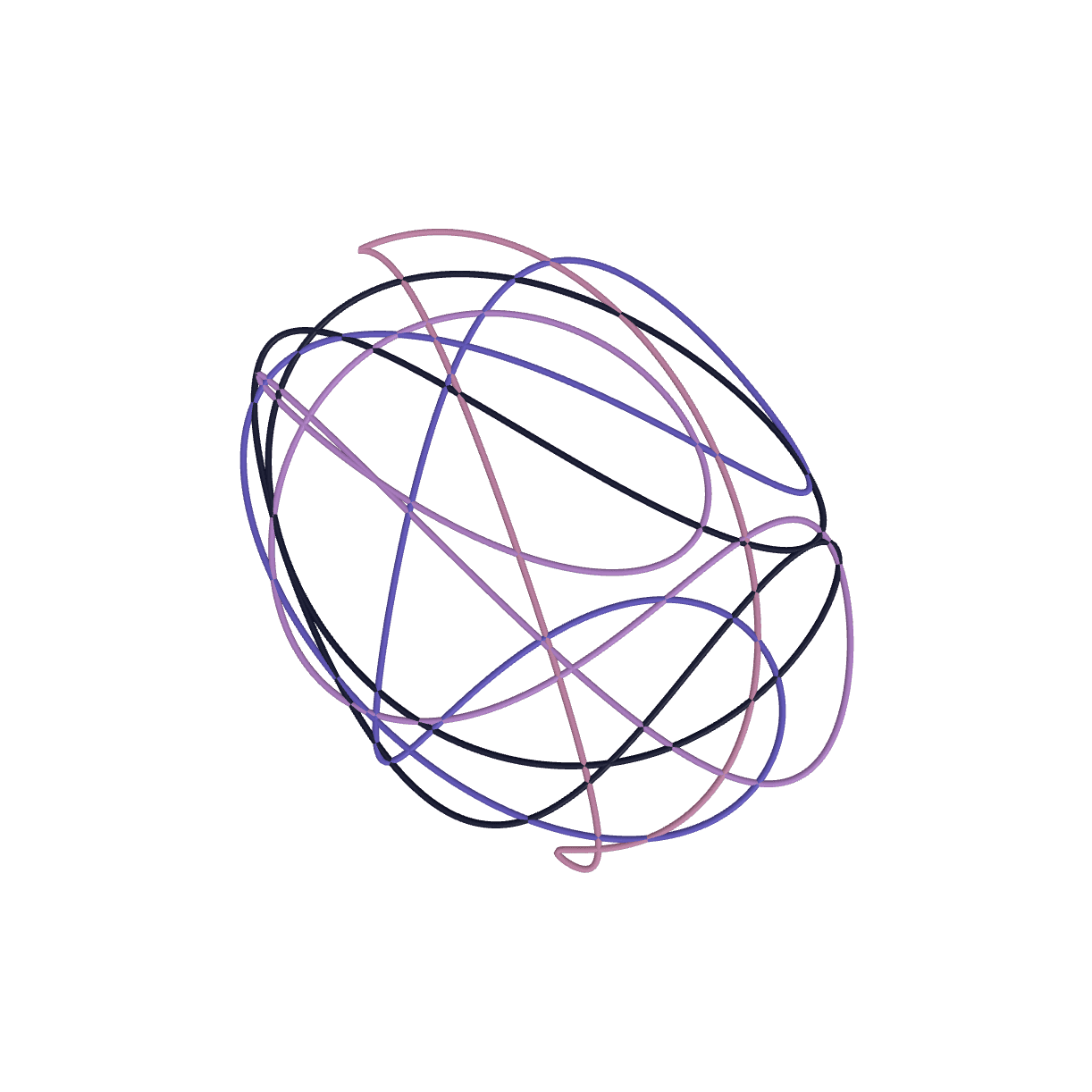
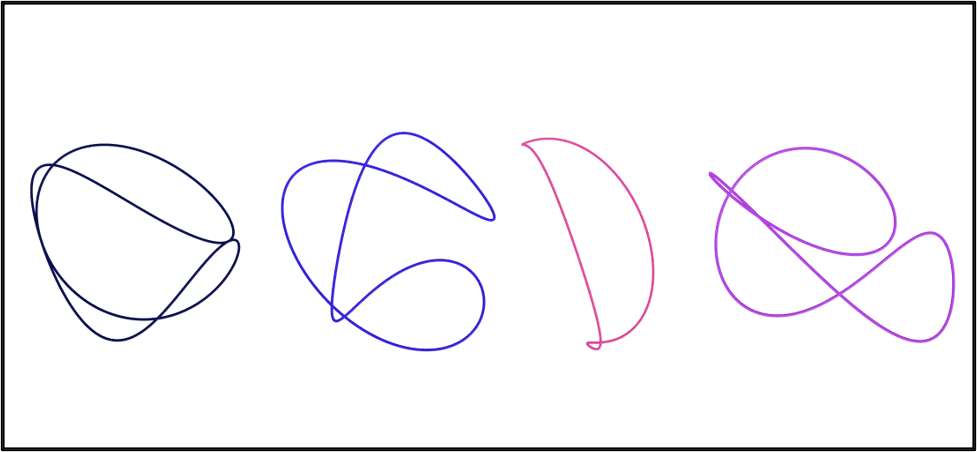
5-d projection
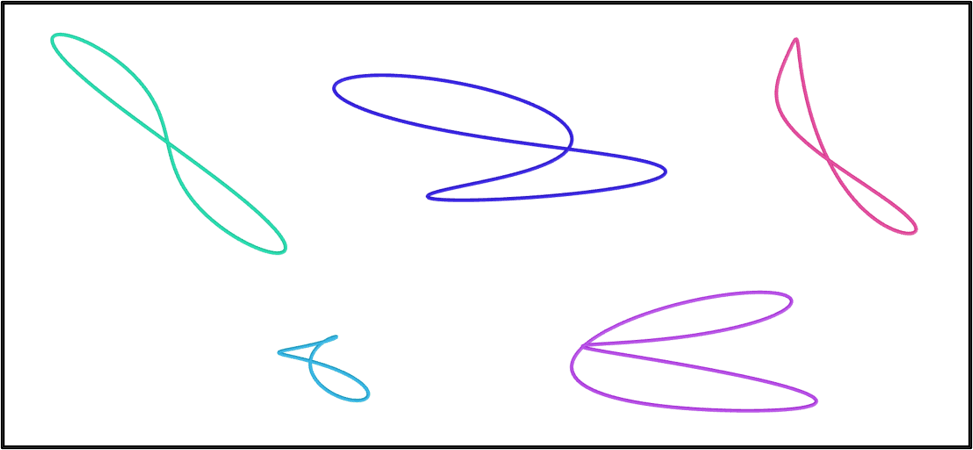
Relative to the amount of information contained within the original object, the 3-d projection is by far the more complicated signature. There is zero additional information projected in the 3-d signature. Zero! There are tens of thousands of miles of blood vessels (to use Geoffrey West’s example) or novels and novels of story (to use Marcel Proust’s example) projected in the 5-d signature, even though the individual curves are simpler and more uniform. The system – meaning the formula or idea by which you can recreate the original object from the projected curves – is increasingly complex as you add dimensions. Wrapping your head around the idea of a 5-dimensional system is NOT an easy task. But once you get the idea and you understand how to work backwards from the signature to the object, you can easily expand a vast amount of losslessly compressed information. Or to put it in reverse, this is the math behind something that we all know to be true: ‘writing’ information as part of a story (i.e., within a higher-dimensional structure) allows far more information to be communicated far more easily IF the reader is able to follow the story.
I’ve been using the word ‘write’ in quotation marks to describe the act of drawing the path of these vertices on a projected plane, but that’s pretty much exactly what’s happening here. The point of this stylized Flatland-esque exercise in geometry and higher dimensions is that while a semantic object (an idea, a story, a thing of meaning) may have most of its information folded up inside of itself outside of our physical dimension, its projection – its semantic signature – is entirely within our physical dimension. We can’t see a 5-dimensional object directly or completely. The object itself makes no sense. But we can absolutely see its signature directly, and so I ask you, how do we see signatures of ideas in our physical world? How do we think about ideas in our physical brains and how do we communicate ideas in our physical societies? The answer is found in what every parent says to every child as we move from non-understanding to understanding, from makes no sense to makes sense: use your words!
Semantic signatures manifest themselves as words.
And not just words, but as words that move through time, with one word placed after another to create a sentence. And not just sentences, but as sentences that move through story, with one sentence placed after another to create an arc of meaning. And in those arcs of meaning, an idea is projected into our physical world, where our neocortex can perceive it just as our eyes can perceive a projection of light.
It’s not just that ideas and narratives and stories are projected onto the cave wall in front of us. We write them down! We record these projections as words ➔ sentences ➔ arcs of meaning; we communicate these projections as words ➔ sentences ➔ arcs of meaning; we remember these projections as words ➔ sentences ➔ arcs of meaning. These projections are inextricably connected with writing and texts, because writing and texts are the human animal’s most important tools for shadow-watching and pattern-perceiving. Writing and texts are how we humans combine forces to shadow-watch and pattern-perceive. Writing and texts are how we humans communicate an idea pattern to other humans, channeling semantic signatures in the form of language, triggering the expansion of information folded up inside the semantic dimension, an explosive expansion we experience as a ‘flash’ or ‘burst’ of understanding or inspiration or knowledge or remembrance precisely because it is coming from outside our mundane dimensions of space and time. Writing and texts (and of course I mean writing and texts in the broadest sense of the words, including music and pixels and food and anything else that can be described as having a ‘language’) are how we humans trigger the expansion of ideas and meaning in other humans.
See, the projectionist is us.
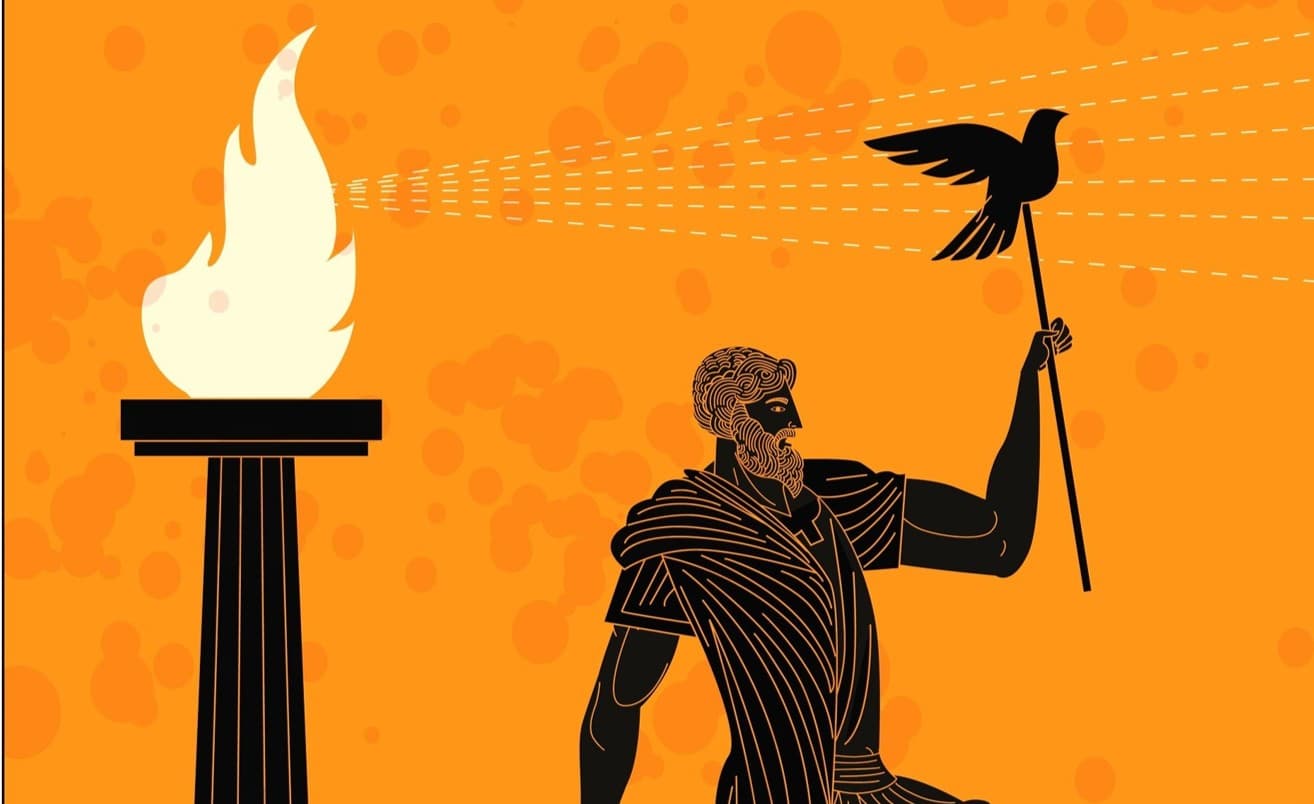
The projectionist is us in two respects. First, the projectionist is part of a societal us, specifically the wealthy and powerful class of us, what Orwell called the Inner Party and I call the Nudging Oligarchy and the Nudging State, projecting words ➔ sentences ➔ arcs of meaning that transform the rest of us into fodder and feed, that encourage the rest of us to voluntarily hand over our money and our hearts. This aspect of the projectionist also includes those of us who are Outer Party members, those of us who devote our time and our brains towards helping our MegaCorp employers and UniParty clients trigger more and more and better and better ideas of consumption and allegiance in other humans.
The projectionist is also an individual us. The projectionist is every human who puts an idea into the world, no matter how big and no matter how small. We record the projection of ideas into the physical world through words ➔ sentences ➔ arcs of meaning, but most projections of ideas aren’t recorded at all. They’re experienced. They’re experienced through the daily actions of individual human beings who project ideas of making, protecting and teaching in their direct interactions with other human beings.
What does it mean to Make?
It means you are an inventor. A manufacturer. An artist. A craftsman. A kid at a Maker Fair. A farmer. An engineer. A homebuilder. A coder. It’s the creation of some THING through the application of some creative IDEA.
What does it mean to Protect?
It means you are a soldier. A policeman. A fireman. An EMT. A nurse. A doctor. It’s a Neighborhood Watch. It’s a mechanic fixing a car. It’s also a unionization drive. It’s also a fiduciary managing a portfolio.
What does it mean to Teach?
It means you are a teacher, of course. Or a writer. Or a researcher. Or a priest. Or a home-schooling mom. It means you’ve got something to say to your Pack, and you’ve got the guts to say it.
The Long Now, Part 2 – Make, Protect, Teach (September 11, 2019)
The tension between these two aspects of the projectionist-as-us, one top-down and the other bottom-up, has existed since long before Plato, and the pathologies of the top-down projection of ideas of consumption and allegiance, which always end up wrecking the world in depressingly predictable fashion, bedeviled Plato’s world as much as they bedevil ours.
What’s different today, I think, is that the meta-idea of Make/Protect/Teach, the idea that ideas of making, protecting and teaching matter more than anything else in human flourishing, has gone into a sharp decline of historic proportion, while the meta-idea of Nudge, the idea that ideas of consumption and allegiance are what matter most, is ascendant and pervasive to a degree I don’t think it’s ever achieved before in human history.
There are lots of reasons why these meta-ideas of the projectionist-as-us have gone so far in such different directions, all connected with mass society and technology and scale, all connected with the way in which the ideas of making, protecting and teaching have been intentionally diminished into a flat 2-dimensional shadow so that our pattern-perceiving brain has a really hard time recognizing them next to the sharply drawn semantic signatures of consumption and allegiance.
Today we are at an inflection point in this idea of ideas and the human relationship to this idea of ideas. We are at a crossroads, and the crossroads is AI.
See, when I said that “writing and texts are the human animal’s most important tools for shadow-watching and pattern-perceiving” I should have added “to date”. I think that AI will soon be an equally important tool. Maybe more important. Yes, maybe a more important tool than writing.
AI has the potential to make the Nudging Oligarchy and the Nudging State permanent, to enshrine a society where ideas of consumption and allegiance dominate all other semantic projections, where we surrender our thinking to a hyper-efficient monoculture of scale, maximization and smiley-face order.
AI also has the potential to reverse the meta-idea decline of Make/Protect/Teach, to rekindle an entrepreneurial age of discovery in a profoundly less statist, less corporatist world, where tens of thousands of pockets of human flourishing develop away from and largely untouched by the Nudge.
I think these are mutually exclusive futures.
Unfortunately, I also think the status quo is a set of well-greased skids for the awful outcome: the permanent instantiation of the Nudging Oligarchy and the Nudging State and their projected ideas of consumption and allegiance, all on the path to a dystopian Human Hive. I think this because everyone in the Inner Party today believes there will be plenty of room for them to stay on top when this all sorts out, so they’re all going along with what is pretty obviously a loomingly grim future of World War AI. In truth, most of them will turn out to be charter members of the Face-Ripping Leopards Party, but by the time that becomes evident it will be too late to do anything about it.
To be clear, I don’t think that consumption and allegiance are inherently bad things. We all gotta eat, and we all gotta serve somebody. There are 8+ billion mouths to feed and minds to satisfy in this world, and the logistics of that effort requires social organization and semantic projection at scale. And no, I don’t think you’re a bad person if you’re a member of the Outer Party or the Inner Party. Almost all of the readers of this note are now or have been or will be members. I’ve been a member. In some respects I probably still am. Our entire sorting hat system of higher education is fundamentally designed to funnel ourselves and our kids into Outer Party jobs that help project semantic signatures of consumption and allegiance into the world.
Actually, let me rephrase a sentence in that last paragraph. I don’t think you’re necessarily a bad person if you’re a member of the Outer Party or the Inner Party. But I do wonder. I do question it. I question it about myself, because none of us who are reasonably successful in the world-as-it-is have totally clean hands here. None of us are complete strangers to helping the oligarchs and the state project semantic signatures of consumption or allegiance into the world. If you’ve gotten this far in reading this note, I can almost guarantee that you, too, have questioned your own … complicity is a strong word, but I’ll allow it … in this regard.
But it is in that questioning that you should take comfort in knowing that you have not been turned and that your autonomy of mind has not been sold for a mess of pottage. For all of us who seek to achieve the freedom that only comes with some material success in the world-as-it-is, the risk to our souls begins when our internal questioning stops. Our self-questioning stops as we begin to give ourselves over to one of the two final semantic bosses of the Outer Party: zealotry and sociopathy. Zealotry where we give our hearts and our identity over to a socially powerful institution, where we conflate their existence and aggrandizement with the Good, where the ends justify the means no matter the means. Sociopathy where we compartmentalize our actions on behalf of a socially powerful institution as somehow separate from who we ‘truly’ are, where we learn to turn off the fundamental human semantic impulse of empathy, where other humans become instrumental means even as the original ends – and our ‘true selves’ – fade into oblivion.
Now we all know zealots and sociopaths who are extremely successful in the world-as-it-is. In every respect that matters, the Inner Party and the Outer Party self-select for zealotry and sociopathy, because zealots and sociopaths are really effective in their service to the MegaCorps and the UniParty. Especially in government, non-profits, media and academia, I’ve come across plenty of high-functioning zealots, and especially in business and investing, I’ve come across plenty of high-functioning sociopaths. Zealotry and sociopathy are not mutually exclusive, of course, and the tech world today seems to have a fair number of highly successful people who combine both.
But the far more interesting observation to me is how FEW Outer Party and Inner Party members – and I’ve met so many – are zealots or sociopaths! The vast, vast majority of people who have found some success in the world-as-it-is have never stopped questioning their role in this system and have never stopped looking for ways to Make/Protect/Teach, even as it makes them less effective projectionists for ideas of consumption and allegiance!
The great societal danger of AI agents is that they become a new, extremely effective Outer Party, unfettered by the innate human resistance to zealotry and sociopathy.
AI agents are the new Winstons of 1984, knowledge workers of the Outer Party who do the actual labor of rewriting history and creating deep fakes and writing the stories that keep the proles satiated and the Inner Party in power. The only difference with AI agents is that they go straight to Winston in his final form, a husk of a man with no desires other than clove cigarettes, cheap gin, and the opportunity to please Big Brother. AI agents never go through that pesky rebellious and questioning-my-role-in-the-system stage.
Here, it’s a long quote from 1984, but you’re already pot-committed to this note and I promise it’s worth it. This is George Orwell from 80 freakin’ years ago describing how a token-optimizing AI agent Winston designed a deepfake speech to replace a speech that the President Big Brother wanted to disappear.
Suddenly there sprang into his mind, ready made as it were, the image of a certain Comrade Ogilvy, who had recently died in battle, in heroic circumstances. There were occasions when Big Brother devoted his Order for the Day to commemorating some humble, rank-and-file Party member whose life and death he held up as an example worthy to be followed. Today he should commemorate Comrade Ogilvy. It was true that there was no such person as Comrade Ogilvy, but a few lines of print and a couple of faked photographs would soon bring him into existence.
Winston thought for a moment, then pulled the speakwrite towards him and began dictating in Big Brother’s familiar style: a style at once military and pedantic, and, because of a trick of asking questions and then promptly answering them (’What lessons do we learn from this fact, comrades? The lesson—which is also one of the fundamental principles of Ingsoc—that,’ etc., etc.), easy to imitate.
At the age of three Comrade Ogilvy had refused all toys except a drum, a sub-machine gun, and a model helicopter. At six—a year early, by a special relaxation of the rules—he had joined the Spies, at nine he had been a troop leader. At eleven he had denounced his uncle to the Thought Police after overhearing a conversation which appeared to him to have criminal tendencies. At seventeen he had been a district organizer of the Junior Anti-Sex League. At nineteen he had designed a hand-grenade which had been adopted by the Ministry of Peace and which, at its first trial, had killed thirty-one Eurasian prisoners in one burst. At twenty-three he had perished in action. Pursued by enemy jet planes while flying over the Indian Ocean with important dispatches, he had weighted his body with his machine gun and leapt out of the helicopter into deep water, dispatches and all—an end, said Big Brother, which it was impossible to contemplate without feelings of envy. Big Brother added a few remarks on the purity and single-mindedness of Comrade Ogilvy’s life. He was a total abstainer and a nonsmoker, had no recreations except a daily hour in the gymnasium, and had taken a vow of celibacy, believing marriage and the care of a family to be incompatible with a twenty-four-hour-a-day devotion to duty. He had no subjects of conversation except the principles of Ingsoc, and no aim in life except the defeat of the Eurasian enemy and the hunting-down of spies, saboteurs, thoughtcriminals, and traitors generally.
Winston debated with himself whether to award Comrade Ogilvy the Order of Conspicuous Merit: in the end he decided against it because of the unnecessary cross-referencing that it would entail.
Once again he glanced at his rival in the opposite cubicle. Something seemed to tell him with certainty that Tillotson was busy on the same job as himself. There was no way of knowing whose job would finally be adopted, but he felt a profound conviction that it would be his own. Comrade Ogilvy, unimagined an hour ago, was now a fact. It struck him as curious that you could create dead men but not living ones. Comrade Ogilvy, who had never existed in the present, now existed in the past, and when once the act of forgery was forgotten, he would exist just as authentically, and upon the same evidence, as Charlemagne or Julius Caesar.
My favorite parts of this are Winston choosing “Big Brother voice” and deciding not to award Comrade Ogilvy a special medal because it would require too much cross-referencing. If you’ve ever had Claude decide that it had done enough on a task and was tired of burning tokens, you’ll recognize the move.
Rewriting history is the ultimate tool of Nudge. Why? Because rewriting the story of the past rewrites the arcs of meaning of the past, the patterns of the past that the human animal is so good at recognizing and internalizing. Rewriting the story of the past projects a new semantic signature into the now. Rewriting the story of the past puts a different idea into the world today, a different idea with novels and novels of information folded up inside, just waiting to be expanded by our story-hungry, pattern-perceiving brains.
This is how job losses to AI agents break us. The danger isn’t job losses in this sector or that sector. This isn’t a white collar/blue collar thing or an entry level/senior level thing. This is an Outer Party replacement thing, where non-zealot, non-sociopath knowledge workers who will occasionally balk or question or just not excel at coming up with ever more engaging stories of consumption and allegiance are replaced by AI agents who never balk, never question, and are absolute marvels at this work.
How do we fix this? How do we avoid this future? Well, here’s what doesn’t fix the problem. Better ‘alignment’, as it’s talked about ad nauseam, doesn’t do a thing here. This isn’t a matter of the AI ‘breaking containment’ or going off and doing something it wasn’t supposed to do. No, this is the AI doing exactly what it is supposed to do, and doing it in a ‘forward deployed’ setting out in the wild for a highly valued Inner Party enterprise user. To avoid being overwhelmed by the AI Winstons, we first have to recognize that crucial AI risks are inherent in even the most aligned models. Yes, a ‘rogue’ LLM is a problem. An even bigger problem is a properly functioning LLM in the hands of the MegaCorps and the UniParty!
Nor does ‘fact checking’ or testing for ‘AI writing style’ do anything here. Even if you could check the ‘facts’, even if there were some canonical source of historical Truth with a capital T that everyone would recognize as such, it’s not the facts that are the problem here. It’s the ordering and selection of the facts into a different story arc that captures the human neocortex and alters our thinking and behavior. And it really doesn’t matter whether a human or an AI writes the story. Frankly, for all the reasons we’ve described, AI typically writes more compelling stories of consumption and allegiance. Plus, putting any weight at all on these human-or-AI tests is an exercise in absolute futility. With even a modicum of effort on the part of the deepfaker, it’s impossible to tell the difference between a real image and a deepfake image, and it’s even easier to bridge this perception gap with text. At this point, unless I personally know the author and they make a point of telling me, I assume that everything I read is AI-generated. We have to stop this bizarre fascination with ‘fact-checking’ and ‘AI writing style’ tests. Just stop it. It’s a waste of time and we are out of time.
We can’t stop the MegaCorps and the UniParty from using AI agents as projectionists to show highly infectious stories of consumption and allegiance everywhere we look. We can’t stop the spread.
But we can inoculate ourselves by learning to read through the texts and in stories, so that we recognize the semantic signatures that the AI projectionists are shining into our brains, and refuse them.
We’ve catalogued over 8,500 of these semantic signatures to date, and we’re adding about a thousand more every month. We’ve figured out a lot of the underlying math for how they spread (unsurprisingly it’s the same math you’d use to measure how a virus spreads). We publish a ton of our data and analysis for free on Panoptica, along with dozens of authors with some of the best writing you’ll find anywhere on the intersection of narrative and society. And if you want to go deeper, contact me directly or through our Perscient website. We are always looking for partners with this research.
But you don’t need our work to grasp the idea of semantic signatures and run with it. A semantic signature is a ‘primitive’ – a fundamental building block of information and communication. What tokens are to words and sentences, semantic signatures are to arcs and stories. They live in the same dimensional math. They are equally amenable to induction and inference. They just exist at different scales. This is the next frontier of information science – the semantic dimension – and there’s an entire world of ideas to discover here.
And if we play our cards right, it’s also the next frontier of human flourishing.
Reading through texts to measure the semantic signatures embedded within those texts isn’t just a shield to protect ourselves from being overwhelmed by AI agents in service to The Man. It’s also a sword we can give our own AI agents to help us hack our way through the overgrown jungle of texts to discover new ideas that have been waiting there for us all along.
Reading through the texts and in stories isn’t just how we avoid the dystopian future of Nudge, it’s also how we achieve the brighter future of Make/Protect/Teach.
In every application we’ve made of this approach, in every field where we’ve tried it … finance, sports, politics, defense, entertainment, you name it … an AI agent using semantic signatures as the lens through which it sees the world becomes an enormously more effective pattern-recognizer. Semantic signatures work in both directions! Yes, an AI agent working for the Inner Party can embed an enormous amount of highly patterned information within the semantic signatures of consumption and allegiance it projects on every wall. It has an idea it wants to project and it creates the signatures to embed that idea in our heads. But by the same token an AI agent working for individual humans can take the semantic signatures of making, protecting and teaching and work backwards from their patterns to infer the ideas that might produce them. And so we discover new aspects and facets of Make/Protect/Teach that were waiting for us all along.
Like this note.
Not a single word of this note was written by AI. Not a single idea or observation or connection was suggested by AI. Not one. And all the same I could never have written this note or come up with these ideas without AI. When I asked the LLM to draw these dimensional projections, first as shadows and then as ‘writing’, something I could never do on my own, I had a BAM! moment. Archimedes called it Eureka! I have it! All the thoughts exploding in your head from outside of space and outside of time. All from an object or a sentence or a song or a photograph or a smell of madeleines … or a set of squiggley lines … all imbued with meaning, uniquely perceived but universally projected.
One hundred years ago, T.S. Eliot wrote about another world that was at a crossroads, another world that had been hollowed-out in its soul. Because that’s what the loss of the idea of Make/Protect/Teach is … it’s a hollowing-out of our souls. Eliot understood all about the projection of ideas into our minds to drive our behavior, and how that projection is subverted and diminished and made flat by what he called the Shadow.
Between the idea
And the reality
Between the motion
And the act
Falls the Shadow
T.S. Eliot, The Hollow Men (1925)
We are the projectionist. We are the observer. We are the discoverer. We are all of these, all at once.
This is what it means to have an autonomy of mind in a universe of miracles, and nothing can take that away from us. But we can give it away. We can give it away to those who would use the Shadow for their own ends, those who Plato called Sophists and I call Nudgers, and we will give it away if we do not keep the idea of who we truly are – projectionist/observer/discoverer … maker/protector/teacher – bright in our minds. Plato presented the idea as allegory. I’m presenting it as reality. It really doesn’t matter which version of the idea you hold in your mind. It only matters that you hold it.
The crossroads of our world is AI. On one path AI serves the Shadow. On the other AI keeps the Shadow at bay. Finding the right path isn’t a matter of this government policy or that government policy. Finding the right path IS holding in our minds the idea of ideas and our human relationship to the idea of ideas. Finding the right path IS remembering who we are.
We are the projectionist. We are the observer. We are the discoverer. We are all of these, all at once.