The Semantic Universe
March 1, 2024·AI
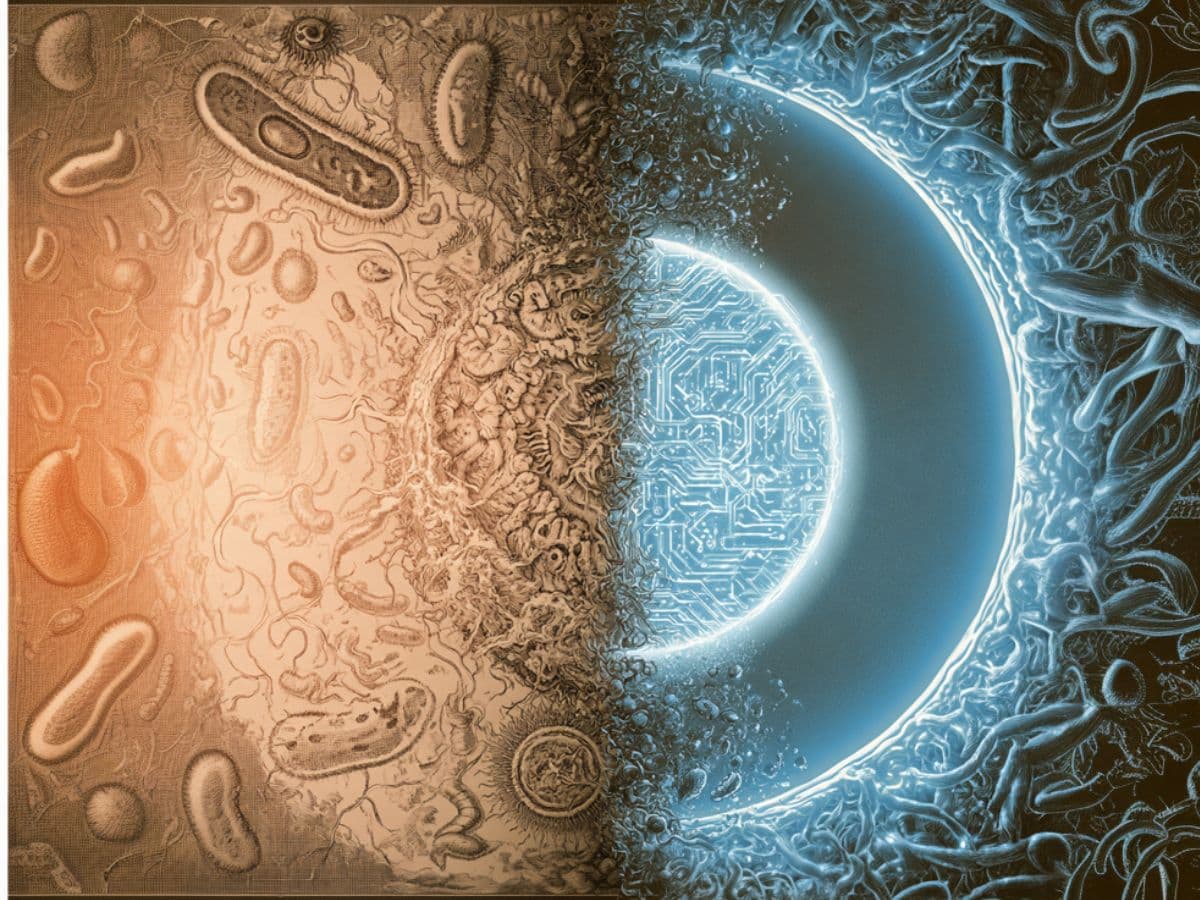
This is a draft introduction to a much larger piece I’m writing that’s tentatively called “The Semantic Universe”. It argues that there are five dimensions to reality: three spatial dimensions (height, width, depth) plus time – what’s called spacetime in physics – plus semantics (which is a ten-dollar word that means ‘meaning’), all of which give form to a reality substrate of Information with a capital I. Of these, semantics is the most ‘fundamental’ dimension, more so even than spacetime. It’s what ancient Greek philosophers called the logos and what John the Apostle called the Word. It’s what Kant called transcendental schemata, what Hegel called the Geist, what Wittgenstein called propositional logic, and what Quine called ontological relativity. Wheeee!
Another way to think about semantics is that it’s the structure that gives form to unstructured information with a lowercase i, like text and pictures. In our everyday lives we use words like ‘story’ and ‘narrative’ to describe the semantic dimension of our universe, and I honestly believe that stories are just as real as the coffee mug sitting on my desk right now. Not ‘real’ in an ethereal thought experiment sense, but real in a completely physical sense, instantiated within the electrochemical activity of quadrillions of self-organizing neurons distributed across billions of human brains. And that’s the kicker. The semantic dimension of reality is not just accessible to human brains, but to any sufficiently large information processing network. Like whale brains. Or alien brains. Or ChatGPT4+. Once again … wheeee!
Here’s another way to think about it, from a note I wrote ten (!) years ago, Hollow Men, Hollow Markets, Hollow World:
I’ll close with a few selected lines from TS Eliot’s The Hollow Men, because I’m always happy to celebrate a time when poets wore white-tie and tails, and because I think he’s got something important to say about information and communication, authenticity and deception.
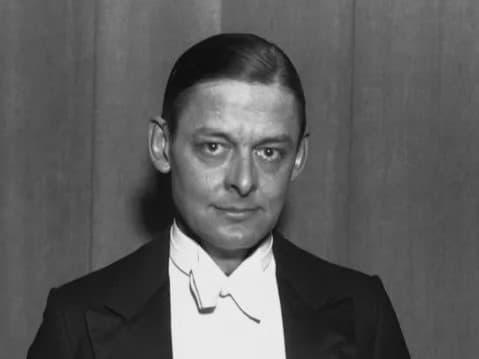
Credit: Bettmann archive
Between the idea
And the reality
Between the motion
And the act
Falls the Shadow
What is the Shadow? I believe it’s the barrier that communication inevitably creates among humans, including the mental barriers that we raise in our own minds in our internal communications – our thoughts and self-awareness. Sometimes the Shadow is slight, as between two earnest and committed people speaking to each other with as much authenticity as each can muster, and sometimes the Shadow is overwhelming, as between a disembodied, mass-mediated crowd and a central banker using communication as “policy”. Wherever you find a Shadow you will find a hollowness, and right now the Shadows are spreading.
My goal in writing this … my goal in ALL of this … is to illuminate the Shadows. Not in a way that creates new Shadows but in a way that makes them smaller, that allows all of us large information processing networks, from humans to whales to aliens to Nvidia H100 clusters, to communicate more authentically about the meaning of the universe. No biggie.
How to communicate THAT? Well, I really am happy to celebrate a time when poets wore white-tie and tails. I really am happy to celebrate a time when explorers and writers would give a series of ‘lectures’ to their explorers and writers club before they wrote it up. That’s all very old-white-guy of me, but IDGAF. So over the next three months I’ll be giving three or four lectures on the Semantic Universe on Epsilon Theory subscriber-only webinars, not as a finished product but as a work product, culminating in our Epsilon Connect conference at Vanderbilt University from June 1-2.
And if you have any thoughts on all this (other than this sounds completely crazy … trust me, I know!), I’d love to hear from you.