The Weird Thing
July 31, 2024·Politics
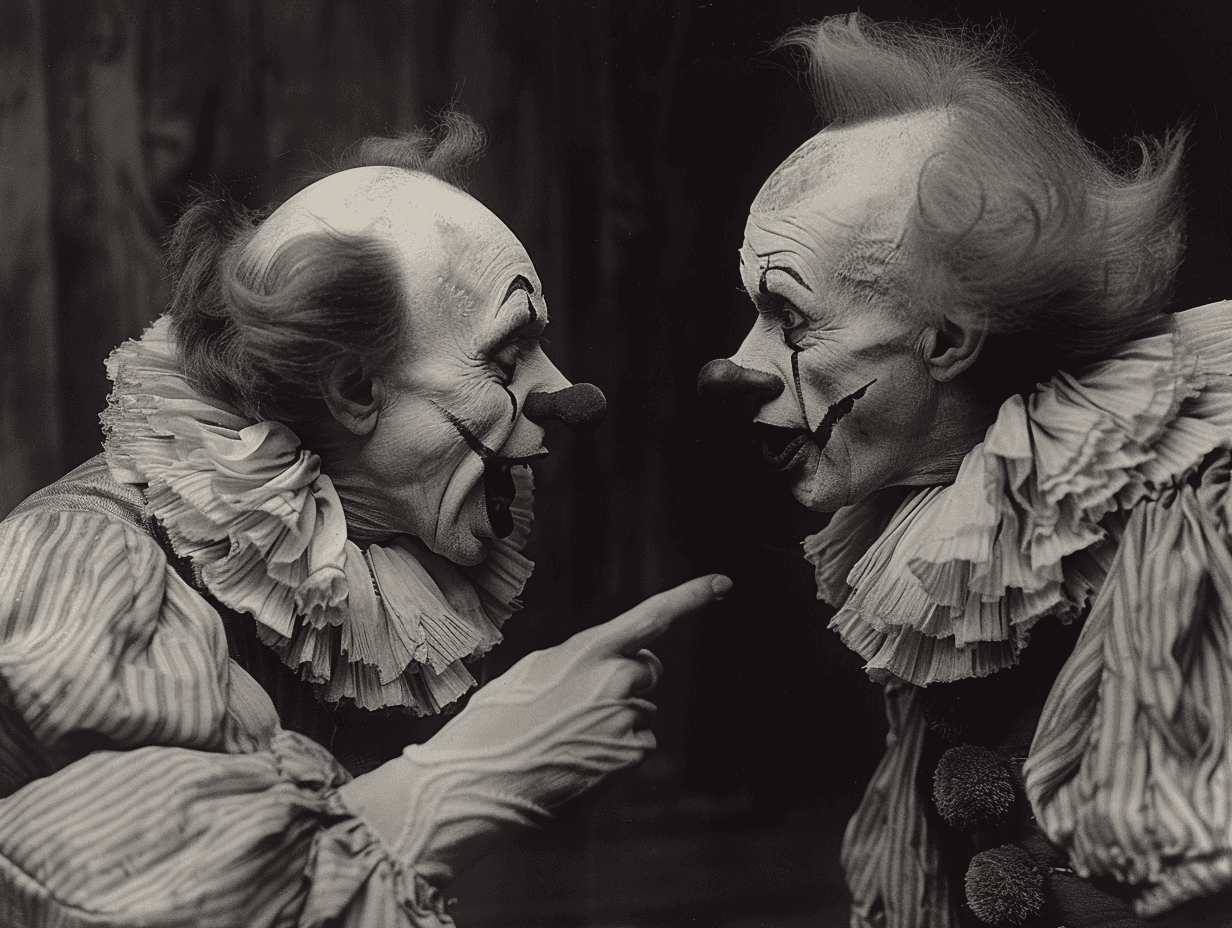
If you haven't been paying attention, one of the latest narratives to take root in the zeitgeist of American politics is the framing of the GOP presidential ticket as being weird. This is just one man's opinion, but I think it is a pretty good tack. Trump is a pretty weird dude, all considered. He's also the kind of guy who thrives on being hated but not so much at being laughed at. It is not an especially mean or vitriolic criticism in comparison to others that might be chosen, so I think it is less likely to backfire, too. All in all, it's a clever angle of attack.
There are two weaknesses to it, I think. The first is that Vice President Harris is also kinda weird, and part of an administration that has had a lot of weird people in it, too. Really weird. Weird enough that even after MAGA, the flag-hugging, and the watching Facebook boomers do the Trump dance at rallies, I think most Americans still look at San Francisco, Austin, Berkeley, and Portland as their capitals of weird. And it ain't because these places are hotbeds of reactionary politics, y'all. The second weakness is that it's the kind of criticism that would have been most useful to pull out on the three or four inevitable instances that you knew Trump would make an outrageous claim like he invented the question mark or something. But that was never how 'weird' was going to be used. It was always going to be a line that got exhausted and exhausting within about three days.
Why? Because, to borrow the parlance of those using the term, it is an othering word. It is a word which says 'he is not like us' and 'he doesn't belong.' As simple and almost juvenile-sounding as it is, weird is a symbol whose meaning has been mediated by every culture and subculture in the western world to align with some of the most powerful cognitive universals that lurk in our individual and collective subconscious. There are a lot of things a leader can be. He can be cruel; we can convince ourselves that he does what needs to be done. He can be inexperienced; we can convince ourselves that he brings a fresh new perspective. He can be a lout; we can convince ourselves that we're voting for a president and not a priest. He can even be a hypocrite; we can convince ourselves that he's mature enough to change his mind when the facts change (what do you do, sir?tm). What he cannot be, what he must not be is Not Us.
We cannot help but to perceive the meanings our subcultures have embedded into this kind of symbol. For those with an existing aversion to Trump and his election bid, weird provided all manner of stimuli that cause human brains to find such symbols attractive, and to imagine that it was all their idea in the first place. I discuss many of these in my earlier essay, We Are Losing Our Minds. Weird suited Team Blue's autobiographical narrative. It reinforced their cultural norms. It was simple and reductive. It referenced all of those shared cognitive universals and human experiences. And yes, once a few important people started using it, weird gained the benefit that symbols derive from common knowledge, something that everybody knows everybody knows. This was always the way it was going to go.
But the weirdest thing about weird is that there are people who really ought to get how this works by now who really don't get how this works.
One of the most common questions we get in meetings with prospective clients and those interested in learning about our narrative research is "how we weight different outlets and speakers." The implicit assumption is that an analysis of the emergence of a narrative ought to take into account how important the speaker is. And there is some truth to this - reach matters. That's why we talk about missionaries of common knowledge in reference to the old tale of the Green-Eyed Tribe, where blue eyes are taboo.
It is an age-old custom on the Island that anyone with blue eyes must get in his canoe and leave at dawn the morning after he discovers the truth. Yet it is a primitive tribe. There are no mirrors, no cameras, no reflective surfaces. No one on the island has seen the color of his own eyes. Yet the strength of the taboo is such that even telling another tribe member the color of his eyes would be far too shameful, and so that is also taboo. Thus, everyone on the island knows the color of everyone’s eyes – except his own.
What happens when a missionary visits the island and tells the tribe, “There is at least one among you with blue eyes?”
Assume that the missionary is (in this case, correctly) afforded the status of a trusted arbiter. If there is a single member of the tribe with blue eyes, the blue-eyed tribesman will look around and see only people with green eyes. He will immediately recognize that he is the one of whom the missionary spoke. He will grab his canoe the very next morning and depart. And what if there were two? The missionary did not mention the quantity, but each of the blue-eyed tribesmen, seeing only one other such tribesman, will have noticed the other’s eyes. So, too, will the rest of the more appropriately named members of the Green-Eyed Tribe. On the first day, each of those two blue-eyed tribesmen will expect the other to depart, ending the search for the violator of the tribal taboo. When neither departs, each will then recognize that there were not one but two with blue eyes. The other and himself. Knowing the truth, each of the two will leave on the second day in shame.
We can therefore generalize the response to this taboo as follows: if there are n members of the tribe with blue eyes, they will depart together n days after the missionary’s declaration.
It is a silly story, of course, and a classic exercise from the game theory canon. It is popular enough to have spawned variants in the Nash equilibrium chapters of introductory texts, including The Women of Sevitan, which rather more scandalously involves philandering husbands being branded in place of tribesmen leaving the island. But it remains useful. It reinforces that even narratives which begin with some kind of authority 'organizing' a propaganda effort will spread based on how we are driven by neurobiology, culture, and the nature of symbols to perceive, internalize, and adopt them. Almost all of that process falls well outside of anyone's capacity to organize with any measure of control. In the socially networked age, this effect is vastly, hilariously exaggerated.
Virality in the socially networked age is practically always an emergent property of a social environment awash with embedded symbols and the way in which various subcultures mediate their deeply abstracted meanings.
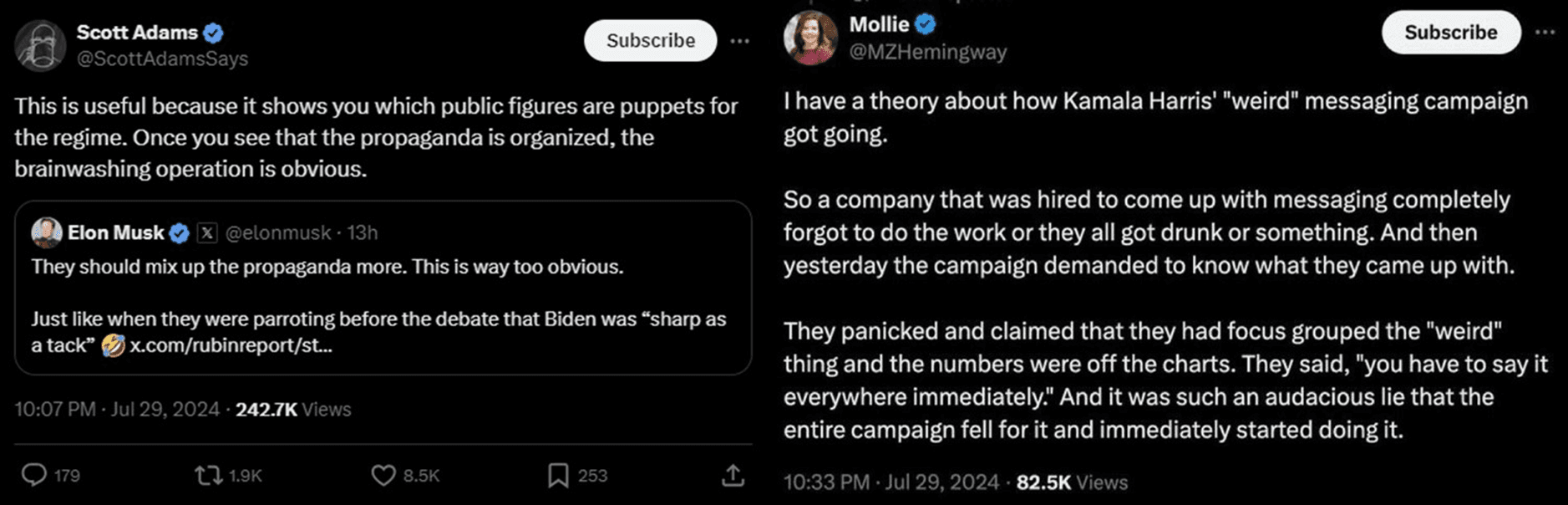
But the core belief that many people have so much trouble shaking is that the stories and symbols which take shape and assert dominance over our conversations are the result of a cabal of coordinated messaging. Like Scott and Mollie, we want to believe that propaganda is always a structured, directed sort of thing. It simply must be the result of a news media full of people just waiting to coordinate their messaging to promote the latest narrative from on high! And it isn't as if people don't still try, or that they didn't try with this little movement. It isn't as if influencers don't play a role in mediating the meaning and relationships of these symbols, or that they didn't do a bit of that here. God knows they do and they did, and we're all the worse for it. But weird didn't need a meticulously planned conspiracy to become a dominant narrative. The brains of a huge part of America were ready for it, the symbol was designed for this moment, and there wasn't anything that anyone could have done to slow it down.
I think there is a rot in the media and a blight within our political class, but it is not a rot built from conscious coordination and collusion so much as it is a rot built of homogeneity. What we desperately want to see as the result of the directed coordination of propaganda machinery is almost always something far more prosaic:
The inexorable, inevitable outcome of monocultures.
Comments
Great follow-up brief to Rusty’s tour de force note yesterday!
I’m a believer in bottom-up change, and this note kicked that belief into the next gear. Thank you for sharing @rguinn! You’re right, that is the weirdest thing about weird.
“But weird didn’t need a meticulously planned conspiracy to become a dominant narrative.”
But it’s my expression of MY autonomy of mind and spirit that you are calling weird, right? Is it like the dominate narrative of ether before quantum physics?
Isn’t a word a non fungible token?
fungible weird jim
“I think most Americans still look at San Francisco, Austin, Berkeley, and Portland as their capitals of weird” - Rusty
You must’ve left out Burlington, Vermont only because of its smaller scale. Otherwise….
What struck me most about this “weird” thing is that it isn’t directed at the voters the way “deplorables” was. Trump is the one being “othered” and not his fan base. If Hillary’s dumb comment taught the DNC anything it was this, and the Dems might have learned that lesson.
Orchestrated to some degree or not, the stickiness of weird is undeniable.
I wonder how much they’re going to regret playing this game when the response is going to be ‘the people who applaud grown men dressed as women doing highly sexualized dances in front of children think we’re weird because we would like more people to get married and have babies’.
Vance’s weirdness—which is more a combination of social awkwardness and attention seeking from what he perceives to be his crowd—seems downright pedestrian when you start comparing it to a lot of the other things that have been shoehorned into everyday life. And this sort of very dumb battle is exactly how you get fewer and fewer potential supporters to stick up for your more fringe ideas.
On this one I’d bet on Scott Adams being correct. To judge between the two theories it would be helpful to know whether the news pundits in multiple states all started saying “weird” on the same day, or was there evidence of the delay of a wave spreading. Perhaps seeing a compilation video of many pundits saying “weird” has given me a false sense of synchronized appearance of the messaging.
I suspect it won’t stick. It is a boring message that will lose its energy quickly, and as others have said, it is too easy for the Republicans to just hold up a mirror to the more extreme parts of the Democrats base and say “Oh really, you think we are weird?”.
The stickiness of any word is undeniable.
-rumplestiltskin jim
Couldn’t agree more on this point, but it’s going to be interesting to watch as it’s directed at Trump himself and not his fanbase this time around.
Plenty of weirdness within the fanbase on both sides - always was, except now it’s more visible (edit) and “whataboutism” is such a bottomless pit effectively (over)used to demonize the other side.
Sigh. On the political playground Team R shot back with Wacky. Those still on the fence must now decide which moniker they dislike more - Weird or Wacky? My 5 year old grandson can now enter this substantive platform debate as he learned Nana Nana Boo Boo on the Pre-K playground.
Continue the discussion at the Epsilon Theory Forum...