
Vertigo
July 23, 2025·Politics
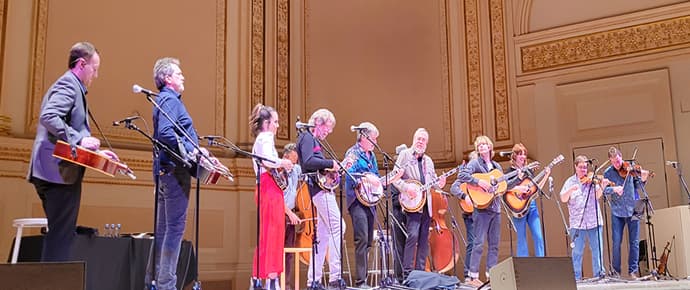
It was the best concert that fifty of us ever saw. The other two thousand hung in the balance.
There are three kinds of live music experiences, really. There’s amplified music, by which I mean that the sound people in the audience hear is coming through a microphone or instrument cable by way of a speaker somewhere. There’s acoustic music, by which I mean that the audience hears what comes out of an instrument or a voice. And then there’s a sort of in-between, music that doesn’t necessarily need to be amplified but is. It’s a kind of music where if you’re sitting in the right place you get a face full of strings and snaps and wood and breath, and if you’re sitting in another you get whatever the sound engineer pumped out through a set of speakers.
Bluegrass is the third kind.
Oh, if you’re at the campground after hours during a music festival or at a picker’s night at your local pub the music will come to you au naturel. But the instruments in a typical bluegrass setup – 6-string guitar, upright bass, banjo, fiddle, mandolin, and sometimes a dobro – are capable of really different volumes. The f-style mandolin, which the lady in the red skirt (Sierra Hull) and the marvelous hippie next to her (Sam Bush) are playing in the image above, is like a whisper next to the kinds of big pre-war dreadnought guitars favored by bluegrass flatpickers. Especially those with a more modern, driving style of playing like Billy Strings and Molly Tuttle above. These days the solution to that problem is – mostly – amplification.
It wasn’t always that way. If some folks had their way, it still wouldn’t be. Bluegrass is, at its heart, an acoustic mode. Mandolin virtuoso Chris Thile, for example, runs a folk music camp called Acousticamp, where if the name wasn’t enough, they cross out the last three letters amp in all the branding just to be sure you get the picture. For most of the early history of bluegrass, the unavailability or aversion to amplification meant dealing with the natural differences in its instruments in more creative ways. Some of those workarounds would come to define the style of the music itself.
Bluegrass music, for example, has nearly always embraced the “high lonesome” sound and harmonies of male tenor voices. It was a necessary adaptation to cut through the mid-range wash of a steel guitar and the powerful sonic bottom of an upright bass. The banjo can produce a percussive pop that is much louder than any of the other instruments, but its fiber head cannot sustain in the way a shell of tonewoods selected specifically for their sonic qualities can. It has an extreme dynamic envelope. As such, the banjo’s role in bluegrass is predominantly percussive. It’s why the third image you have in your head of a banjo player (after you’ve cycled through Deliverance and Kermit) is probably playing a fast, repetitive pattern of rapidly plucked notes. The father of bluegrass himself – Bill Monroe – pioneered an almost furious way of playing the mandolin that was basically the only way it could be heard over the din, even with the sort of sensitive jazz-influenced guitar player you might have on stage in those early days of bluegrass. The hugely diverse instrumentation is also why the format of turn-taking in solo breaks became a permanent fixture of the genre. When it’s the fiddle player’s turn, the other instrumentalists adjust to allow it to be heard as the primary instrument.
Bluegrass evolved as an acoustic art form.
But it’s just not loud enough to hear it from the mezzanine at the Ryman…or Carnegie Hall.
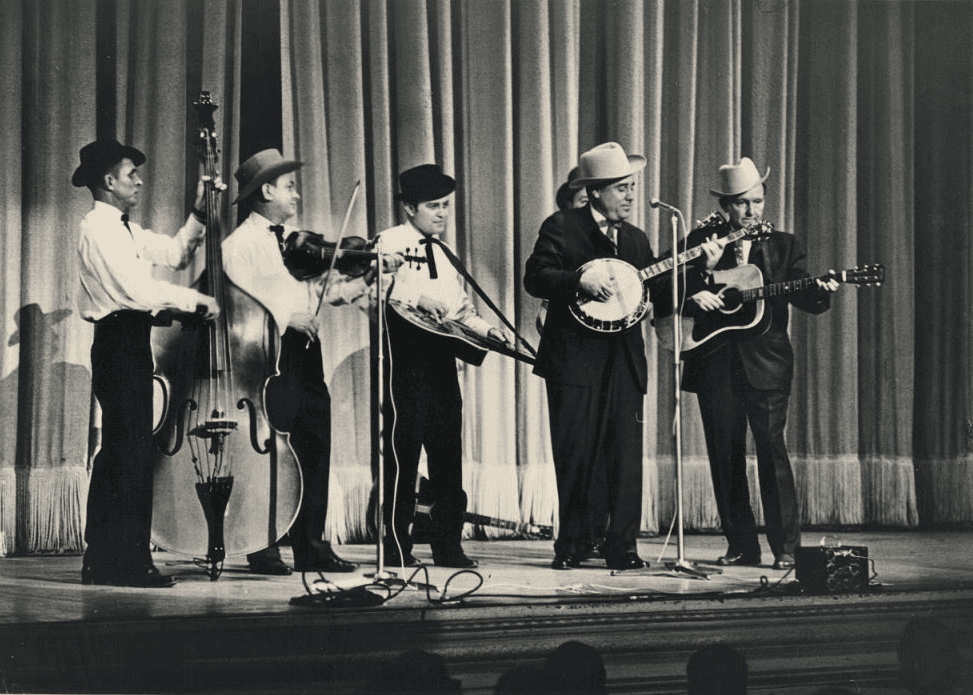
About 60 years before I was sitting there in the front row, Lester Flatt and Earl Scruggs brought bluegrass to Carnegie for the very first time. In a lot of ways, they brought it to America for the first time. Not to the country, of course, where fiddle tunes and string bands had been a familiar setting for years, but to radio listeners in the suburbs and cities. Monroe would have been with them, too, but he and the duo were still in the midst of a multi-decade feud. It was a triumph – or at least as much of a triumph as a niche music style is capable of being. Even back then, the recording from this coming out party peaked at number 7 on Billboard’s country music list, lagging behind such timeless classics as Buck Owens & His Buckaroos performing a whole album of songs written by Tommy Collins.
During the COVID years a half century later, banjo genius Béla Fleck felt the pull of bluegrass again. A master of many styles with Grammys across more categories than any man alive, Fleck had spent some years emphasizing folk, jazz, and world music styles. It was time to go back. His My Bluegrass Heart album was a love letter to all the people who had helped him grasp The Thing about bluegrass. To people like famed guitarist Tony Rice, who had declined and passed away too soon at the end of 2020, but also to a surprising generation of emerging young talent that might never be brought together on stage with such an august group of bluegrass legends again without the perfect excuse. The victory lap of the My Bluegrass Heart tour – a concert at the Ryman in Nashville followed closely on its heels by a chance to bring bluegrass back to 57th and 7th – was exactly that kind of excuse.
An astonishing array of string music talent walked on stage at the Stern Auditorium that day in January 2022. If you don’t listen to this kind of music, you wouldn’t know their names. If you heard them, though, you’d know what you were hearing was something special. But more importantly, it was special to them. There is not a chance in hell that any of them wasn’t thinking about Flatt and Scruggs at Carnegie Hall when they walked on stage one by one to the sound of Sam Bush’s frantic chop chords. It was a moment that mattered.
And to the fifty or so of us in the front five rows, it was the greatest thing we’d ever heard. Brilliance from the first pick to the last bow.
But that’s the thing about amplification of acoustic music: not everyone gets the same experience.
That goes double for bluegrass music and triple for bluegrass music carrying the ambition to bring twenty musicians on stage at once. It is a devilishly tricky style of music to amplify. You need vocal mics, sure, but that’s not a big deal. A space like Carnegie can accommodate a lot of dynamic vocal microphones without risking serious problems. Instruments are the problem. Traditionally, smaller bluegrass ensembles huddle around one or two large diaphragm condenser mics. These are big, hulking, powered microphones like a Neumann U-87 that pick up everything. There is a kind of dance that takes place in which the instrumentalists and singers alternate between pulling closer and pulling away from that big mic in the center to adjust the emphasis, tone, and projection of each instrument. In a sense, that dance makes this amplified format stylistically and spiritually consistent with the acoustic roots of the style.
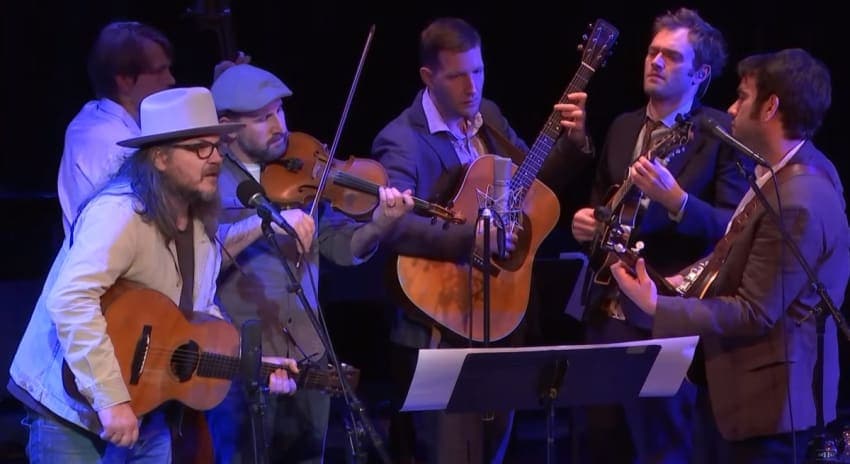
Jeff Tweedy performing with the Punch Brothers on Live from here
Yet once you’re managing three mandolins, two fiddles, two upright basses, four (!) banjos, three guitars, a couple dobros and instrument changes for many of the above, things get a lot more complicated. Every microphone you add to the stage, especially when some of them are those big condensers that pick up everything, effectively lowers the gain you can push through to the mains without risking feedback. Yet there’s no getting around the need to push a lot of gain for some of the instruments. More to the point, there is no hope of someone 20 rows deep in the mezzanine hearing a mandolin solo without some real juice. I’m not sure what happened at sound check that day. What I do know is that the engineers at Carnegie chose to be on the safe side. The very safe side.
About four or five songs in, it became clear that outside of the first few rows getting the raw acoustic sound of the instruments, nobody in Carnegie Hall could hear any of the once-in-a-lifetime things that were happening on stage.
Now, bluegrass crowds are notoriously whoop-and-hollery. There is not a venue on the planet where it would be inappropriate to whoop, clap, or shout any family-friendly word of encouragement after a musician finished their solo turn at the mic. Indeed, it’s in pretty poor taste not to. But the whoops were quickly turning to shouts.
“Turn it up!” “We can’t hear you!”
Béla Fleck, the guy who was silently directing this whole company of geniuses with little more than an occasional nod of his head or a lean of his body, seemingly had a choice. In reality, it was only a couple people shouting, and they would have shrugged and given in after a while if you ignored it. Most people were excited just to be there that day. If you stop the concert to fix the sound, if you tell the crowd that you’re sorry the sound kind of sucks, the perfect story you wanted to tell about that day breaks. If you don’t, then the actual thing you came to do, that bluegrass heart you wanted to expose to the world at Carnegie Hall once again, well, it breaks instead. There’s a moment of vertigo that takes place in the mind of every speaker, performer, artist, or public figure in that moment when you know that something is going wrong.
What are you going to choose? What are you going to protect? Reality or the story you want to tell about it?
The socially networked world is a world of symbols, and I think that usually steers us to protect the story. More accurately, I suppose, I think it inspires us to careen collectively between an obsession with a powerful and moving story on the one hand and scientific precision about reality on the other. We can elect a demagogue or a technocrat but rarely anything in between. And since seemingly everything is fated to be caught in the Widening Gyre of politics, that pattern seems to hold just about everywhere else, too. Choose story or choose reality.
But Béla Fleck didn’t have to choose. He had already chosen over many years to build a reserve of the two things indispensable to the protection of both reality and the story we want to tell about it: absolute trust and absolute competence.
Béla sailed through that moment of vertigo effortlessly. He subtly acknowledged the audience, led the band forward without so much as a break in the program, and stole moments during solo breaks to coordinate specific instructions to the sound engineers that resolved basically all the audio issues in fairly short order. Everyone in the crowd knew that Béla was on it, which in a sense made the performance seem even more natural and less artificial. We were all part of a raw, living moment together. Which, when you come to think of it, served the story about a special night of an authentically American style of music pretty damn well.
We live in a world where facts don’t matter and people are desperate for connection and meaning. Is it too trite to say that the answer to it might be for more of us to make a habit of doing what we say we will do and doing it well?
Maybe so, but sometimes I think it’s the only way past the vertigo.

Comments
Oh man. I can’t believe you were actually there! At least I can say that I know someone that was there. In my best Barney Fife impersonation, “Oh, big ain’t the word for it!”
Kudos.
Love this point, “the answer to it might be for more of us to make a habit of doing what we say we will do and doing it well”.
I would add to that: we need a new kind of social media system that encourages people to do that, and holds us all accountable.
Golden Ratio
Inside a math textbook or look all around,
In surprisingly many places the ratio’s to be found.
Step up to the Acropolis and you will see this phi.
Once you discover it’s everywhere it’ll fill you with glee.
No culture monopolizes this, take the Taj Mahal shrine.
The fact that we all can see it is a process quite divine.
Even without naming it, the aesthetics will provoke
Innately, deep emotions the design will evoke.
Perhaps blasphemous, but there may be a ratio more golden
One in business and friendship, a concept quite olden.
It’s very simple: what you say versus what you do.
When making arrangements, is the default that they’re true?
In this domain, ideally, you find a person who is one-to-one.
No need to reconfirm, once meet arranged, you’re done.
Just like the beauty of a building designed just right,
Relationships of kept promises, their future will be bright.
Our forthcoming social network, launching from stealth in 2026, will be generous and supportive rather than manipulative and extractive. One key function will be supporting members into becoming the best versions of themselves, including accountability to self and to others.
Continue the discussion at the Epsilon Theory Forum...