What Country Friends Is This?
May 10, 2019·Politics
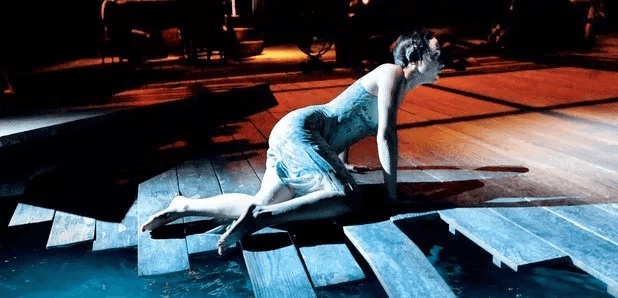
From the RSC's 2012 Roundhouse production
The shipwreck play is a Shakespearean staple[i].
Sometimes the shipwreck is the story’s MacGuffin. Tempest – you may be unsurprised to learn if you did not already know - opens cold to the audience, with peals of thunder on a ship at sea. The first scene in The Comedy of Errors sets up its own absurd plot with a long-winded description of a shipwreck in the distant past – a shipwreck that sundered a man’s two sets of identical twins. Others among his plays use shipwrecks as simple devices to move the plot forward. The rumored loss of Antonio’s trading vessels is a critical device in The Merchant of Venice. A fierce storm wrecks Pericles’s ship on Pentapolis, just in time for King Simonedes’s tournament for the hand of his daughter Thaisa. After the tournament, another storm arrives just in time to complicate Thaisa’s pregnancy so much that Pericles throws his only-mostly-dead spouse overboard to appease both the gods and his crew.
Still Slightly-Alive Thaisa: O dear Dianna, Where am I? Where’s my Lord? What world is this?
Pericles, Prince of Tyre, Act 3, Scene 2, by William Shakespeare
The shipwreck device is convenient – and powerful! - because it rather unusually satisfies both of John Gardner’s[ii] two plots that more or less account for the stories told in all fiction and literature: “A stranger rides into town and a man goes on a journey.” The shipwreck play is at once the story of a stranger in a strange land AND of a land whose balance has been upset by his arrival (or her arrival, and sometimes both his and her arrival. Remember, there’s a lot of boys dressing up as girls dressing up as boys in these plays). In the first case, the plot advances as a family, town or community deals with the changes and uncertainty brought about by a stranger’s arrival, and as they stitch their new reality back together. In the second case, the plot moves forward as the man on a journey adapts to, conquers or succumbs to the challenges presented by the new world unfolding before him.
These archetypes are powerful and interesting because they tell the story of a fundamental change in the water in which the characters swim - an immediate shift in the Zeitgeist to which everyone is accustomed.
Just as there are plot archetypes, so too are there archetypes of the manner in which the characters respond to the change in the water. There are far more sprinkled throughout the Western Canon, but Shakespeare’s shipwreck plays give us four of the most important:
Prospero (Tempest) comes to terms with the new Zeitgeist through cleverness. He seeks to turn the changing Zeitgeist to his advantage by manipulating others caught in the net of the storm. The pairs of separated twins in Comedy of Errors comes to terms with the new Zeitgeist through apathy and blind luck. They try nothing, fumble around in confusion at their new world and hope for the best. Pericles comes to terms with the new Zeitgeist through loyalty and faith. The gods, in turn, provide resolution through two of the most literal examples of deus ex machina in the canon: the resurrection of Thaisa and the miraculous reunion with daughter Marina.
When we write on Epsilon Theory about the elements and manifestations of our Zeitgeist - the widening gyre of polarized politics, the black hole of markets, about financialization and the myth of college, the cartoonification of economic data and tools of abstraction everywhere - we get emails. Most of those emails are variations on this: “Now that I am aware of these abstractions, memes and narrative, I see them everywhere. I am actually finding it a bit paralyzing. I feel like I need to DO something. What can I DO?”
It’s the same response often encountered by those who discuss, write about and reveal the behavioral biases of investors. We hear and understand that they are a problem for us and how we engage with both political and financial markets, but how do we conquer them? How do we exploit them? How do we change ourselves so that we aren’t subject to their influence?
It's a fair question. It's one I ask myself, too. A lot.
Our justifiable instinct is to demand an Answer. It’s a demand that steers us to become Prospero, to believe that we ought to navigate the change in the waters - and nudge the others swimming with us - through cleverness and tactical genius. Or to become Pericles, where we might navigate those waters by renewing our faith in and loyalty to the ideas that have always worked for us in the past. When neither of these strategies works, we figure that maybe we’d be happier if we just ignored the presence of narrative and abstraction (or, say, behavioral biases) altogether and hoped for the best.
But there’s another answer - the fourth one. It comes from the best of the shipwreck plays.
Viola: What country, friends, is this?
Captain: This is Illyria, lady.
Viola: And what should I do in Illyria?
Twelfth Night, Act 1, Scene 2, by William Shakespeare
When shipwrecked Viola lands alone on the shores of Illyria, her approach is not to nudge, to conquer or manipulate. She also recognizes that this is a different world, that she cannot simply live life in the old way and expect to thrive. She isn’t ready to give in to apathy. She knows two things: she must survive, and she must be humble enough not lose her identity in whatever games she must play to do so.
Clear Eyes. Survival.
Full Hearts. Identity.
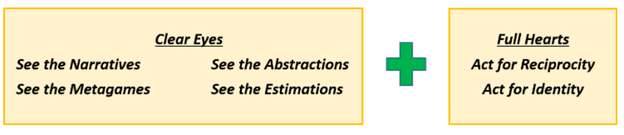
Part of the reason that the awareness of narrative (and biases) can be so paralyzing, even when we incorporate it as part of a process instead of an answer, is that we tend to find Clear Eyes much easier than Full Hearts. Once you know how to identify Fiat News, you will see it everywhere. Once you learn to spot cartoonification, you will see if everywhere. Once you learn to spot missionary behavior, you will see it everywhere. Once you learn to ask, "Why am I reading this NOW?" you will ask it constantly.
Identity and reciprocity, though? Those are hard.
How do we own our own cartoons without becoming manipulators in our own right? How do we spot the myth of college and the unassailable value of the credential while still promoting and celebrating the I Am of our children? How do we observe and respect the narratives surrounding companies, industries and asset classes without buying into them? You see, there's no safety net on identity or reciprocity. Acting on them is an act of PURE risk-taking.
If you've got an hour to carve out this weekend, grab a glass of wine and read about Viola, who adapted to a change in the water by navigating the balance between Survival and Identity.
You'll find no better example in literature of the Clear Eyes and Full Hearts we so often write about.
[i] Hey, you signed up to read about narrative, so if you’re not prepared to get some Shakespeare thrown at you from time to time, you’re probably in the wrong place.
[ii] Or Tolstoy, or Dostoevsky, or the many others to whom this has been attributed. Gardner’s claim is the best.



Comments
Start the discussion at the Epsilon Theory Forum...