When the Story Bends
March 24, 2020·Politics
The pandemic narrative changed this weekend. I'm guessing you felt it.
Let me show you what you probably felt.
Pictured below is a network graph of articles published by high-circulation US media outlets about COVID-19 the weekend of March 14th and 15th. Closely clustered articles and those connected by lines are more similar in the language they use. Bold-faced nodes and connector lines are those which we judge to be about the stock market, the economy, unemployment and a prospective recession. Colors reference different language-based clusters assigned by the graphing algorithm. The lighter, faded nodes and lines are those which are about other topics.
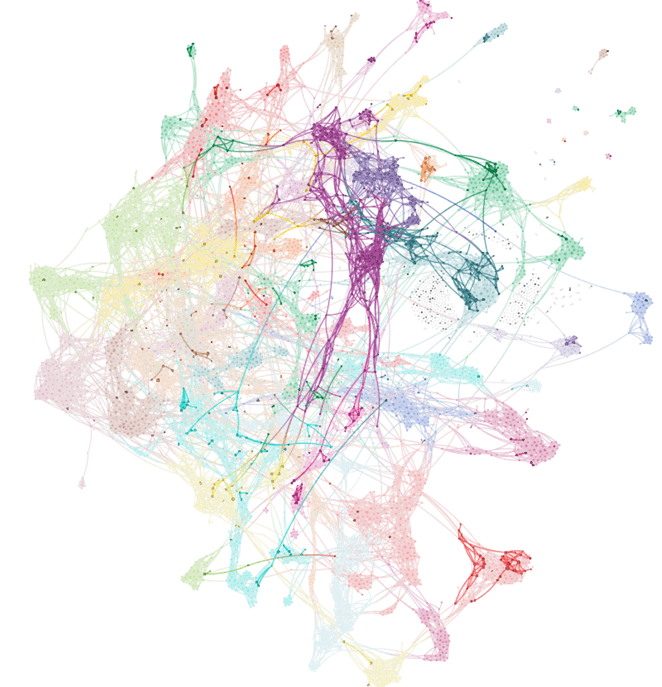
Source: Epsilon Theory, Quid
And here is a network graph of articles published this most recent weekend (in case you're curious, we chose parallel weekends to minimize bias relating to the tendency of weekday news to skew towards financial markets).
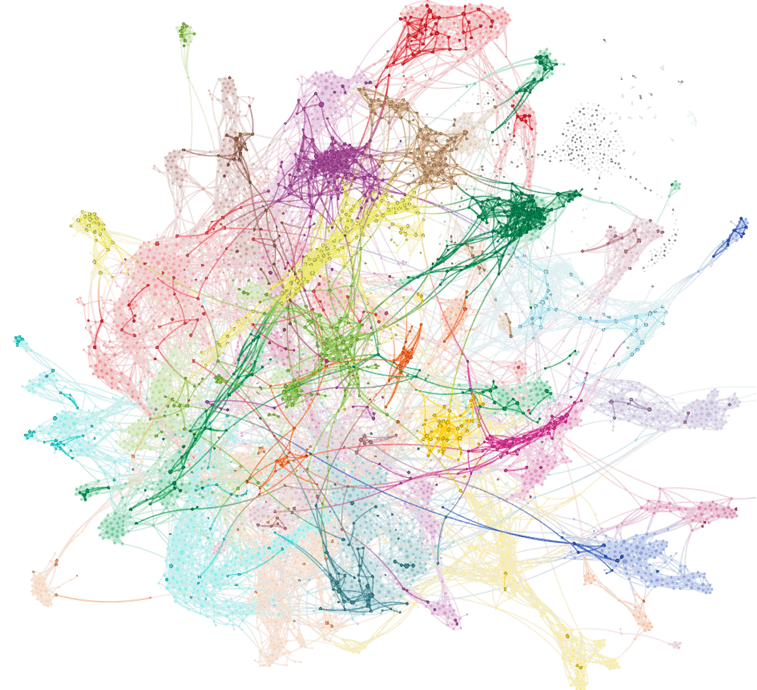
Source: Epsilon Theory, Quid
Even if you know nothing about what these graphs are doing or what they mean, my guess is you will notice two things. You'll notice there are a lot more bold-faced dots this weekend than last. That just means outlets published a lot more pandemic articles that referenced the economic impact, too. That isn't nothing, but in our opinion it isn't the most interesting feature of the graph. Much more interesting to us is that the articles with language about economics impact and financial markets are far more well-distributed AND far more central. They don't exist alongside other pandemic-related topics: they are explicitly integrated into EVERY pandemic-related topic.
In less than one week, the narrative shifted from "COVID-19 is a public health crisis" to "COVID-19 is a financial crisis."
Such is the power of the narrative missionary.
Don't mistake me. It IS both. Obviously it is both. The economic crunch that will be felt by hourly workers, service workers, and small business owners will go beyond whatever Congress's bill will have the ability to rectify. It is very real. There are second-order effects and frictional effects that are very real. An SBA loan facility may not be able to restart a restaurant that already closed. A relief check may not be able to pay rent on an apartment someone has already been evicted from. A world in which people are allowed to go back into public doesn't mean people are immediately going to crowd back into theaters to watch performing artists. This is going to be bad. This is going to be unevenly felt. We cannot predict all of those effects. That's why we should all be creative in looking for ways to provide bottom-up support for those communities. That's why we should continue to prod targeted sacrificial giving to local communities from all Americans.
That's also why any time and treasure spent thinking about large public equity-holders who knowingly took equity risk in for-profit enterprises is time and treasure wasted.
But even if COVID-19 IS both a public health crisis AND a financial crisis, it should still matter to us when we observe a rapid, coordinated shift in the framing of it across public figure statements and media.
As always, the most important question we can ask when consuming media is this: why am I reading this now?
I can't tell you that there are not people who examined the situation last week and suddenly came to earnest conclusions that the economic costs to small businesses and families might be more extreme than they thought. Surely such people exist. But I can also tell you that the overlap between groups promoting this framing and those who two weeks prior called it a media-fueled panic and those who two weeks prior to that called it 'just the flu' is significant.
If I had been calling something a 'hoax' and a 'panic' only to find out that I was dreadfully wrong, can you imagine how seductive it would be to be handed a way to retcon a new reality? How delighted might I be to say what I was really doing all along wasn't completely mismanaging an unfolding pandemic, but instead carefully weighing the pluses and minuses of subjecting the population to massive economic pain or a medical crisis?
I'm really not being cynical. It really is seductive. I really am empathetic. I really do think that public servants who want to do good and know they've messed up the response thus far are grabbing this as a lifeline. And I really do believe that many (okay, some) of them are NOT just worried about how stocks are doing, but about how families and towns and communities are doing.
But the answer is NOT the arbitrary, panicked rejection of the distancing and quarantine measures put in place across the country.
Friends, we can carry multiple ideas in our head at the same time. We can believe that this is a public health crisis AND that this is a financial crisis AND that it's probably possible for people to exercise responsible social distancing in parks AND that the recent emphasis by public figures to frame reopening the economy as our direst need represents an attempt to effect early exits from social distancing measures in regions that have ZERO business exiting social distancing measures.
And maybe you carry one of those ideas with a bit more weight than another. That's fine. Because it doesn't matter. Regardless of what it is that you or I care most about, the best path to fixing it is the same:
- We must give the health care system the time and breathing room to care for the known and as yet unknown clusters that exist in America;
- We must take the uncertainty we created through weeks of universal undertesting out of the system;
- We must give people confidence that there will be an end to quarantines by communicating how that will take place; and
- We must give markets confidence that the economy will be restarted by communicating how that will take place.
We achieve precisely ZERO of these things by making vague assurances about "reopening America!"
We achieve EACH AND EVERY ONE of these things by developing and communicating a clear plan for how we will use widespread testing to craft a workable American version of the test-and trace approaches that have successfully brought multiple economies in Asia back online
And we do it NOW.