
When Was I Radicalized? (Boeing edition)
November 5, 2019·Money
To receive a free full-text email of The Zeitgeist whenever we publish to the website, please sign up here. You’ll get two or three of these emails every week, and your email will not be shared with anyone. Ever.
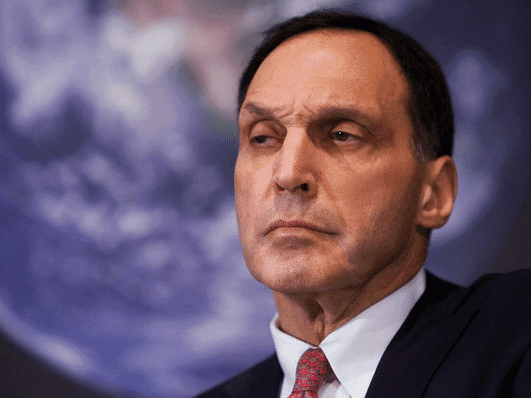
That's Dick "Gorilla" Fuld, former CEO of Lehman Brothers, who oversaw a criminal fraud conspiracy that went by the name of Repo 105.
Dick Fuld never saw a courtroom, much less a jail cell.
When was I radicalized?
When Dick Fuld walked away scot-free from Lehman with half a billion dollars in cash comp and stock sales during his tenure.
I thought of Dick Fuld today when I saw this picture and read this article.
Prosecutors Face Complex Path to Charging Boeing Over 737 MAX [Wall Street Journal]
To bring a successful criminal case against Boeing itself, prosecutors would have to show that executives repeatedly concealed or ignored the 737 MAX’s engineering problems, experts said.
And there is a larger economic and political component: A corporate indictment and potentially huge sanctions must be balanced against the economic and national-security risks of incapacitating the country’s second-biggest defense contractor.
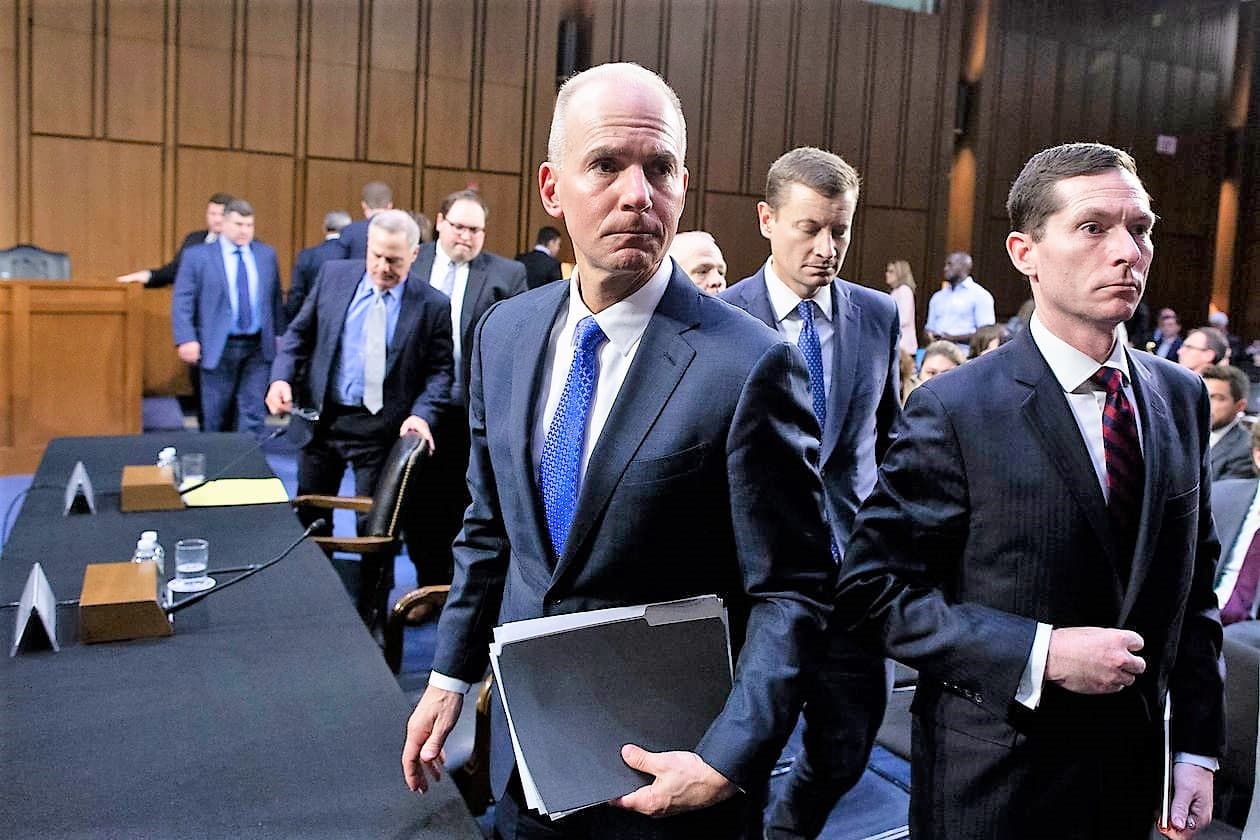
That's Boeing CEO Dennis Muilenburg, about to testify before Congress about the 737 MAX.
The article is correct, of course. There's no way that the Justice Dept. will ever bring a criminal case against Boeing, not one that hits top management or really shackles the company.
And I know that Boeing said today that Muilenburg won't get a bonus or (more) stock grants until the 737 MAX is flying again, but this article got Radical Me thinking ...
I wonder how much money Muilenburg and his management team and his board of directors have pocketed since he took over as CEO in 2015 and Chairman in 2016?
I wonder if executive compensation practices have changed over that span since ... you know ... Boeing started buying back nine billion dollars of stock every year?
Tell you what, I'll make it easy and I won't even count the cash compensation of Boeing management since 2016. I'll just stick to the direct value of the sterilized stock options they exercised and the restricted stock units they were vested. And I won't count any compensation of any sort here in 2019.
Over the 3-year period 2016 through 2018, Boeing employees received newly issued stock that's worth $4.9 billion today. There was another $3.5 billion worth of stock issued to the Boeing pension plan, which was immediately sold into the open market.
As a result, $5.4 billion of the $25.2 billion in stock buybacks that you thought was a "return of capital" over that span was actually a USE OF CASH to either buy shares directly from management or mask the dilution of non-management shareholders.
In 2017 alone, the one good stock-performance year Boeing has had in a decade, $3.8 billion in buyback activity went to sterilize new stock issuance. That's 29% of cashflow from operations for the year. The board totally reconfigured their stock compensation system to accomplish that. You know, the board that Muilenburg took over the year before.
And as they say on Wheel of Fortune, once you buy a prize, it's yours to keep. There's no clawback here. There's no repercussion over the 737 MAX, either civil or criminal, for Muilenburg and crew. The only thing the 737 MAX debacle is going to make more difficult is for these same guys to pocket ANOTHER fortune.
And yes, some portion of this stock-based comp went to rank-and-file Boeing employees ... I figure 5-10% is a good rule of thumb for most S&P 500 companies and their employee stock ownership programs (ESOPs). The balance went to employees as part of whatever employment agreement they might have, and the Boeing 10-Ks are silent on the distribution profile of that. But remember, I'm not even counting cash comp here. This is three years of stock comp for the management of an American icon of a company that had two so-so years and one really good year.
Is Muilenburg a billionaire from being a Boeing management lifer?
A guy who says his top management "insights" are:
"React quickly. Events can change everything. So must you."
"Know your team. What really matters to them, on every scale?"
"Chart the course. What should the next 100 years look like? "
No, he's not a billionaire. He's just a centimillionaire CEO of a Too Big To Fail company.
LOL.
Yeah, It's Still Water.
It's the greatest transfer of wealth in 100 years. Not to founders. Not to visionaries. Not to inventors. Not to entrepreneurs. Nope ... to managers.
This is the story of every S&P 500 company over the past five years.
Oh yeah, one more thing for the "Yay, Stock Buybacks!" crowd.
Over the past 20 years, Boeing has NOT bought back stock in two of those years. That was way back in 2002 and 2003, back when the top management and board jobs were just a twinkle in Dennis Muilenburg's eyes.
Wanna guess what the total value of exercised stock options by Boeing management was in the years where they did NOT have stock buybacks to sterilize the issuance and so had straight shareholder dilution?
In 2002, with zero stock buybacks, the total value of exercised stock options was $31 million.
In 2003, with zero stock buybacks, the total value of exercised stock options was $19 million.
It was hundreds of millions in the years before that, when they had stock buybacks.
It was hundreds of millions in the years after that, when they had stock buybacks.
It is BILLIONS of dollars today, as Dennis Muilenburg cranks up the buyback machine to its current record levels.


Comments
When do the marches start? Yellow Vests? Tires burning in the streets? Oh yeah they do that in Argentina, not Murica! Yay Capitalism!
Really, buyouts fail on a simple question: Why is it better to give company money to share sellers rather than to shareholders?
Go Ralph Tnader!!
Slap top management with serious prison time. After a trial of course. That is more likely to change company behavior than levying huge corporate fines while letting senior management off with scant punishment. “Privatizing gains and socializing losses” reeks of well, sadly post-modern capitalism/plutocracy.
Interestingly the WaPo just published an article on this exact issue today: https://www.washingtonpost.com/business/economy/company-insiders-are-selling-stock-during-buyback-programs-and-making-additional-profits-when-stock-prices-jump-and-its-legal/2019/11/06/fc592f58-e493-11e9-a331-2df12d56a80b_story.html
Does this call for a “Why am I reading this now?” or a “Yay Journalism” moment?
Asking for a friend.
IMO share buybacks should be prohibited, for just this reason. The grant sterilization issue is probably why so many buybacks are done near stock price peaks. Also, share based compensation (which might become less attractive) should have a long vesting period, at least 5 years (if not the 100 years that Muilenburg claims to be his planning horizon lol).
Absolutely drives me nuts when companies BORROW money for stock buybacks to reduce share counts to drive up EPS. Everyone knows that everyone knows that debt (esp non-productive debt) in lieu of equity weakens companies…right? If I were king for a day, the C-suite would not be judged for comp on EPS but Earnings as a Percentage of Enterprise Value (equity plus debt). You borrow $1b for a $1b stock buy-back, share count drops, but Enterprise Value remains the same…no smoke and mirrors financial engineering. Just sayin’.
Agree. And they were illegal, up until 1982 (SEC Rule 10b-18). I’ve heard the (weak) argument that halting stock buybacks would prevent a public company from working towards eventually going private. If a company wants to take itself private, let them reverse the process and do an LBO. Stock buybacks have been weaponized, and there are now more cons than pros in this type of compensation.
But Ben - I think even you’d admit that this is absolutely rational behavior by private sector actors in response to terrible public sector policy. Why should we regulate private sector behavior? Why not “regulate” this horrible government (read Fed QE/balance sheet expansion) policy to eliminate the incentives for this type of activity. Regulating the private sector on exec comp/share buybacks without getting to the root problem will only result in the excess liquidity making its way into another sector, which you’ll then advocate regulating…rinse/repeat.
Stock buy backs used in this way are just a symptom.
There are two problems.
There’s no way that the Justice Dept. will ever bring a criminal case against Boeing, not one that hits top management or really shackles the company.
Boards which are supposed to be there in order to represent owner interest, does nothing of the sort and has become part of the management.
Without addressing 1, you will continue to get management that does bullshit things.
Without addressing 2, you will continue to get management that does bullshit things.
Killing buy backs would just cause management to get more creative, and even less transparent. At least you can see the bullshit now.
Continue the discussion at the Epsilon Theory Forum...