
"Yay, College!"
January 4, 2024·Jobs and School
In Epsilon Theory lingo, yay-something in quotation marks and with an exclamation mark is a narrative that has been said so loudly and for so long by the Nudging State or the Nudging Oligarchy that it has become common knowledge – something we all know that we all know – and as a result is not just accepted but embraced by we-the-people.
Now to be clear, the something in yay-something is always a good thing in its non-capitalized, non-sloganeered form. It’s something like patriotism or capitalism or going to college, all very good things indeed. But in its yay-form these very good things become narrative cover for the Nudging State or the Nudging Oligarchy to gather up more of what they can’t get enough – power and money.
- “Yay, Patriotism!” becomes narrative cover for a ginormous surveillance and military-industrial complex grown far beyond what is required to defend the United States, gorging itself on an annual budget of three-quarters of a TRILLION dollars.
- “Yay, Capitalism!” becomes narrative cover for a financialized economy in service to the increasingly disconnected interests of an increasingly narrow managerial class, supported by more than a decade of government-directed interest-free financing to the richest corporations and households, alongside TRILLIONS of dollars in direct asset purchases by the US government.
- “Yay, College!” becomes narrative cover for an academic-industrial complex that rivals the medieval Catholic Church not only in its sheer size and societal reach, but also in its cultural self-righteousness, intellectual rot and economic rapaciousness, all fueled by TRILLIONS of dollars in tax-deductible donations, tax-free investment portfolios and unlimited government-provided debt financing for its starry-eyed customers.
Once you start looking for the yay-form of society-supportive, human-uplifting concepts like patriotism and capitalism and education and healthcare and sport and art and public works and banking and philanthropy and religion and science, now perverted into self-aggrandizing, self-enriching Schemes of Enormous Proportion!, you’ll see them everywhere.
But you can’t say anything bad about them.
You can’t say anything bad about the schemes covered by yay-something narrative constructions because of the three-step dance that always follows:
- The direct beneficiaries of the yay-something construction (not coincidentally the richest, most powerful people in the world, all with direct access to a broad media reach) and their Renfields (media cultists showing their doubleplusgood thoughts, institutional squires showing their feudal loyalty, wannabe direct beneficiaries showing their ambition) immediately accuse you of being an enemy of the non-capitalized, non-sloganeered good thing.
- The actual enemies of the non-capitalized, non-sloganeered good thing join the fray, attaching their know-nothing terrible ideas to your comments. These terrible ideas are almost always framed within Red Tribe vs Blue Tribe political narratives to drive wider media engagement.
- Every Red Tribe and Blue Tribe true-believer dutifully takes their party line, and every normal human being lumps you in with the politicized terrible ideas of the actual enemies of the non-capitalized, non-sloganeered good thing. The direct beneficiaries and Renfields of the yay-something construction smile for the camera, say “See, told you so!”, and we all move on to the next faux controversy, leaving the self-aggrandizing, self-enriching scheme to roll on and on.
Oh, you have a problem with stock buybacks used to sterilize massive share dilution and create an obfuscated transfer of billions of dollars from investors to entrenched senior management at Google and Meta? at JP Morgan? at Boeing? at IBM? at Bed Bath & Beyond? You have a problem with airline CEOs who levered their companies to the hilt, personally extracted hundreds of millions of dollars through stock-based comp sterilized with stock buybacks funded by that leverage, and then received a government bailout with zero clawbacks? Why you, sir, are clearly an enemy of capitalism just like all your Bernie Bro socialist pals!
This is the immense social power of the yay-something narrative construction and why every core institution of modern society goes to such lengths to create one. And yes, this is why we can’t have nice things like non-capitalized, non-sloganeered patriotism and capitalism and education and healthcare and sport and art and public works and banking and philanthropy and religion and science.
But every once in a very rare while, the direct beneficiaries of a yay-something narrative construction overplay their hand so egregiously, embarrass themselves so publicly, reveal their mediocrity so clearly, that the common knowledge propping up the yay-something narrative collapses.
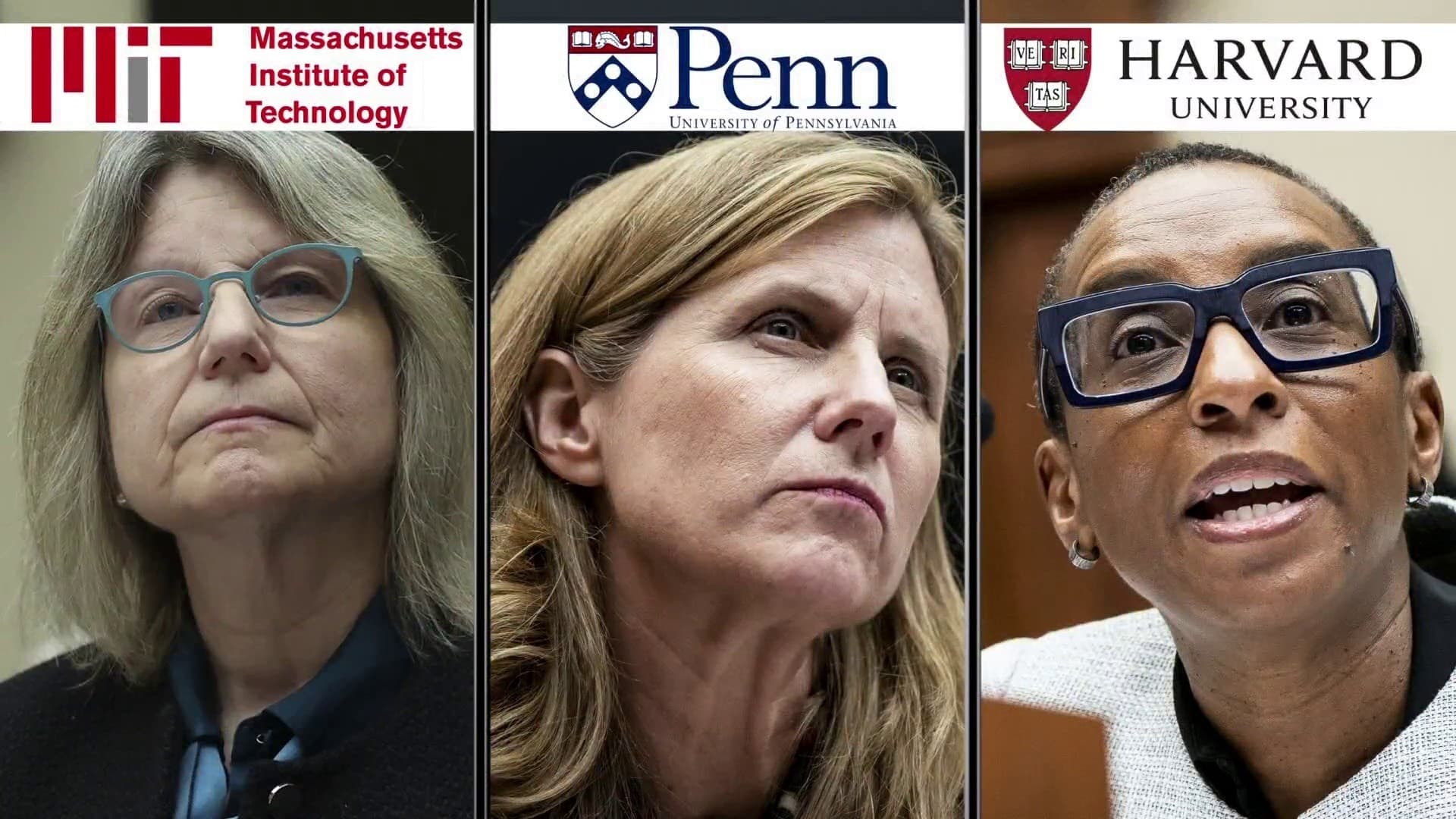
It’s an Emperor’s New Clothes moment, a missionary statement that forces the crowd to look at itself along a new dimension, breaking the old common knowledge structure.
This is what has happened to American higher education.
This is the breaking of “Yay, College!”.
Last February, we published Part 1 of a series on “Yay, College!”, titled The Smiley-Face Super-Villainy of American Higher Education. It’s a good note, I think, focused on the common denominator of all of these yay-something schemes:
IT’S ABOUT THE MONEY!
- College tuition is 13.5x more expensive today than it was in 1980, far outpacing inflation, and 3.4x more expensive today than it was in 1980 relative to our incomes.
- The increase in tuition costs, both in absolute terms and relative to income, has been financed by approximately $3 TRILLION in aggregate student loan debt, of which $1.5 TRILLION is current debt from direct federal lending that is insanely easy to qualify for but cannot be discharged by bankruptcy.
- Universities and colleges have used this cost-plus federal reimbursement scheme to embark on what I believe is the greatest institutional land purchasing and construction boom in post-World War II American history. My example in this note was NYU. There’s a great recent article in the WSJ about Auburn on exactly this subject, as well.
- Universities and colleges have also used these windfall revenues to fuel an incredible expansion in administrative (faculty less so!) staffing. My example in this note was the University of Florida, whose 2020 list of employees is 1,035 pages in length. That is not a typo. The list of University of Florida employees is one thousand and thirty-five pages long.
Next week we’ll publish Part 2 of the series, titled The Intellectual Rot of the Industrially Necessary University.
Why did it take me almost a year to write the second part of this series? Haha! Well, the easy answer is that I only got half-way through a second installment titled “The Big Short of American Higher Education” – which would have looked pretty prescient right now! (and still applies, btw) – because I wanted to see how the student loan repayment circus would play out in both the courts and the real economy. But the real answer is that I was as immersed as everyone else in the common knowledge structure of “Yay, College!”, not in an inability to recognize its leading role in the creation of the financialized Fiat World we call home, but in an inability to recognize that major societal change in the academic-industrial complex was even possible in my lifetime. I’ve become so inured to the impossibility of breaking through the narrative walls and moats and palisades of the yay-something structures, so accustomed to being the yappy little dog that chases the unperturbed cars zooming past, that writing Part 2 and barking some more at the entrenched system of American higher education didn’t excite me that much.
But today? Well today I think we are the dog that caught the car! It’s time to stop barking and time to start working towards what could emerge from this common knowledge collapse to support the non-capitalized, non-sloganeered, very good thing that is college. And that excites me very much.
Step 1: Clear Eyes – let’s take a close look at both the outward-facing form of “Yay, College!” and the academic-industrial complex (The Smiley-Face Super-Villainy of American Higher Educationis a good place to start, along with The Ministry of Rites and the Compassionate Man, Starry Eyes and Starry Skies, and Pecking Order) as well as its inward-facing function (next week’s note The Intellectual Rot of the Industrially Necessary University), so that we know what we’re dealing with here. It really is the functional equivalent of the medieval Catholic Church.
Step 2: Full Hearts – let’s meet in the Epsilon Theory Forum and on Office Hours and at the Epsilon Connect conference in Nashville this June and talk together about how we build/evolve/emerge a new societal structure around American higher education and academia, both in real-world and in narrative-world, both in form and in function. This is the Make/Protect/Teach opportunity of a lifetime, a secular Reformation for a modern age, and I can’t wait to do this with you.
Clear Eyes, Full Hearts, Can’t Lose!



Comments
The note and WSJ article about university cost explosions reminds me of a sad lesson I learned working at a large state school math department as an undergrad. I’m sure this is familiar to anyone in the military, government, or any organization large enough to have a weighty budgeting process.
I was the main computer guy for the math department. I think it was end of summer and everyone was gone and the chairman of the department came to me and said “quick, I need to spend $50k!“. He knew I would be the right person to go to because of how well I’d helped them develop a plan to shovel over a magnificent $600k grant to NeXT and Sun earlier in the year to get workstations on all the profs’ desks.
The tech committee profs who supervised me were all unreachable for the next several days at least, so I told him he should buy a few NeXTStations for the computer lab and this ridiculous $30k color NeXT cube to go on my desk. When the committee returned to campus, I did get scolded a bit for getting the color one, but they let me keep it on my desk as long as I didn’t complain about them running remote Mathematica kernels on it (dual monitors too!).
I was shocked to learn later that it was just about not getting the budget cut (and by such a piddling amount!) It was common practice there to just buy a bunch of crap you don’t need to exhaust your budget just to make sure you didn’t have it reduced in the following year. There was absolutely no incentive to save state/student money, only an incentive to protect your turf and avoid the trouble of having to ask for more down the road.
Play this scene in every department of every school every year for a while and it might add up to a decent chunk of the bloat we are seeing.
If one’s budget isn’t growing YoY by at least a reasonable amount then obviously this is a sign of failure! Budget as progress metric because, if you can’t find progress in some numbers then surely there is no progress to be found. I’ve seen exactly this in academic, gov’t, and corporate settings.
I believe it was after part 1 of this was published last year that there was some discussion of credentialism. It still seems like this is a linchpin of the common knowledge structure in the Yay College case. What unique value are universities providing today beyond credentials? I think it is quite close to zero since it is easy to imagine alternative institutions that provide the other purported values (education, research, social development/network). The credentialing problem is more difficult. Like many of our other discussions I can envision alternative systems that I think could be very interesting but they will struggle with scale and will be much more frictional than current systems, at least to start.
I think one challenge to Ben’s conclusion in this note is whether this occurrence has truly broken common knowledge as described. Several real world conversations I’ve had on this have still shown highly autotuned responses in favor of the university presidents…i.e. that all of this is simply furtherance of the longstanding far-right & racist scheme to undermine ‘higher education’ (as it will inevitably be called in such statements!). Many people simply never see any narrative that contradict their priors.
[quote=“Rech, post:3, topic:3080, username:rechraum”]
that all of this is simply furtherance of the longstanding far-right & racist scheme to undermine ‘higher education’ (as it will inevitably be called in such statements!).
100%
https://x.com/ibramxk/status/1742515298513633284?s=20
This topic came up in OH a few weeks ago also and some discussion was around research funding. Obviously the ivy league scandal is mostly around soft science where I don’t have any personal experience. But I gather that it may not be common knowledge how funding works, at least in much of the university hard science world, and I thought maybe a quick synopsis might be useful.
There are two key details in my mind. The first is that professors obviously are incentivized to build a suitably large research program, especially at large universities, to accomplish both scientific and career goals. What this often means is a group of 5, 10, 20, perhaps 30 or more of graduate students, post-docs, and other associated researchers who become dependent on the program for the success of their careers. Graduate students are there for 5+ years without much recourse if things go south (i.e. the lab’s funding decreases over time and is no longer capable of financially supporting as large of a group). Obviously this creates a situation where there is a huge amount of pressure on the PI (primary investigator i.e. professor(s) who run the show) to maintain consistent funding.
The 2nd key detail is that the funding situation was majorly altered during the great recession and the systemic changes wrought have not really reverted to my knowledge (caveat here that my personal experience ends some years ago now so perhaps things have improved). Other trends are certainly at work here too like overproduction of PhDs, aging professors systematically granting more funding to their aging peers instead of younger professors, etc, all issues that clearly line up with Yay College in their own right. Anyway, prior to the financial crisis I think it was typical that a professor could expect to write 5-10 grant applications in a year and have maybe 2 or 3 granted, enough to support the program for a few more years on a rolling basis. But post GFC this ratio skyrocketed to 20, 30, even more grant applications every single year in order to have a chance at achieving the necessary 2 or 3 successes.
These are such basic and fundamental changes to the nature of these institutions which I think have had major repercussions. I suppose my thinking along these lines is in regards to an attitude of ‘cut the funding’. I was negative about budgeting in line with Chris’s comment above, but as always there is another side of the coin and I just wanted to point out that often there are many, many less visible people, a lot of them young and relatively powerless, behind the professors who get the attention and scorn in situations like these.
Thank you Ben, yet again, for identifying another converging singularity of obfuscated truth. So with clarity and purpose, may we begin the strenuous task of separating university and state.
I can speak to this as an Assoc Prof in a Dept of Med. NIH funding has ~7-10% fund rate for grant applications at the R01 level (the gold standard $2.5m-3.5m/5year grant, also the Unviersity gets 50% of this, with the remaining going for research and salaries). While you can get some bonus points for being a “young investigator”, there is such few funds to go around, only 1-2% of PhDs end up as research professors. The costs have exploded so even getting 1 R01, which used to be enough, is not enough to hire more than 1 person besides the main Professor. Better be careful who you hire.
Most of the smart people dont go into academia (I must be dumb) and so the talent pool you can rely on small at best. What are the implications? I dont want to spend a ton of money on a subpar post-doc who is going to leave right after i train them, maybe i can get them on a T32 for 2 years which pays their salary, but that is not a given. The play is to hire full time research staff at $50-60k/year, and plug into the growing consulting/outsourcing science network. This allows for cost control, I get cutting edge research data, and with a few other PI collaborators we can publish high impact.
Interesting to see how the space evolves here. Many Profs in the biomedical space also have side companies since the $150-200k salary cap range is not going to cut it long term. This assumes you dont play politics and try to do the dean/dept chair route.
Really interesting, Colin! Thank you for posting this.
Spot on! The political autotuning into “Republicans pounce!” is the single biggest defense mechanism of all the yay-something constructions today.
This was almost word for word an episode of The Office and it was quite hilarious. The real joke was most people watching didn’t know how common this practice is.
A group of old high school friends met for dinner in Dec. and by old, I mean early 60s. A mix of careers from finance to veterinarian to law enforcement to marine biologist. The marine biologist mentioned that professors don’t make diddly but that he’d finally gotten to be an administrator of something or other and thus obtained a higher salary. Apparently, the value of teaching and doing genuine research is lower than the value of moving sheets of paper from one side of the desk to another. Amid this sclerotic bureaucracy is it any wonder that a group of people who do not believe in objective truth and who have a "will to power’ could obtain that power while everyone else was focused on appeasing the local commissar and protecting their turf?
Continue the discussion at the Epsilon Theory Forum...