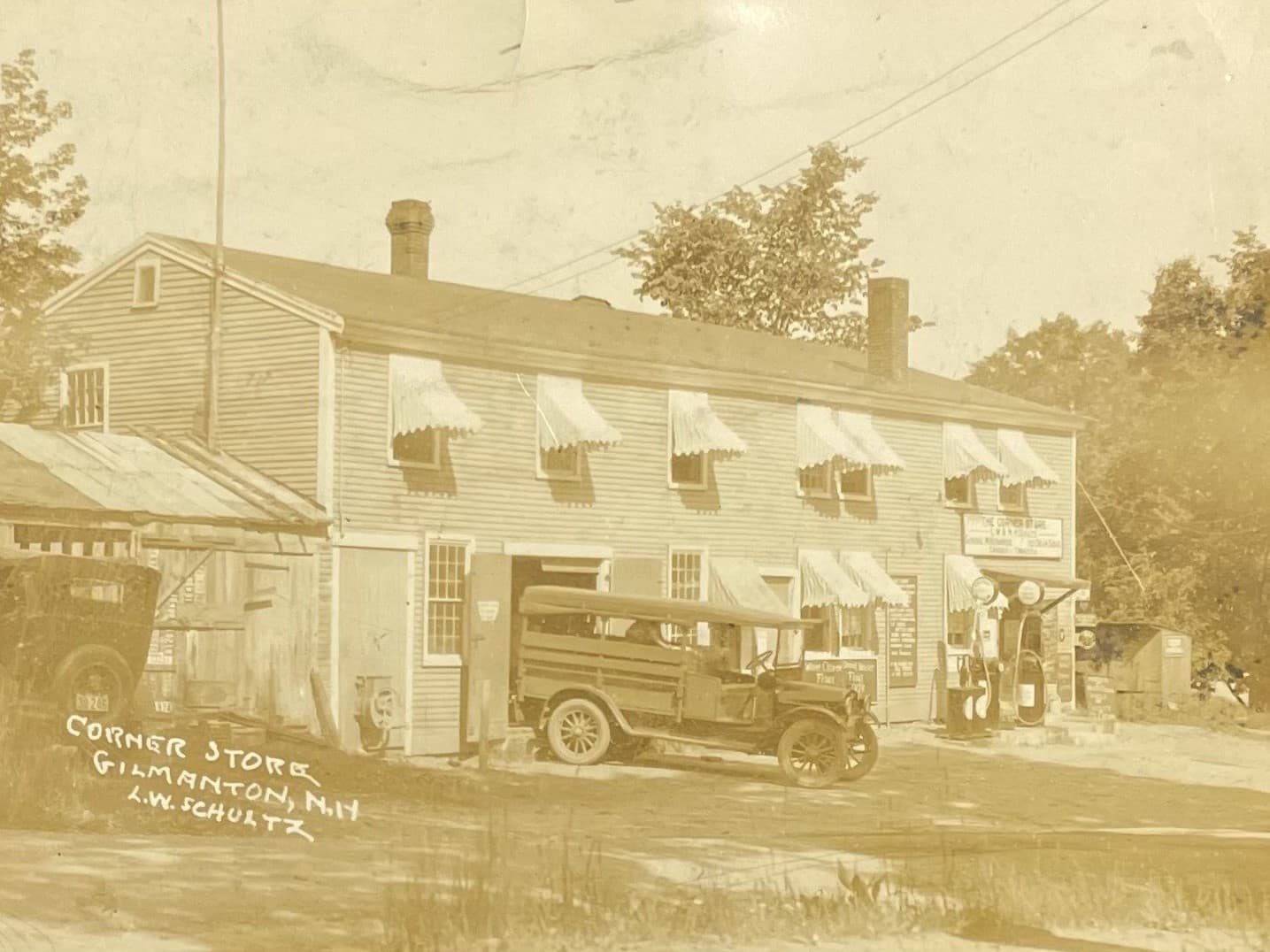
A Corner Store Story
July 3, 2026·Stories of America
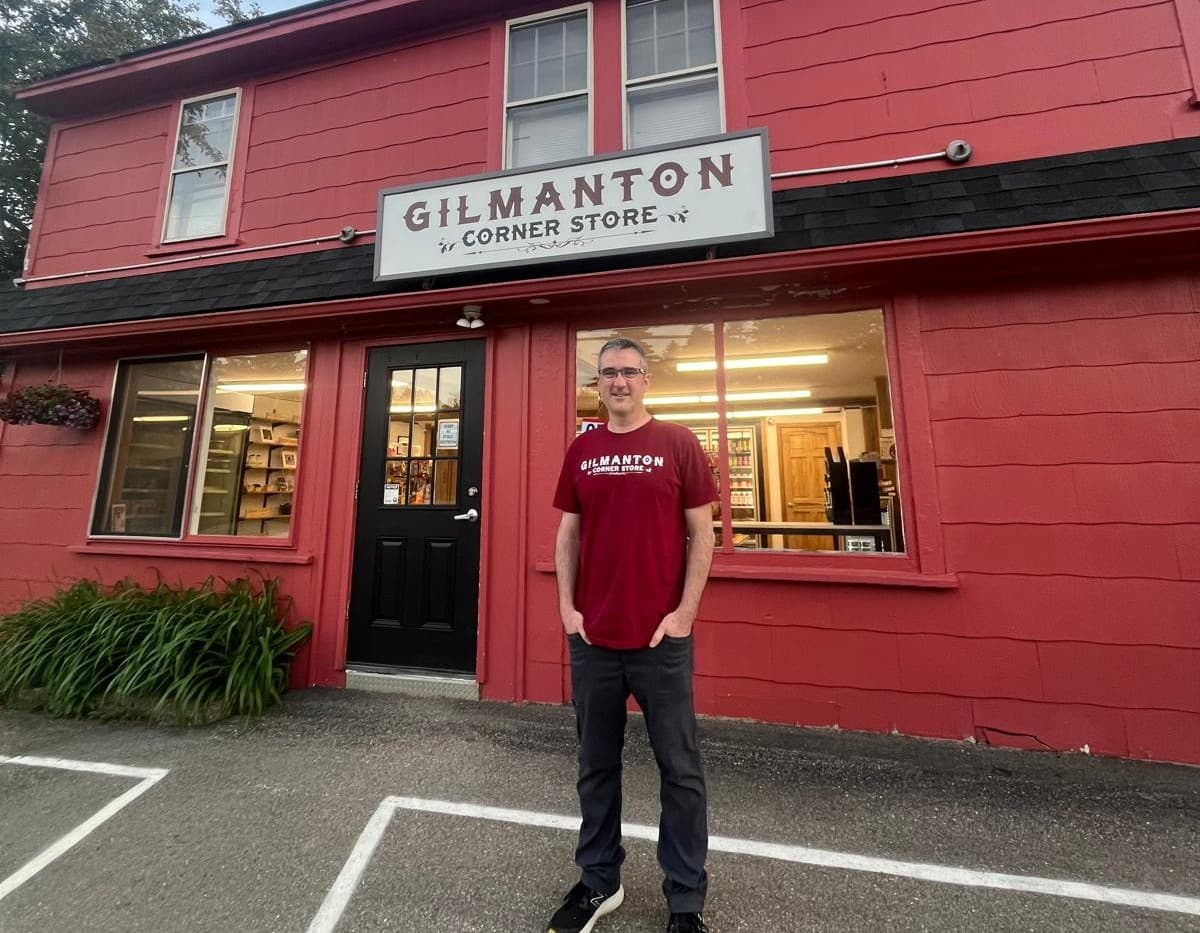
Gilmanton Corner Store owner David Smith, June 2026. Photo by Bill Donahue.
The week I moved to Gilmanton, New Hampshire, in March 2015, the Corner Store closed, after operating without interruption in the same spot for 75 years. It closed abruptly, with the owner lamenting, “We didn't survive the winter,” and then there was a cavity in the center of Gilmanton, population 4,000. At the intersection of our two busiest roads, Routes 140 and 107, the shelves were empty, the lights off.
I live about 300 yards up the hill from the store, in a house that’s been in my family since 1905. After the store closed, I ached each time I walked by. I remembered going there as a kid in the seventies and the way the storeowner called soda–Coke, Sprite, whatever–tonic, pronouncing the word tawn-ick. I remembered buying licorice for a nickel.
But the corner store didn’t come back. Instead, the modest red-shingled building that once housed the business became home to one so-so pizza joint, then another, the second one guided by owners who never cleaned out the grease traps. Eventually, I’m told, sewage flowed into one of the two adjoining apartments.
By 2022, the store was vacant again and, sitting there empty, the ungainliness of the building was laid bare. The store’s shingles are made of concrete and asbestos–carcinogenic if scraped or removed. The retail space is a shade less than 1,000 square feet–arguably not big enough to yield a viable income.
The store remained vacant for years. Our town needed a savior. And in time he materialized.
On Memorial Day Weekend 2026, David Smith, a 46-year-old longtime Gilmanton resident, reopened the Corner Store, after leaving his job in the grind department at New Hampshire Ball Bearing, a factory. Suddenly the store is very nice inside. Clean. Sparsely appointed, with a cooler full of beer, both Budweiser and local brews. There are lottery tickets for sale, and cigarettes, and three kinds of Lay’s potato chips (sour cream, salt and vinegar and barbecue) and candy bars and a small table stacked with cookies made by a Gilmanton business, Bees and Trees Farm. There’s coffee. There’s a deli serving sandwiches. In a cooler by the register, there are plastic containers of both worms and crawlers. On a back wall, there’s an array of wooden plaques, locally made and bearing slogans such as, “It’s not the mountain we conquer but ourselves.”
One of the first customers was Mary Robinson, who worked as a cashier at the store from 2006 to 2015. She wept when she stepped inside–and when I interviewed her at the post office, where she now works as a cleaner, she said, “David Smith knows what this community needs, and he has given us a gift. We need that store,” said Robinson, who first came to Gilmanton in 1974, as a foster child. “It's a place where we congregate. It’s not a church. It’s not the town hall. It's just a nice place to walk into, and it smells great and it's welcoming.”
Within a week of the store’s opening, one Gilmantonite brought Smith a brown manila envelope to wish him well. When Smith opened it, he found ten $100 bills inside. Two women brought Smith flowers. A Facebook post recapping the store’s first day got over 500 likes and (this is almost unheard of in Gilmanton) no hate.
Smith is a soft-spoken man with short salt-and-pepper hair and glasses. He’s fit and slender, having summited all 48 of New Hampshire’s 4,000-foot peaks, and he’s an idealist. His only other business venture is a campsite that he rents out at hipcamp.com, where he proclaims,
"The goal of life is living in agreement with nature."
Smith grew up in southern New Hampshire–in Derry, a town that feels closer to Boston than to the wilds of Gilmanton–and he first began coming north as a teenager, to visit a friend’s lake house. He became enchanted with the farms and the woods of Gilmanton, and in his early twenties, he got a job at the town’s second nexus point. Working for the Gilmanton Iron Works Market, seven miles east of Gilmanton Corners, he made pizza and sandwiches. “That was like going to college for me,” Smith says. “The owners taught me so much–about all kinds of food and running a business and being part of the community.” Smith began to envision himself running a country market. Every time he drove by the Corner Store his eyes glimmered.
Soon, though, he landed a job at the ball bearing factory. He bought a house by a lake in Gilmanton. He became a father and raised two kids. But then in 2022 he met a woman who harbored her own ambitions of buying the Corner Store. Tauntingly, Yasha Joy told Smith, “I'm gonna own that place before you do.”
In 2023, Joy did buy the store. That October, a happy photo appeared on Facebook–the new couple, just ten months into their romance, standing on the pavement outside the business, clutching a large set of keys. They planned to renovate together.
But the relationship fell apart, and Joy shifted her focus to making the ramshackle apartment above the store liveable. Finally, in January 2025, she contacted Smith. Did he have any interest in renting the retail space on his own?
He did. He signed a five-year lease. Then, after refinancing on his house so he could get a bank loan, he embarked on a 16-month campaign to resuscitate a building that had been abused and neglected for decades.
Smith started by removing numerous barrels of coal from the basement. “Where was the coal stove?” he wondered. “How long has it been since they burned coal here?”
He moved onto the electrical system. He was still working at the factory, but he spent all his free time at the store and soon enough he found live electrical wires in the wall, uncapped by wire nuts and poised to ignite the insulation. Working with an electrician, he tore the place apart–and found a snaking network of archaic BX wiring, ungrounded and likely installed circa 1940. He fitted the whole store with new wiring.
As the archeological dig continued, new problems emerged. “The handwashing sink tied into a stink pipe,” Smith says. “The stink pipe was cast iron and split open like a hot dog. I don't know if the gasses coming out of that pipe were septic, but they didn’t smell good. And when you turned on the sink faucet, the water would go all over the floor because the plumbing was rotted out. So there was a lot of mold.”
“The floors were gross. They were covered in grease.” As Smith bore down on them, he found himself dealing with “very rigid tiles” that were old and brittle and breaking into pieces. Were these tiles, like the shingles outside, made of asbestos?
Smith called in an asbestos specialist who began excavating the floor. “There were layers of asbestos,” Smith says, “tile, subfloor, tile, subfloor, tile, subfloor. The guy told me it was the most flooring he'd ever pulled out in one shot. He wanted to save a crosssection of the floor and put it in epoxy just to show how many layers of flooring there were. But underneath there were pine floors. Which I sanded and finished.”
“I had no regrets,” Smith says, summing up his renovation journey. “I just kept remembering that I was doing what I wanted to do for a long time. I’ve been talking about this store for 20 years.
Smith manned the register as he and I spoke. When customers wandered in, he’d pause to direct them towards the bread or to tell them to watch their step as they navigated the one stair down into the deli. He seemed to revel in his new role as pillar of the community. “I’ve always been more of a wallflower,” he told me. “But here the conversations are one-on-one. They’re short–you know, five minutes, 10 minutes–and you get a good story. Like the other day, I had this guy come in, and I guess he owns the world's smallest stallion. He showed me pictures of himself with Oprah. He was on Good Morning America. Random, right? But here I meet people. I get to be part of things. I’m at the center of the town’s life.”
In Gilmanton, the store has always been at the center–and this was most true immediately after its current home was built in 1940 by a local farmer, Harmon Stockwell, and his wife, Roxey, a grade school teacher who became the principal storekeeper. When the Stockwells finished, the store had one of the few telephones in town. So when news came to Gilmanton–if a baby was born, say–it came first to the store, and it was Roxey who traveled over dirt roads to inform the relevant families. Later, after the US entered World War II, Roxey posted photos of each of Gilmanton’s active servicemen in the store’s front window. These soldiers wrote letters to the store, and Roxey would in turn share the missive with the whole town. In 1943, when Gilmanton honored 42 local war veterans, the spectators gathered by the gas pumps out in front of the Corner Store.
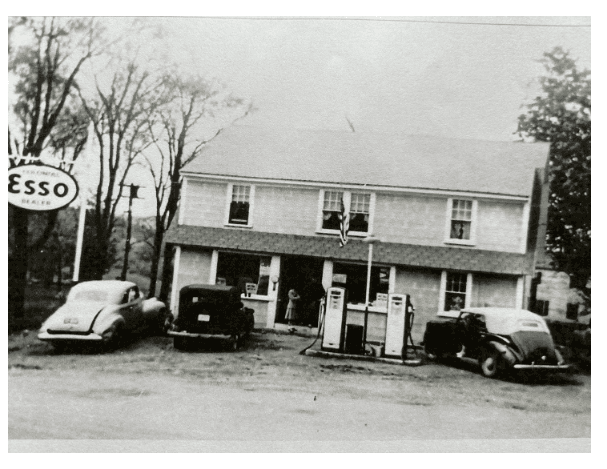
The Gilmanton Corner Store in the 1940s. Photo courtesy of JR Stockwell.
Roxey wasn’t just a patriot. She was also a diehard Christian who evangelized as she taught in public schools. And, though she only served as storekeeper until 1949, she set a tone: In Gilmanton, the store has always been a bulwark of conservative recalcitrance.
The novelist Grace Metalious learned this the hard way. Metalious moved to our town in the mid-1950s and finished writing her 1956 blockbuster novel, Peyton Place, in a tar-paper shack on Gilmanton’s Loon Pond Road. The book is about sexual scandal and moral hypocrisy in, ahem, a small New England town, and the storeowners of Metalious’ era never forgave Grace for writing it. They banned her from the store, and the ban was intact for years, possibly until Metalious died in 1964, at the age of 39, of cirrhosis of the liver. In 2016, when two of her children gave a talk to a Gilmanton gathering, they spoke of the ban as though it were a fresh wound.
Another Corner Store controversy came in 1977, soon after an enthusiastic cadre of thirtysomething professionals moved to Gilmanton, drawn in part by the town’s ancient white clapboard homes. These antiquarians helped to establish an Historic District, which encompassed the Corner Store, and they enforced an array of exacting rules about, for example, what color a home could be painted.
The strictures did not sit well with that era’s Corner Store proprietor, a heavyset and somewhat dyspeptic man named Paul Leonard, and when Leonard renovated his building, adding what is now the larger of the two apartments, he hatched plans to install a picture window. The Historic District Commission deemed Leonard’s window a no-no and ruled that he could only build “two six-over-six Colonial style windows.”
In the wake of this decree, one local, William Gray, told a reporter that a “dictatorship” had overtaken our town and that Gilmanton’s new rulemongering elite was “disliked by the common people.” In the Fourth of July parade that year, a group of picture window proponents rode down Route 107 on a prizewinning float that bore a giant window frame and, beneath it, a placard reading, “To be or not to be?”
I turned 13 that summer, and I remember my grandmother’s bemused regard for the scuffle. “This will pass,” she said, electing, in the wisdom of old age, not to take sides. And she was right: That controversy did pass, after Leonard installed his window and the antiquarians had no choice but to get used to it.
Gilmanton went on, and the Corner Store remained integral to our lives, and there emerged new reasons to love it. In the eighties and nineties, a group of retired men gathered there every morning to chew the fat over coffee. In the 2010s, when Mary Robinson worked at the store, she bought a stockpile of cookies and candy at the start of each shift and then spent the day doling these sweets out, gratis, to local children.
But by then country stores nationwide had been imperiled for over 60 years, thanks to the midcentury rise of the supermarket, and a new threat was mounting: The proliferation of discount chains such as Dollar General, which calls itself "today's general store." In 2017, the equation was so bleak that a headline in The Wall Street Journal read, “Country Stores, a New England Institution, Are Going Dark.” The story went on to make clear that the New England country store–situated, almost inevitably, beside the town green and within spitting distance of the church steeple–is a singular thing in America.
Last year, the Tuftonboro General Store, 45 minutes north of Gilmanton, closed down after a run of more than 200 years. Owner Dave Dauphinias was making so little money that he couldn’t hire anybody. He tried to run the store solo, but that proved impossible, so reluctantly he posted a sign on the door: "Due to circumstances beyond our control, the store will be closed for an undetermined period."
Sixty miles southwest of Gilmanton, in another New Hampshire village, Hancock, population 1,750, my friend Jarvis Coffin, a one-time advertising executive, ran that town's version of the Corner Store with his wife, Marcia Coffin from 2017 to 2020.
The Hancock Market has about twice as much retail space as the Corner Store, and the Coffins spent about 60 hours a week trying to keep the business afloat, along with a nearby inn that they owned. They never saw a profit. And while Jarvis doesn’t regret his mercantile moment, he speaks soberly about the “terrible arc” that is the life cycle of so many New England stores. “People buy them,” he told me, “and they're really enamored of the idea of being a small store owner, but then very quickly they find out that it's a ton of work. And then they sell it to somebody who gets bored and can't make a go of it. Then the store goes dark and then someone comes in and rescues it and they prop it up, and it just goes up and down like that. It's really hard.”
The Hancock Market is now owned by wealthy benefactors who can afford to lose money. Numerous other New England stores, meanwhile, are getting inventive. They’re going online to sell branded goods; they’re becoming community-owned non-profits.
The Gilmanton Corner Store remains a for-profit business owned by a single working class man, and when I talked to David Smith two weeks after he reopened the place, he said that he was “breaking even. I don't know if I’ll make enough to pay my mortgage,” he said, “and my health insurance and the utilities for my house and the store.” The following weekend, though, it was warm and sunny outside and prospects looked brighter: The line for the deli was out the door. Smith was making sandwiches steadily from 11 to 3.
Mary Robinson, the former cashier, insists that Smith can make it, so long as he begins selling a few critical items not currently on offer at his store. “Ice,” she said, her tone becoming hard and matter-of-fact when I found her outside the post office hacking weeds by the driveway. “Propane. These are things that I know, from my history, that either you sell or people drive right by. Newspapers. You know how many Sunday newspapers I folded?”
I suggested that no one cares about newspapers in 2026.
“In this town they do,” Robinson said. “Trust me. Because we have an older population. Your breakfast sandwiches,” she continued, “your coffees. Good donuts because the working guys like those, and we have quite a few working guys here.
“But the more townspeople David meets, the more he'll see what their needs are. He’ll do good. I just hope that the townspeople stand behind him, and not only at first, when the store being open again is a novelty. No, we’ve got to stand behind our store consistently. We need to be there for the long run.”
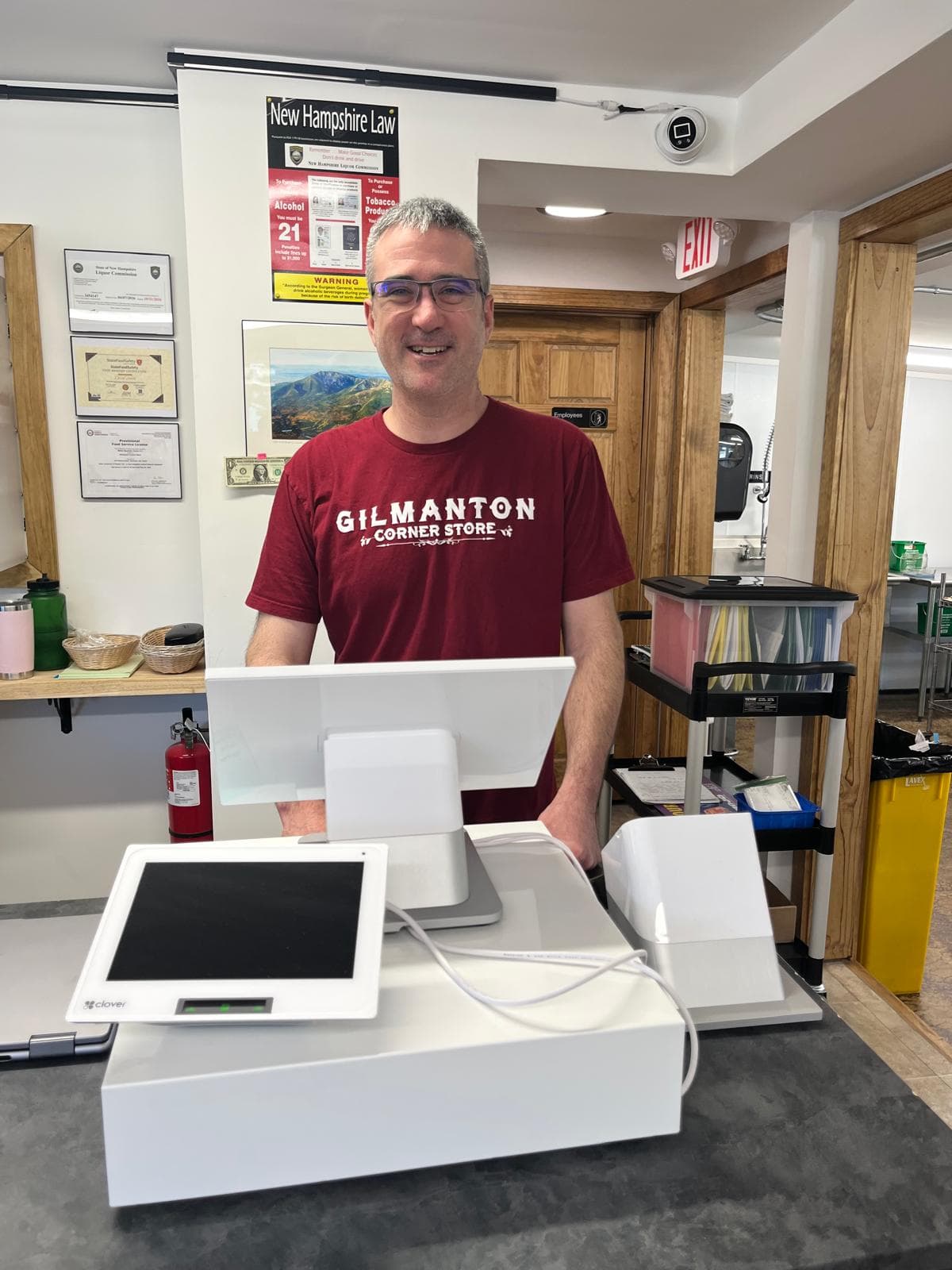
David Smith at the register. June 2026. Photo by Bill Donahue