The Circus Barker Economy
July 8, 2026·Money
There are two ways I can get your attention. I can yell at you, or I can say something outlandish. Either will cause you to turn your focus on me.
The circus barker knows there is intense power in combining volume and outlandish.
“Step right up and see a two-headed lady,” he screams so to be heard all along a crowded midway.
On a single, hot summer night, that may be all he has to yell. Once the night’s crowd heads home, tomorrow will bring a new crowd. Then, a two-headed lady will again suffice. What creates novelty isn’t the act so much as the innocence of a new, unfamiliar audience. For the barker, it’s a daily rinse-and-repeat before moving onto the next town.
Social media doesn’t work that way. It is a never-ending circus. Worse, repetition gets stale. And therein lies the rub. To sustain and grow a crowd in the same place night after night, our modern barkers have little choice but to shout louder and louder and at the same time to add greater and greater ridiculousness to their act. The volume must be turned up to 11 while two heads must grow to four, then eight, and ultimately sixteen.
At the risk of oversimplification – and, admittedly, potential exaggeration – the net result looks something like this:
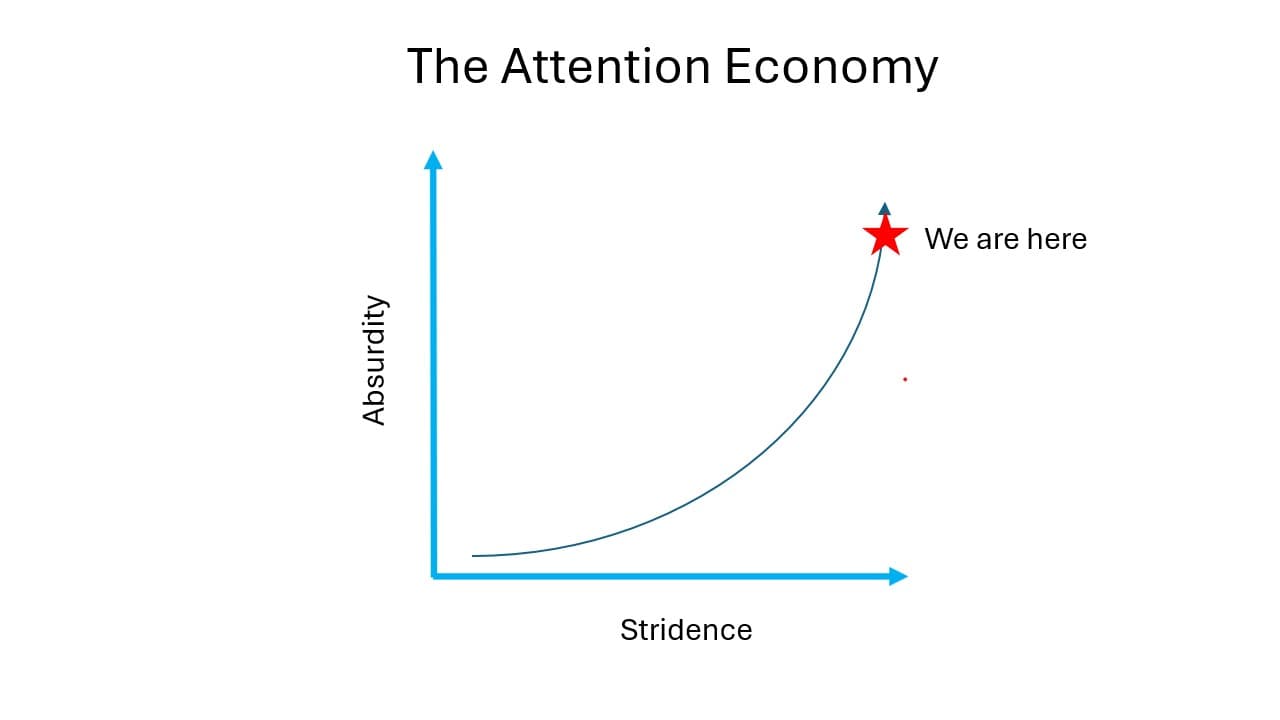
Given the passage of time, to sustain attention today, absurdity and extreme stridence are now required.
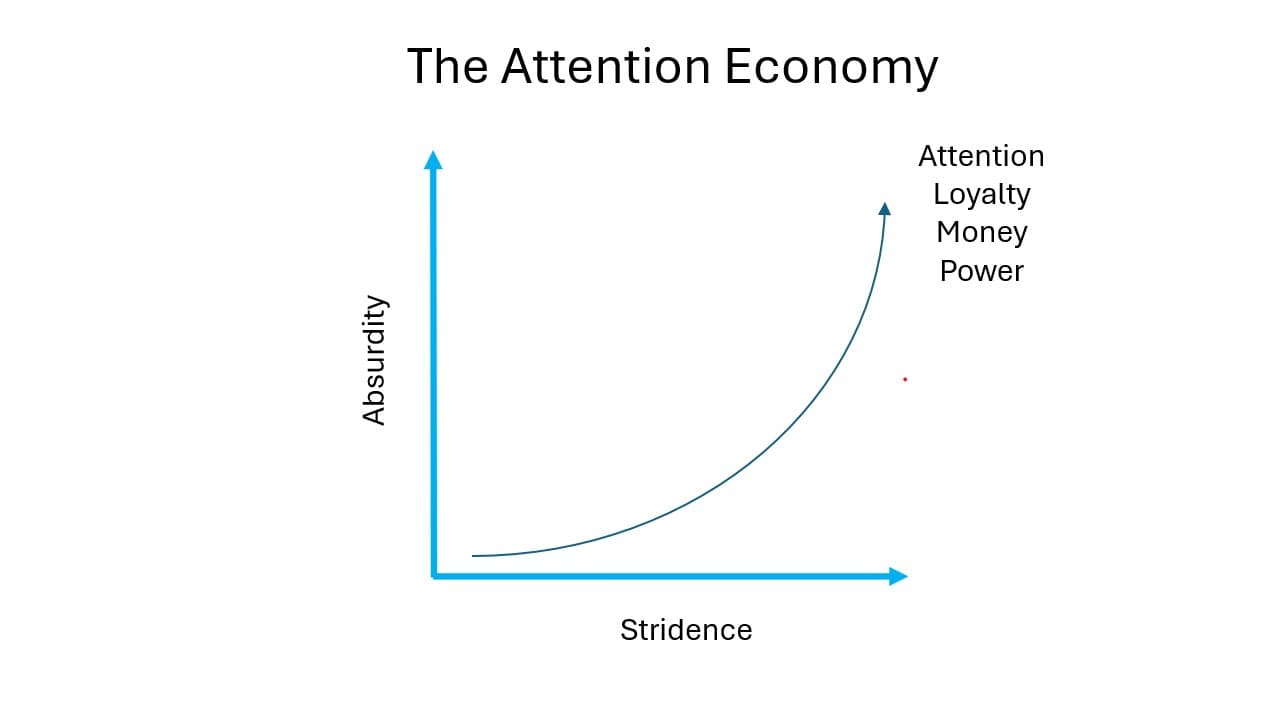
The attention-grabbing combination those two elements is one thing when we’re talking about midway attractions, but I encourage you to consider how many facets of our lives absurdity and stridence now envelop. Today, it is a defining trait not just of popular culture, but the American political system, and the financial markets. He who has the most attention wins. And by win, I don’t mean just eyeballs. Attention today means loyalty, money, and power, too. It’s a “Buy one. Get three free!” Moreover, when done well, the four factors, paired with social media’s dopamine-generating algorithms, foster a proverbial flywheel where more attention fosters even more attention, loyalty, money, and power.
At the risk of repetition, the net result looks like this:
Since the 2008 housing crisis, we’ve seen many, especially in finance, master the model above. Adam Neumann, Trevor Milton, and Sam Bankman-Fried, for example, all come to mind. Then, of course, there is Michael Saylor. He took the model to an even greater extreme. The others look like amateurs in comparison to him. He sustained absurdity far longer – and took his midway circus act far further afield.
Still, the ultimate outcome for all has been the same: a spectacular fall from grace. Ultimately, the ridiculousness of what they were all shouting about collapsed on its own weight.
Which brings me to the present.
Folks long forget that well before the fall of Lehman Brothers, New Century went bankrupt. It collapsed under its own extreme ridiculousness very early. The very weakest fell first and was then followed by the over-believed feeble. Ultimately, and as is always the case, it became Sherman’s March through different degrees of credibility. As confidence fell further, stronger and stronger banks went down.
This is why Michael Saylor’s recent fall from grace matters. He’s not Adam Neumann, Trevor Milton or Sam Bankman-Fried. Having succeeded at an earlier midway (the dot.com bubble), he is a far more experienced act. He knows how the game is played. To keep with my earlier analogy, Saylor feel likes the Bear Stearns of this cycle – a far bigger and far more credible failure, albeit one cut from the same cloth as Neumann et al. Moreover, like the collapse of Bear Stearns, Michael Saylor’s demise has the potential to be both the result of falling confidence and a contributor to a further decline.
Meanwhile, it is worth remembering that the longer the game goes on, those who are now promoting 16-headed ladies will have no choice but to seek out the 32-headed variety next and to add further amplification to their messages. With that, the star shown in the first image above will move further and further up and to the right. Needless to say, at this point in the cycle the more time passes, the more the inherent fragility in the system will grow exponentially.
Which brings me to my punch line. Today, the greatest power in America rests with those whose strident tone is now paired with absolute ridiculousness. Put simply, what is now on offer is truly beyond belief. Moreover, it is in everything that matters: American culture, politics, and finance. Our Attention Economy has been taken to its extreme. People are shouting nonsense and no one even blinks.
But that doesn’t mean it isn’t nonsense. Think Adam Neumann, Trevor Milton, Sam Bankman-Fried. Their stories were always nonsense. And the same was true of Michael Saylor. Circus barkers always yell whatever they have to draw a crowd. When the goal is attention – especially when paired with the loyalty, money, and power that now comes with it – truthfulness doesn’t enter the equation.
If there is fragility in the markets (and in America more broadly) today, it the growing likelihood that history rhymes – that the remaining circus barkers ultimately experience the same fate as those who went before them. Moreover, that history rhymes and they experience the same fate at the same time.
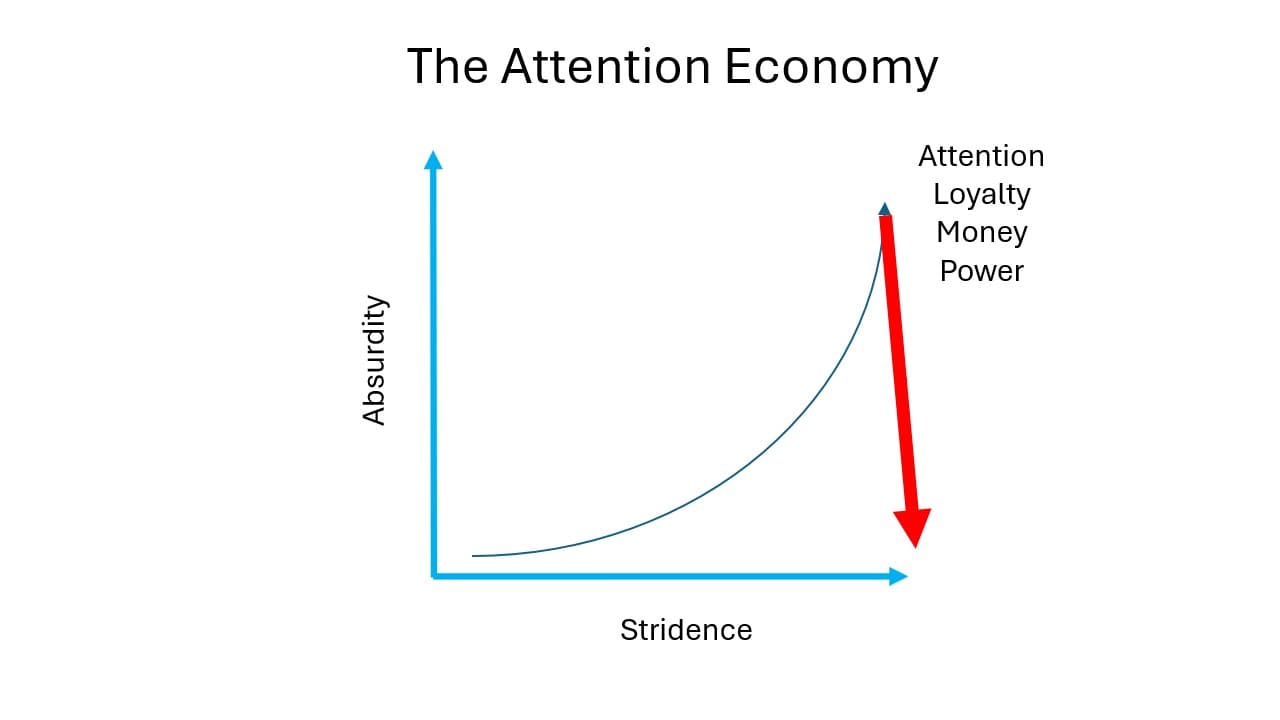
Given how intertwined American popular culture, politics, and the financial markets have become, and the proliferation of circus barkers with outlandish acts that cut across all those venues, the odds of that happening are especially high.
From here on out, I would pay far less attention to companies and earnings and much more attention to popular culture and personalities.
Given how much is now tied to the mast of our most popular circus barkers, their fate is the only thing that matters.
This time it’s personal.