You Can't Always Get What You Want
May 21, 2026·Jobs and School
The Rolling Stones had it about right: "you can't always get what you want. But if you try sometimes, well, you just might find you get what you need." The fight over AI data centers is really about who decides what counts as a need - Wall Street and the builders, or the mayors and residents who have to live next to the infrastructure.
Let's start with the neighbors. They're so… let's say, more Mr. Rogers and less Mick Jagger. New polling shows roughly seven in ten Americans oppose an AI data center in their area, a higher share than say they oppose a nuclear power plant nearby. That's the baseline. If you're curious about how regular locals feel about getting their AI turned on, they would prefer the Land of Make Believe over their living room.
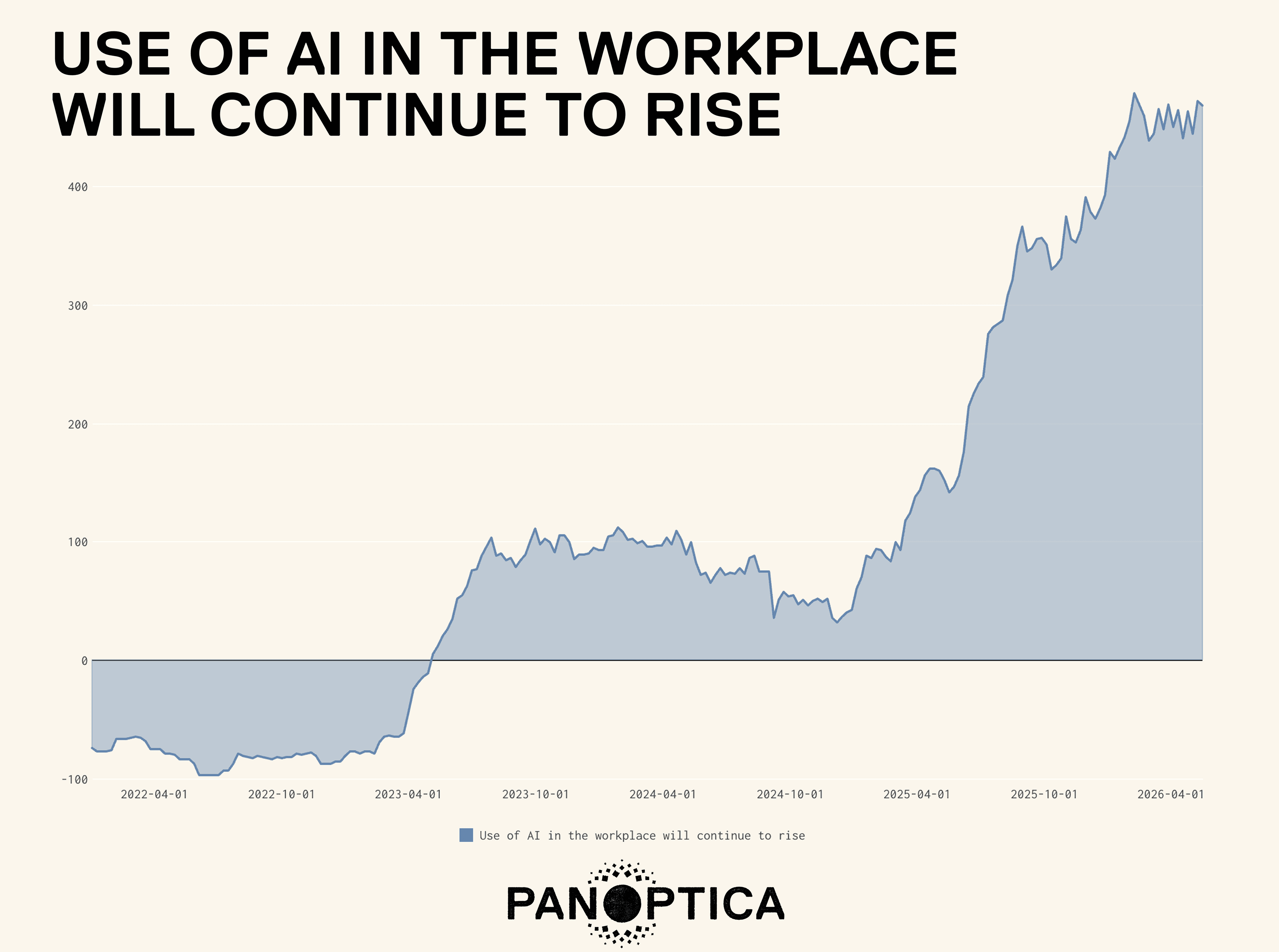
Our Panoptica Jobs and School Storyboards tell you why. "Use of AI in the workplace will continue to rise" is red hot - hitting extreme elevation for the data set.
And at the same time, "AI is going to crush white collar fields" sits stratospheric too.
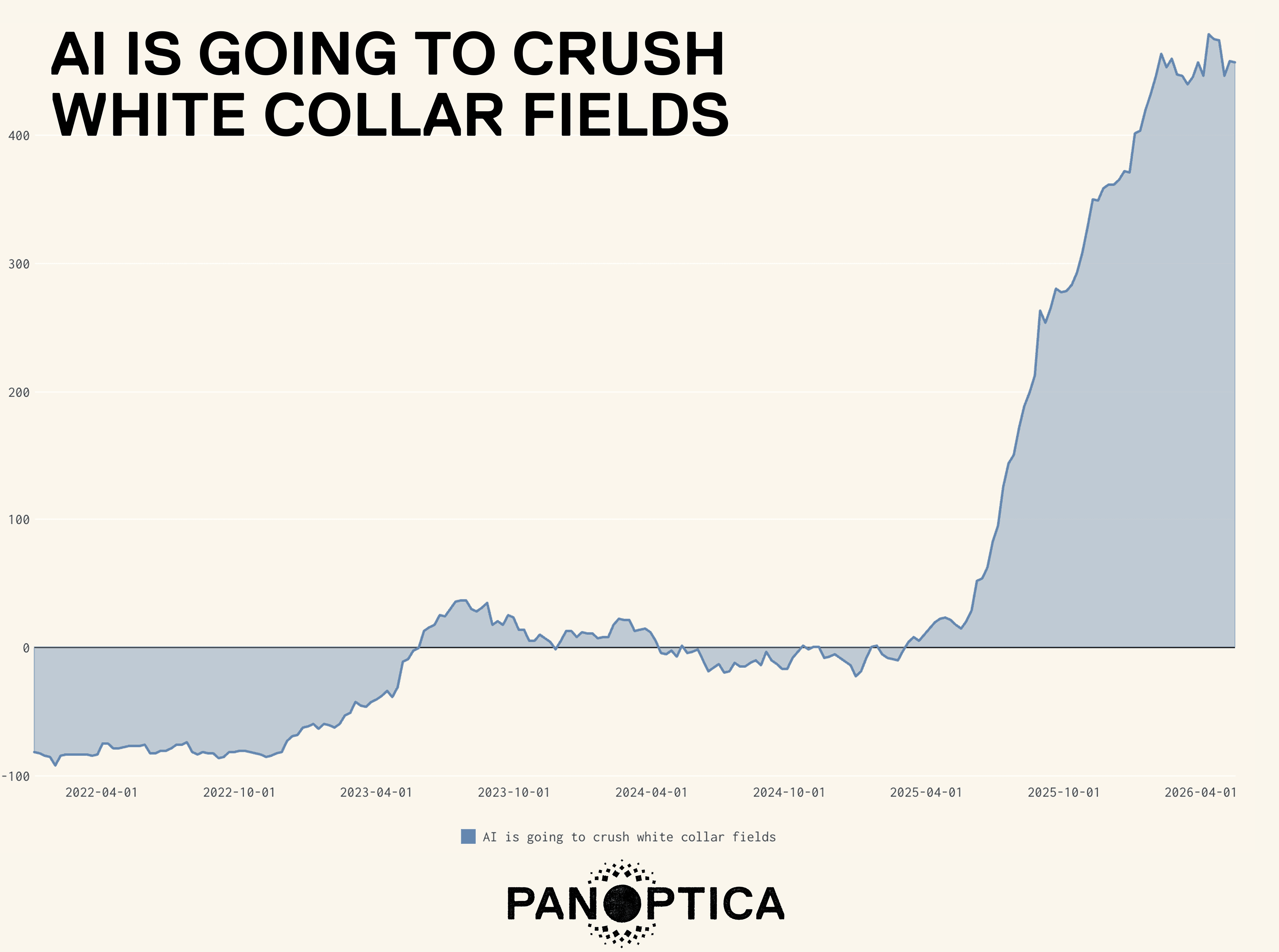
The same people living in suburban homes, running firms, and writing campaign checks believe both: AI is inevitable at work, and it might steamroll their jobs. That's the want-versus-need collision, and it's finally becoming a cohesive position.
From the builders' side, their argument sounds almost noble, and how could it not, because they've mastered the Mick Jagger energy. Nvidia's Jensen Huang has described AI as "one of the most influential forces shaping our world today," a kind of critical infrastructure that "every organization" and "every nation" will need, with "trillions of dollars" of buildout ahead. The breakthroughs in finance, health care, and manufacturing are so valuable that productivity begets capacity, and capacity begets more growth. It's the vision that fuels stock prices.
But here's where politics is already testing the story in a way capital markets can't. On the ground, it's getting loud out here.
In 2025, at least 48 U.S. data-center projects worth roughly $156 billion were blocked or stalled by community pushback. More than 360,000 people have organized in Facebook groups against hyperscale sites - and while that may not seem shocking (or entirely trustworthy, I don't know what happens on Facebook these days), they've quadrupled their membership since December of last year, with a new group starting up almost every day in 2026. That's not theoretical opposition.
In Festus, Missouri, the city council voted 6–2 in late March to approve a 6-billion-dollar AI data center on 360 acres. One week later, in the April 7 election, voters ousted all four incumbents who backed the deal. Effectively, the town fired half its city council over a single project. Politico ran it as "Missouri town fires half its city council over data center deal."
In Utah, Shark Tank's "Mr. Wonderful" Kevin O'Leary is selling a $100 billion "Wonder Valley" data-center empire to out-compete China, powered by enough electricity to exceed the state's current use. Local residents are revolting anyway. The county advanced the plan after a raucous meeting, under headlines like "Mr. Wonderful's Utah Data Center draws not so wonderful reaction from residents." They'll watch him on TV reruns, but they do not want him, or his data centers, as neighbors.
In Indianapolis, a councilman's home absorbed more than a dozen rounds after he backed a data-center project, with a "No data centers" note reportedly left behind; the FBI is assisting in what authorities have called a targeted shooting. In Memphis, environmental-justice groups are turning xAI's expansion into a fight over pollution costs for Black neighborhoods. If I start making Mr. Rogers character analogies for all of them this post will be 2,000 more words (I won't, but feel free to find me on social media and we can build the list).
And now the politicians are noticing. Like, really noticing. This is officially a midterm and next-election issue. Senators Josh Hawley and Richard Blumenthal have introduced the bipartisan GRID Act to force large data centers to secure separate power sources and shield household electricity rates from the burden. As we head toward future elections, it’s shaping up to be quite the wedge issue, cutting across party lines.
The bull case on AI still assumes opposition is friction - something that will resolve once people understand the benefits. But the emerging bet from the towns is that it's a veto. The communal constraint on who's willing to live next to the machines is getting louder than a Stones concert, and it's becoming one of the most noteworthy political narratives of 2026.
When everyone's trying to get what they want, sometimes the constraint isn't capital or model quality - but whether anyone is still willing to live next to the machines.
ps. "Neighbours" is a decidedly fitting early-'80s Stones song for this, if you're curious.